
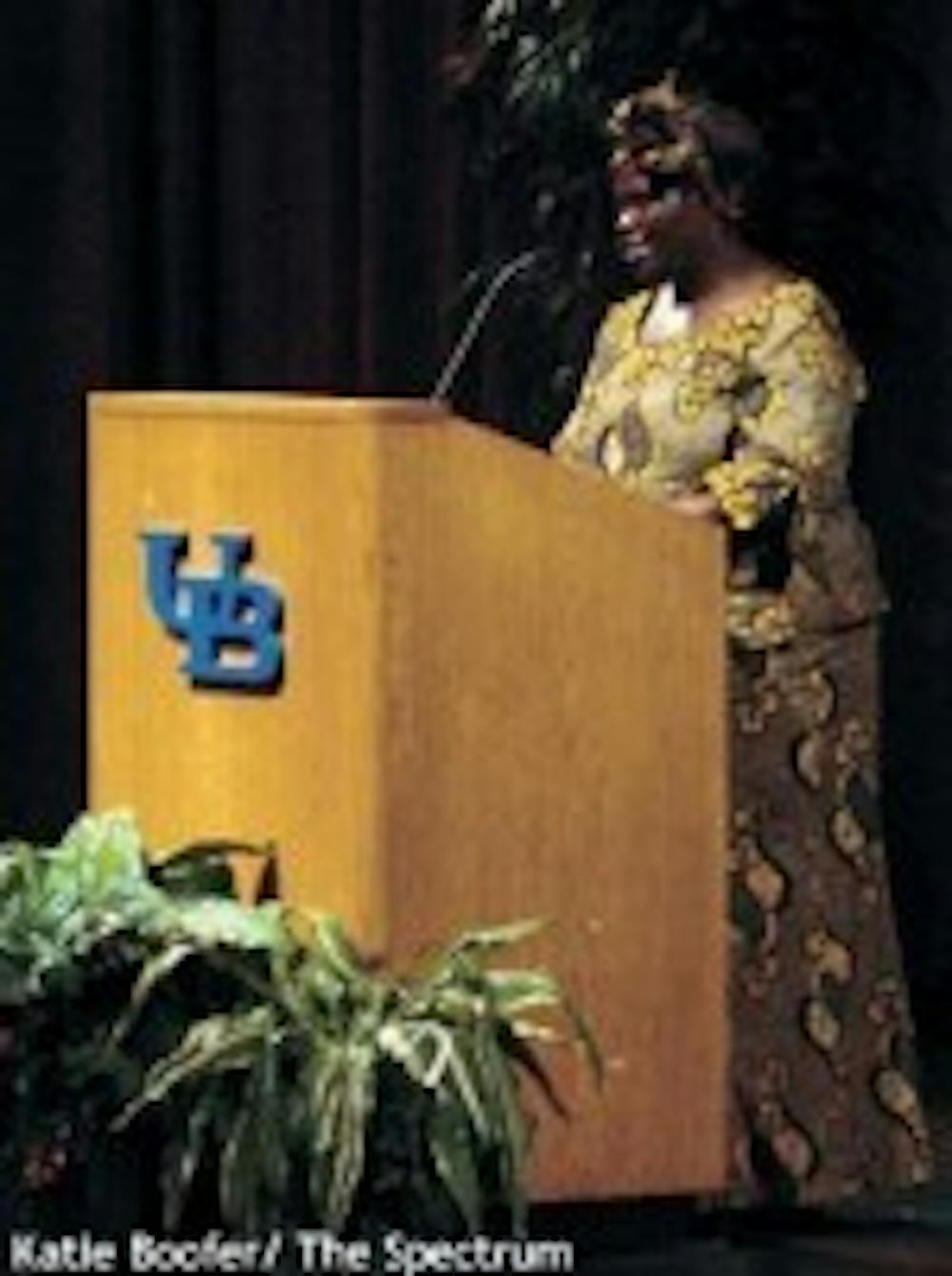
Environmental "responsibility and accountability" was the core message of Dr. Wangari Maathai's speech to students and community members Friday night at the Center for the Arts.
Winner of the 2004 Nobel Peace Prize and founder of the Green Belt Movement, an organization geared toward preserving the environment through planting trees, Maathai's address was presented as part of the 20th Annual Distinguished Speaker Series.
"It's a challenge to begin to think that in order to live with each other we need to manage the world's resources with more responsibility and accountability," Maathai said.
Maathai explained that a major stepping-stone to creating environmental change started with a program developed by then-Senator John F. Kennedy and Martin Luther King to help African students come to America to study.
"Dr. Martin Luther King said he had a dream, part of that dream was to see that young Africans could make a difference in the world," Maathai said.
This dream led Dr. Maathai to a conference held by the National Counsel of Women in Mexico in 1970. While spreading her message for environmental improvement, she was inspired by other women at the conference whose only needs were food, clean water, firewood and an income to support their families.
"I was struck by these women," Maathai said. "Their situations were a matter of life and death and I was already in a privileged position. I was compelled to help them."
Maathai thought of planting trees as the simplest way to assist these women. It was something they could do themselves and was relatively easy to explain. She took her idea back to her native land of Kenya with the ambition to eventually have fifteen million trees planted, one for every Kenyan.
With the assistance of professional foresters, Maathai began to have local peasant women plant and nurture trees on their farms. But after being told by the foresters that fifteen million trees was too large a goal, she had the women produce the tree seedlings on their own and they began to work independently.
"This became an incentive for the women to care for the trees," Maathai said. "If the trees survived they would get financially compensated."
Maathai's program expanded when Mobil Oil began to sponsor it and Maathai received a hundred million dollar donation from environmental worker Margaret Schneider.
"We started teaching each other and duplicating the nurturing process until we had thousand of tree nurseries," Maathai said. "We began to start tree nurseries in schools and teaching the children."
Maathai then developed a program called Civic and Environmental Education that helped educate the Kenyan women about their impact on the environment and how they could help.
The women were questioned on what they believed was the root of their problems, to which they replied, "the government." However, through their work they discovered this was not necessarily the case.
"They came to realize that a lot of the problems they had were of their own making and it was not the fault of a third party," Maathai said. They learned there was a lot they could do for themselves and this was very empowering."
However, the faults of the government could not be denied. They attempted to shut down the seminars by requiring them to have a license for a meeting of more than nine people. Several people were jailed and put under house arrest, including Wangari Maathai herself.
"If the government is corrupt, if they don't care about the people, if they want to enrich themselves with resources, they don't want the people to have a right to those resources," Maathai said.
Maathai's commitment to the environment has ensured that people have a right to the world's resources, and that there is always knowledge on how to ensure the world is here for future generations.
"If you have a clean and healthy environment you will have a clean and healthy population," Maathai said. "It doesn't matter how many hospitals we have, if the environment is sick, the population will be sick."
She explained that everyone in the world would need to have ten trees in order to cleanse the carbon dioxide around us.
"If you haven't planted any trees, you are using someone else's trees," Maathai said.
She explained that the Green Belt Movement's current goal is to plant one billion trees.
Maathai ended her address with a short proverb about a hummingbird that attempted to douse a fire that was destroying its forest home by sprinkling small drops of water on it. After being told by the other animals that it was hopeless, the hummingbird said, "I'm doing the best I can."
"Sometimes we feel like that little hummingbird," Maathai said. "But let us do just what that little hummingbird did - the best we can."



