
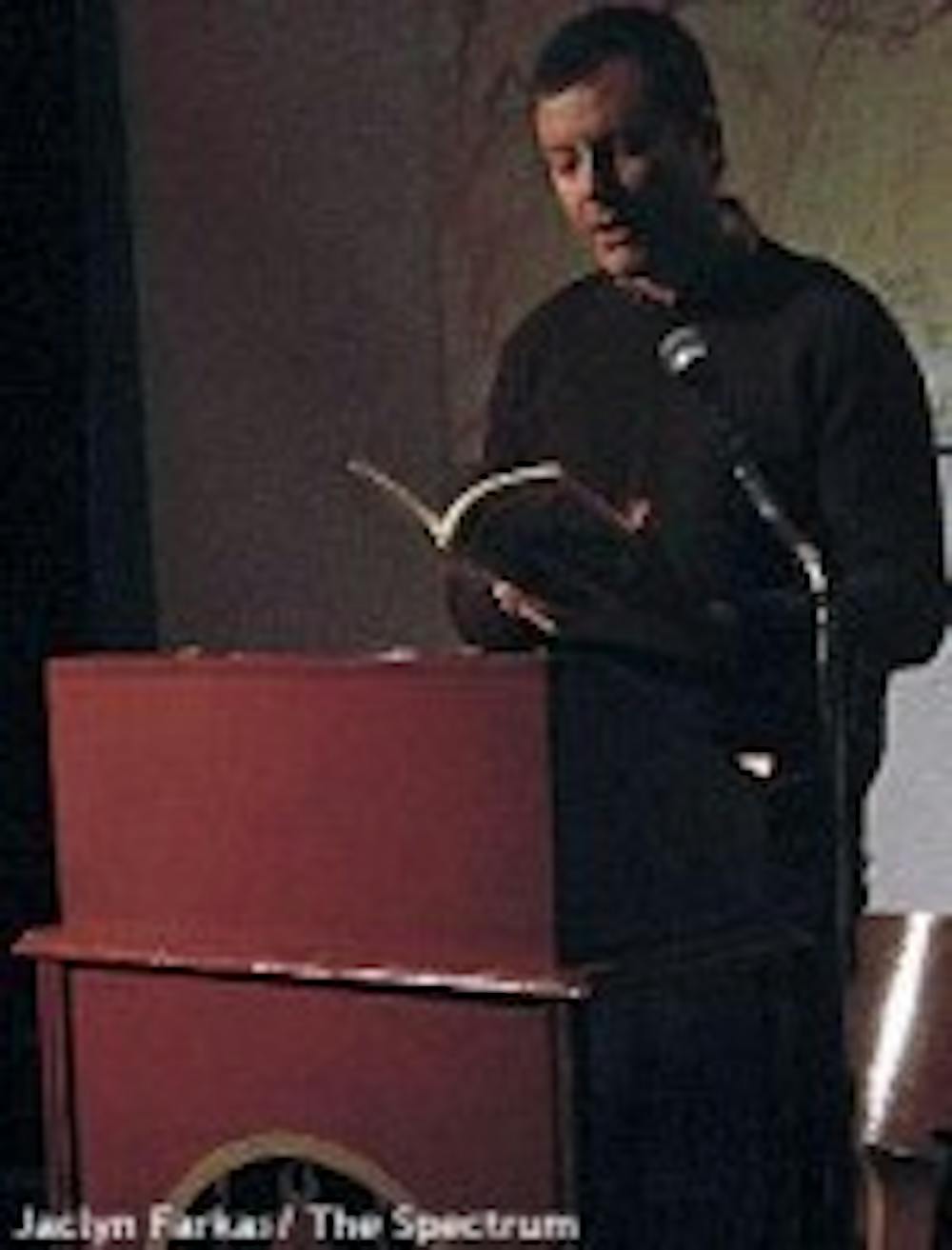
UB's Poetics Plus series continued Saturday with a reading by English poet Miles Champion at Rust Belt Books.
Champion, a native of Great Britain and a current resident of New York City, read to an audience that included several graduate students from the UB Poetics program as well as old friends. He has been writing poetry since 1990.
When sitting down to write a poem, Champion says he avoids going to the page with a fully-formed idea of what the poem will be about, but instead lets the idea form itself in the writing process.
"I only really know once the poem is finished, as opposed to the 'I want to write a poem about X, Y, or Z,'" Champion said. "I want to write the poem and then, when the poem is finished, be confronted with what it's about."
Often, he says, he starts with only small fragments of ideas for a work, which he then molds into a final product.
"I have a sound, or a color, or a tone, or a mood that I want to infuse the poem with, but I don't know where the words are going to come from or what the words are going to be, so it's just very much a grasping in the dark," Champion said. "Then the poem's finished, and it tells me what it's about."
Champion has currently produced four books, "Three Bell Zero," "Facture," "Compositional Bonbons Placate," and "Sore Models."
Opening for Champion was UB graduate student Jeff Hilbchuk. Hilbchuk, who has been a poet for the past ten years values unpredictability in his poetry. He places special emphasis on not "finding yourself."
According to Hilbchuk, the enjoyment of writing is in self-discovery. Exploring yourself however has a downside: it can limit inspiration for writing.
"Once you find yourself you're sort of locked into an identity, and you get locked into a jail. It's a prison, finding yourself," Hilbchuk said. "Once you find yourself, you know yourself, and once you know yourself, then there's nothing new to discover."
Hilbchuk feels self discovery should then be an ongoing process, in order to always have something to write about.
"Once there's nothing new to discover, what's the point? You are never going to find anything interesting or confusing or unpredictable," Hilbchuk said. "So it's the unpredictability that drives writers forward."
Hilbchuk is also heavily influenced by technology. One of his featured poems was based on misinformation gathered from Wikipedia.
"I'm influenced by media, any type of media- books, search engines, Google, Internet, e-mail, TV, movies," Hilbchuk said.
He feels that poets are a special group of people who can be influenced by anything. However, he warns that poets should not depend on the works of other poets as inspiration.
"Once poets get influenced by poets only, they write really masturbatory, wanky things that no one really wants to read," Hilbchuk said "The best poets are interested in the most diverse things, and things that are not necessarily literary."
Many viewers especially enjoyed Hilbchuk's poem based on Wikipedia.
"It interested me that he was very humorous about something that was quite serious as people's willfully maligning public information," said Ruth Reeves, an audience member.
She also enjoyed Hilbchuk's reading as a whole, and found his unique writing style intriguing.
"I just liked the experience of it," she said. "Really two different treatments, but dealing with the same kind of, almost, outrage."



