
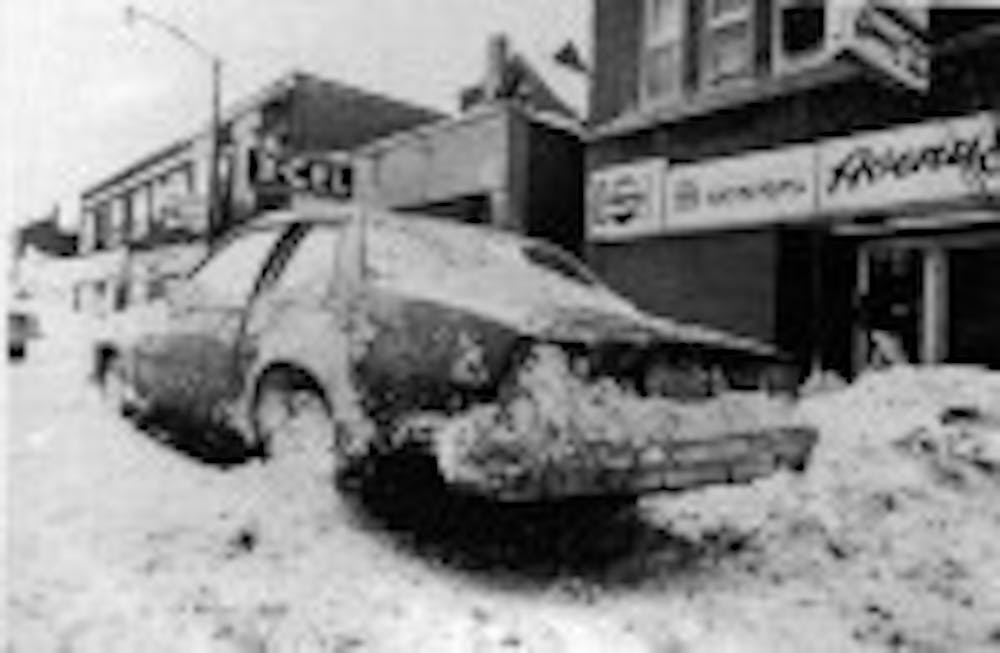
The weather was unusually cold and snowy that winter, even for Buffalo, but nothing compared to the storm that rolled in on the morning of Friday, Jan. 28, 1977.
Forever after known as "The Blizzard of '77," the snow that accumulated and blew off of Lake Erie left Buffalo residents and members of the university snowbound for an entire week afterwards, killing 29 residents and creating a total $300 million in damage.
Then UB President Robert Ketter shut the university down by 9:30 a.m. Friday morning and didn't reopen until the following Friday, Feb. 4. A travel ban was put into effect by the city of Buffalo and all activity within the area came to a screeching halt.
Dave Parobek, a university police officer, was on duty at the newly built North Campus when the storm began about 10 a.m. He retreated to the Ellicott Complex with his fellow officers to escape the 70 mph winds, only to leave a short while later in response to an accident involving 20 cars on Flint Road at Audubon Parkway due to poor visibility.
When the situation finally calmed at about 4 p.m., Parobek and seven to eight officers dried their clothes in the basement of Governor's before traveling back to the Ellicott Complex in a jeep, which took them over two hours. He stayed overnight with the students answering calls by foot.
At one point a girl with an appendicitis attack had to be high lifted over the snow to an ambulance on Millersport Highway, Parobek said. And after President Ketter closed all on-campus bars, some students who became lost while walking to a nearby store to buy beer had to be rescued.
Rhys Curtis was director of Red Jacket, Porter and Fargo in 1977, and was stuck in his home for four days. He recalls strapping on a pair of skis to walk a half-mile to the nearest store for formula for his eight month old daughter. His car was in the garage, but when he finally dug it out he discovered snow in the engine compartment.
On North Campus, enough food was in storage to keep everyone fed for four days and student volunteers helped man the cafeteria.
"It was mainly a question of making sure there was food for the students and something for them to do," Curtis said, now the associate director with residence halls and apartments. "We knew they weren't hitting the books."
Students kept busy with board and card games, movie marathons and sledding on trays from food service, despite severe flooding and false alarms throughout the Ellicott Complex.
According to an article in The Spectrum, 50 staff and students spent the first night of the storm in O'Brian Hall, and about 200 people were rescued by University Police at the Main Bailey parking lot on South Campus and taken to Goodyear Hall to spend the night. University Police also towed all student owned cars to campus lots at no charge.
Dennis Black, vice president of student affairs, was an undergraduate student at UB and unable to get to his home on Grand Island. He stayed with a certain English major's family in Kenmore, learning to play Euchre and watching the mini-series "Roots" on TV.
"You could see the tops of cars, but other than that it was pure snow," Black said, who later married that English major.
Black remembers the National Guard had to cut a trench in the middle of the streets so that cars could pass. The snow was waist high in the lowest spots, and news became obsolete because there was no way to deliver the newspapers.
"We didn't understand how serious it was until after the fact," said Raymond Orrange, an assistant professor in the School of Management.
Orrange was a production supervisor at General Mills downtown, and became stranded overnight in the warehouse along with his car.
"This thing hit and there was probably a window of 20 minutes to leave," he said. "You couldn't see across the street. The cold was breathtaking, where your eyes kind of freeze open."
According to Orrange, the Sabres played in Montreal the next night, Saturday, Jan. 29, and the announcer, stranded in his home, was forced to work from his living room while watching the game on TV.
Gerry Rising, a SUNY distinguished teaching professor in learning and instruction, was in St. Louis consulting on a national math project and was unable to return home for an entire week.
Frank Krzystofiak, the associate dean for executive education, had just started teaching at UB in January of 1977. He was teaching classes Friday morning when someone popped in to tell them the university was closed. It took him over two hours to drive to his apartment in Kenmore.
As a result of the national media attention Buffalo received, he said friends and family called daily to make sure they were okay.
To make up for the lost days, the UB calendar was extended by three days and George Washington's Birthday on Feb. 21 was not observed. Spring vacation was held as planned, but graduation was postponed one week.
President Jimmy Carter officially declared Buffalo a major disaster area on Saturday Feb. 5. Extra snow was dumped on the two frozen lakes on North Campus and vacant lots along Millersport Highway.
The storm was captured in a board game released later that year, and in a book by local writer Erno Rossi called, "White Death - The Blizzard of '77."
MaryAnn Kannalley, a resident of Lockport, was also forced to stay overnight downtown. She slept on a couch with her coat as a blanket in the Marine Midland Bank building where she worked as a secretary. She remembers a man who came in for shelter with a frostbitten ear, and a large group of twenty year olds who bundled each other up so they could venture out for a supply of liquor to last them through the night.
Saturday morning a macaroni substance was served for breakfast, followed by a thin soup for lunch. Niagara Street, she said, looked like a parking lot. She made it to her brother in law's house for the second night, and walked the mile home on Sunday with one broken high-heeled boot.
"The winds would just take you off your feet," Kannalley said. "It was just so good to see my house, and to know that I was home safe."



