
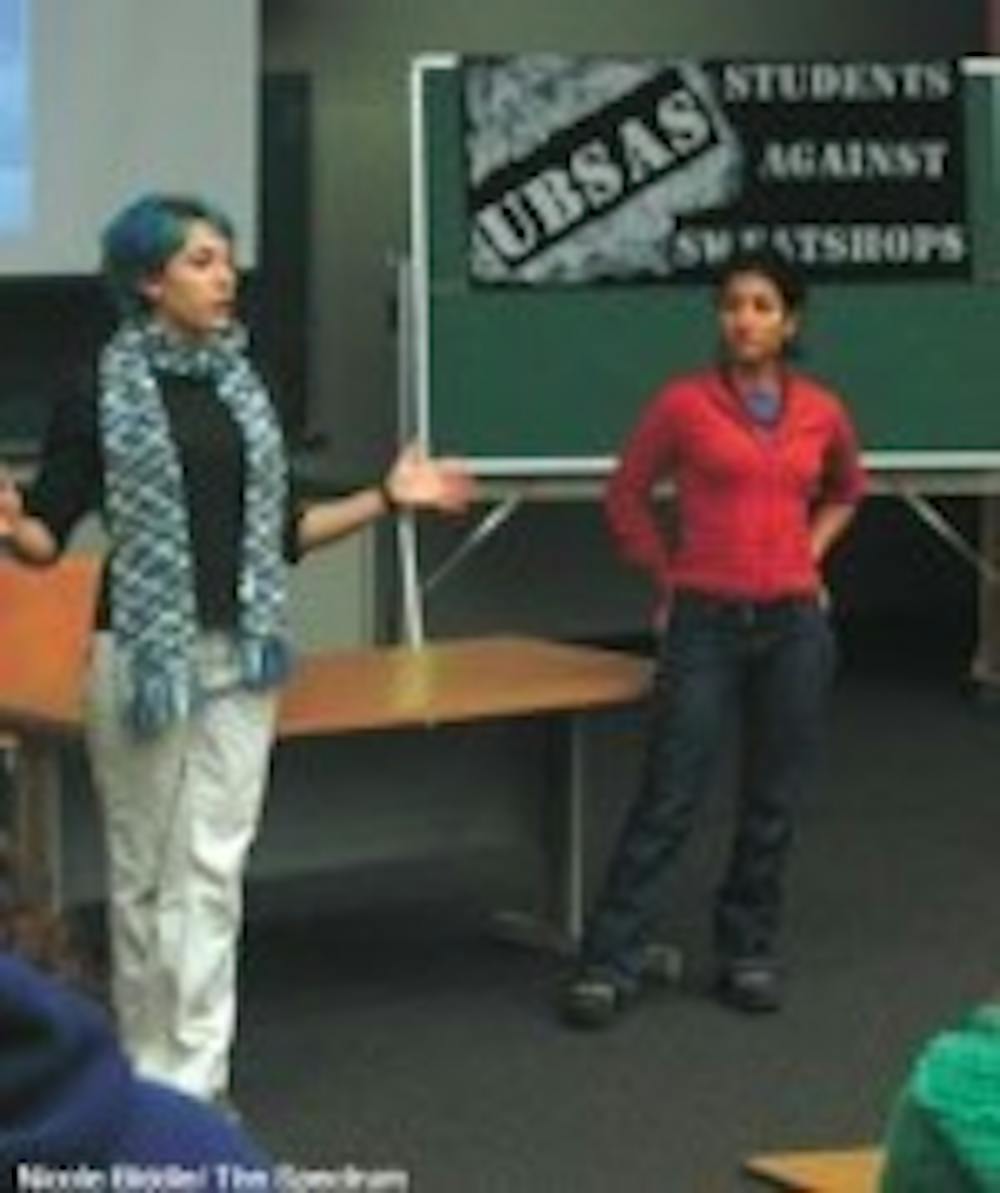
UB Students Against Sweatshops is targeting an issue in its latest campaign that many in the UB community see on a daily basis, though rarely recognize.
After a successful push to affiliate the university with a sweatshop watchdog, the group says there are other injustices right here against UB's behind-the-scene employees: the janitors and custodians who keep campus buildings clean.
At "Justice for Janitors" on Thursday night, UBSAS members unveiled their next campaign, talking to students and community members about the importance of raising the pay for all of UB's custodial staff to that which they define as a "living wage," or $10.75 per hour, accompanied by benefits.
Unionized state employees make up some of the custodial staff at UB, but a great deal of staff is contracted by private companies, namely OneSource and ABM.
According to UBSAS, these private companies offer very little in the way of compensation to their employees. UB officials could not be reached for comment Friday.
"They're giving state money to out of state companies, to exploit our workers here," said Colin O'Malley, a senior member of UBSAS.
Group members at the meeting said they've talked to employees who have worked for ABM and OneSource for 10 years and still make between $7.50 and $9 an hour.
The problem, according to O'Malley, is that as unionized state employees retire over the years, and they are replaced by the private companies who are contracted for as cheap as possible.
"I think UB contracts out its custodial work because it doesn't have to claim responsibility for its employees. They don't have to worry about grievances, picket lines, wages, benefits, etc. They can leave all of that to someone else while they focus on other things," said Devan DeCicco, a senior UBSAS member. "However, it is an unethical practice because they are turning a blind eye to the exploitation that these companies are doing in the university's name."
The event began with an overview of the organization itself, which defines a sweatshop as anywhere workers are exploited, and says UB itself is becoming one, due to the current handling of custodial staff.
The discussion turned to the current campaign, which they are calling the "Living Wage" campaign. Similar campaigns have been run successfully in other schools such as Harvard and Georgetown, UB group members said.
"All of these victories are because there are two groups of people who are organized and fighting: workers and students," O'Malley said.
As with all UBSAS plans, the group considers student participation to ultimately be one of the most important factors, and after flyering for the event all week, some in attendance said they were impressed with the turnout.
"I was surprised because there were so many people here," said Rita Groetz, a sophomore economics major, who added she is considering joining the efforts of UBSAS. "This individual topic hits closer to home for me."
Gloria Almeida, a first-year graduate student in social sciences, said she also decided to join UBSAS because of the closeness of the issue.
"I'm all for addressing issues in our own backyard before we cover the world," she said.
Jessica Kaelin-Piccolo, a freshman occupational therapy major, said her interest in the group was out of character for her.
"I'm totally not into activism or protesting, or anything like that, so I was surprised," she said.
In an open letter to President John B. Simpson (see page 5), who was not available for comment, UBSAS lists three demands -- that all workers earn $10.75 an hour when hired, that they receive benefits, and the contracts between the university and ABM and OneSource be made available to the public.
"UB is allowing privatized companies on our campus to institute a new breed of corporate feudalism by making their workers dependent on the company to meet their basic needs through poverty wages, while those who run the corporation make large sums of money on the backs of the poor," DeCicco said. "I think this is no different from the feudalism of the Dark Ages."
O'Malley said UBSAS will wait for a response from Simpson before planning its next step.



