
There are many faces scattered throughout the meandering hallways, windows and stairways of the topmost floors of Buffalo's historic City Hall. These faces, along with a collection of abstract and experimental pieces from 11 participating local artists make up "The Elevator Stops Here," a newly opened exhibit that runs through April 17 will be filling vacant office space in the enormously grandiose gothic structure standing at Niagara Square.
On display are original art works fro m each of the 11 artists, exploring such pressing themes as politics, government, the built environment and the definition and significance of space and the cultural implications therein.
Situated quaintly on the 25th floor, as well as the awe-inspiring observatory deck three floors above, the collection boasts works as far reaching as Leah Rico's "Plant Societies" with its miniature, lush gardens to Robin Brasington's "Striking Structures," where a fashionably elegant, steel fixture sink filled with murky pink water rests below visions of Baubo, the Greek goddess of obscenity.
In doing so, the exhibit compiled several experimental art forms beneath one roof in one of the largest and most breathtaking city hall structures in America.
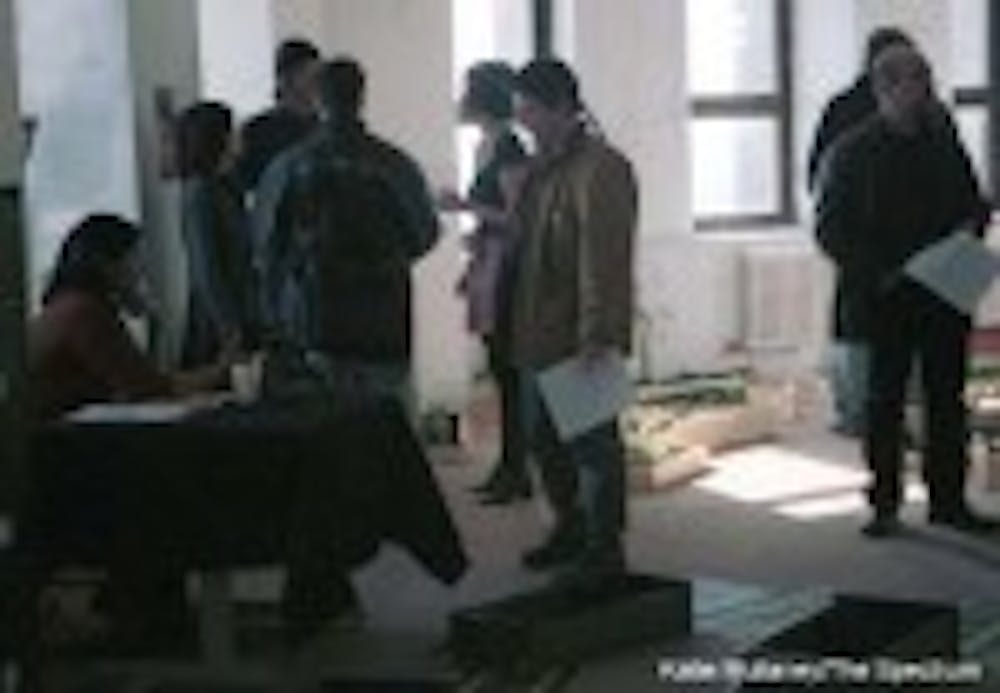
"It is our intention that the ideas presented in the exhibition will resonate with audiences long after the installation closes," said Julie Perini, one of the exhibit's contributing artists whose piece, "Goin' to the Chapel," offered exhibit visitors an interactive experience that pits Reverend Perini with exhibit participants to create a mock mass wedding.
"'The Elevator Stops Here' is a conceptual and temporal site of exchange, a glimpse at a process and an intervention," said Perini.
Like all the other pieces in the exhibit, Perini's "Chapel" took a very unique and novel approach to the development of the art and the concept. By addressing the current cultural climate and the overlapping of personal freedom and government, her piece oddly paired Perini, the exhibit's reverend, with visiting participants who may choose to "marry" whomever they would like.
"Like the elevator itself, the exhibition offers opportunities to be transported, to open doors onto new modes of perception," she said.
Jay Ariaz's "Citizen" was another fascinating piece. With color photographs from a melting pot of participants speckled throughout the top three floors of City Hall, Ariaz attempted to examine the question of just what a citizen is. Alongside each photograph was a quote from each participant, spelling out just what they thought it meant to be a citizen in today's world. Some were pro local government, some showed great distaste for the current political atmosphere, but all were unique expressions from unique individuals.
"Ascending/Descending," a piece by C. Tennant, examined an Esheresque nightmare where Tennant is seen climbing the 500-plus stairs of City Hall frantically as if she was an administrative assistant on the day of Black Monday. Mounting a four-way split screen television set on top of a 1980s-era Stairmaster Stepmill, she portrayed a frenzied office worker forever traveling the building's stairs with no apparent end in sight.
Rico's "Plant Societies" used a collection of native, imported and invasive plants, massed together in individual boxes to serve as a metaphor for the city's multiculturalism in terms of geographic isolation and haphazard boundaries.
On display now through April 17, "The Elevator Stops Here" is a worthy exhibit of 11 local artists, each with a vision that reaches beyond art. It is a conglomerate of emotion and intellectual brainstorming that has significance well beyond its City Hall boundaries.



