
This is part 1 of a two-part series exploring the expanding size of the UB classroom. The second part can be found here.
Sharing a university with almost 18,000 other undergraduate students can make some students feel insignificant, and even lost, while at the same time it can make others feel comfortably camouflaged.
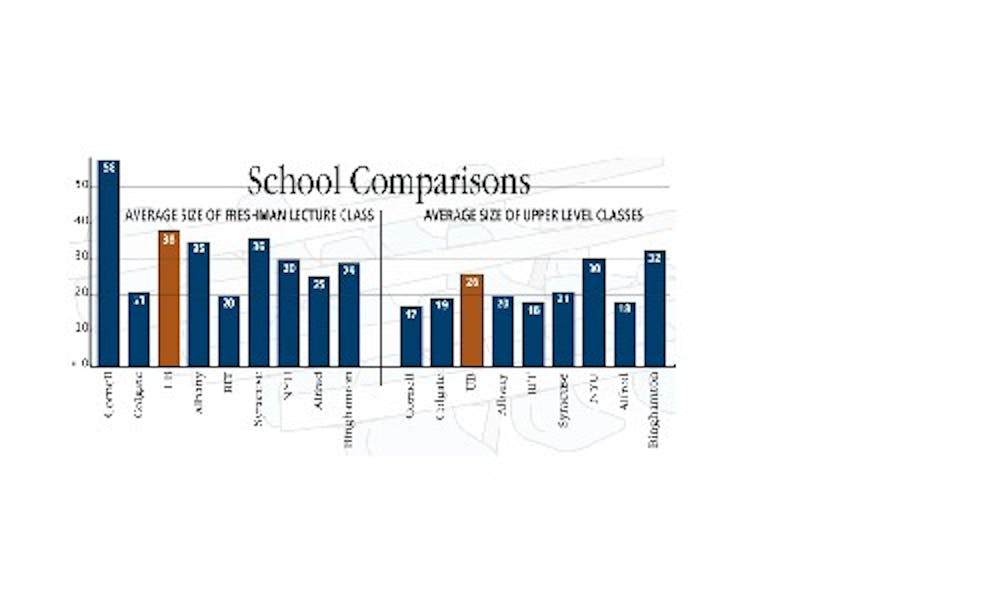
The problem of overcrowded classes in vast lecture halls is certainly not unique to UB, but compared to other major universities, UB has some of the most crowded classrooms around.
UB, however, does not seem to be entirely at fault - the issue of class size is directly tied to enrollment.
Penn State University Park, in State College, Pa., is an enormous campus with almost 35,000 undergraduates and is constantly in search of better ways to make large classes more conducive to learning.
"The standard thought that a larger class is worse isn't necessarily true," said Jacklyn Kramer, a coordinator for Penn State's Center for Excellence in Learning and Teaching, a staff that helps professors feel comfortable about teaching large lecture classes.
A second resource teachers have at Penn State is the Schreyer Institute, whose role is to improve teaching performances in the classroom.
"Merely reducing the number of students in a class does not necessarily improve instructional quality," stated the Schreyer Institute's Web site. "Since large classes will undoubtedly continue to be part of Penn State, the question here is how we can incorporate into larger classes the elements that make small classes effective."
While Penn State and UB will always battle overcrowded classrooms, smaller universities have the luxury of smaller, more personal settings.
Bates College in Lewiston, Maine, with an undergraduate population of 1,700, is the epitome of small-school intimacy. By comparison, Niagara Falls High School enrolls over 2,500 students.
The average class size at Bates is 17 students, and the largest lecture hall on campus seats 70. UB's largest lecture hall, Knox 20, seats well over 400 students.
"Bates is a close-knit community where students get to know their professors very well," said Jordan Chase, a senior public policy major at Bates. "It's great when you need letters of recommendation."
While the close relationship with his professors is helpful, Chase says that sometimes he wishes he were at a larger school.
"There is a down side though," said Chase. "Lots of gossip, same faces every day, and borderline high schoolishness."
Bates, like most other smaller schools, has no need for teaching assistants or recitations - all of the classes are taught by the person who does the grading.
Colgate University in Hamilton, NY, with an enrollment of 2,800, is in the same mold as Bates - an everyone-knows-your-name school with no teaching assistants and a quaint community.
According to Colgate's admissions Web site, there are more than twice as many classes with 20 or fewer students than there are with 30 or more. There are only 11 classes with more than 50 students. By comparison, Penn State has no fewer than 10 classes with over 400 students.
Bates and Colgate are two perfect examples of how low enrollment makes class sizes much more manageable.
In contrast, UB, with its freshmen class ballooning on a yearly basis, will continue to battle large classes indefinitely, and students can hope the professors are prepared.
Next time: What is UB doing to prepare its instructors for large classes, and what do students think about sharing their learning experience with hundreds of other students?



