
When the number of people infected with Hepatitis A from a restaurant in Pittsburgh climbed past 500, and resulted in three fatalities in mid-November, most people may have been inclined to give more than a few seconds of thought to the safety of their own food.
UB students who eat on campus put their faith in the safety of the food provided under the supervision of the Faculty Student Association (FSA).
According to the members of the FSA, this faith is well deserved.
"We follow very strict guidelines to ensure the food safety of the university community," said Cindy Youngers, assistant director of FSA Food and Vending services.
Some students said although they were aware of the Pittsburgh food poisoning incident, they were not preoccupied with the fear that a similar contamination could occur at UB.
"UB food may not taste the best, but I don't think it will ever kill you," said Craig Kincaid, a junior industrial engineering major. "I like food too much to think about it is good for me or not."
According to representatives of the FSA, serving hygienic food to the university community is a priority. Youngers said every step in the process of food service is taken with safety in mind, beginning with the vendors from whom the raw ingredients are purchased. These vendors have to comply with the Hazard Analysis Critical Control Point rules for handling food.
The food is then in the hands of FSA employees who, according to Younger, are well trained.
"They have a five hour seminar about cleaning by using soap and sanitation, and Anita Hathaway is certified to teach the 'ServSafe' class," said Youngers.
"I teach two times a year," said Anita Hathaway, FSA dietician. "Employees must pass the examination, and understand how to handle food safely. Student managers also take the ServSafe examination."
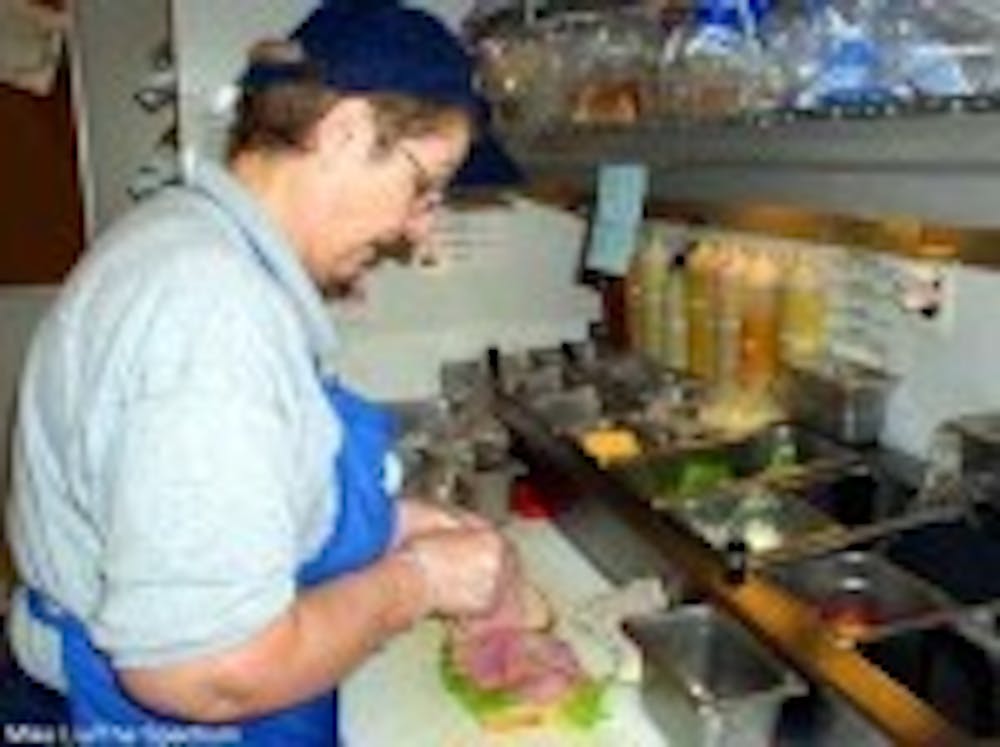
According to Youngers, all employees who have direct contact with the food must wear gloves and change them frequently. Food service equipment such as prep tables, knives, cutting boards, can-openers, thermometer, silverware, and pots and pans are sanitized to prevent cross-contamination.
Youngers points out that FSA's food service is governed by the New York State Health Department, and in the event of an outbreak of food poisoning or a disease like Hepatitis A, the health department would inspect the dining center and FSA employees.
"We take samples of the food and they go to the freezer; if we have major food poisoning, we can get back to the food and send it to the New York Health Department," she said.
To avoid the occurrence of such an incident, the FSA has hygiene awareness programs such as "the victory system" under the health department.
Under this system, the FSA and its employees employ a sort of honor code of cleanliness.
"We also make sure certain foods are stored in certain shelves and every staff (member) has a soap and sanitation bucket so that they can use it frequently," said Youngers.
Niya Massop, a senior early children education major, said she noticed the food servers wear gloves during serving, but she still has doubt of the food's quality, as well as of campus food service.
"I don't think it is so good because even though they wear the gloves, they still touch the stuff that should not be handled with their gloves," she said. "For off campus food service, there is always a possibility that the food is not safe because we do not know what is actually going on in the back."
While representatives from FSA informed students that the process of food preparation and service is handled with great emphasis on hygiene, officials from Health Service advise students not to worry about the possibility of a Pittsburgh incident at UB.
"(FSA) has very good hygiene standards," said Frank Carnevale, director of Health Service and Student Wellness Team coordinator. "UB Health Service serves as a resource for FSA in terms of any questions they have regarding training and providing information. We work together quite well."
According to Carnevale, there are things students can do to take measures to avoid contaminating their own food.
"The most important is to use good hygiene, anything you learned from kindergarten - wash your hands before you eat and prepare food, and after you go to the bathroom," he said. "Also consider getting a Hepatitis A vaccine."
FSA representatives say they welcome feedback from students.
"We encourage students to contact us if there is something that is not right; they can fill in a comment card, contact the manager on duty and log on myubcard.com," Youngers said.



