
UB is blowing the competition away - literally.
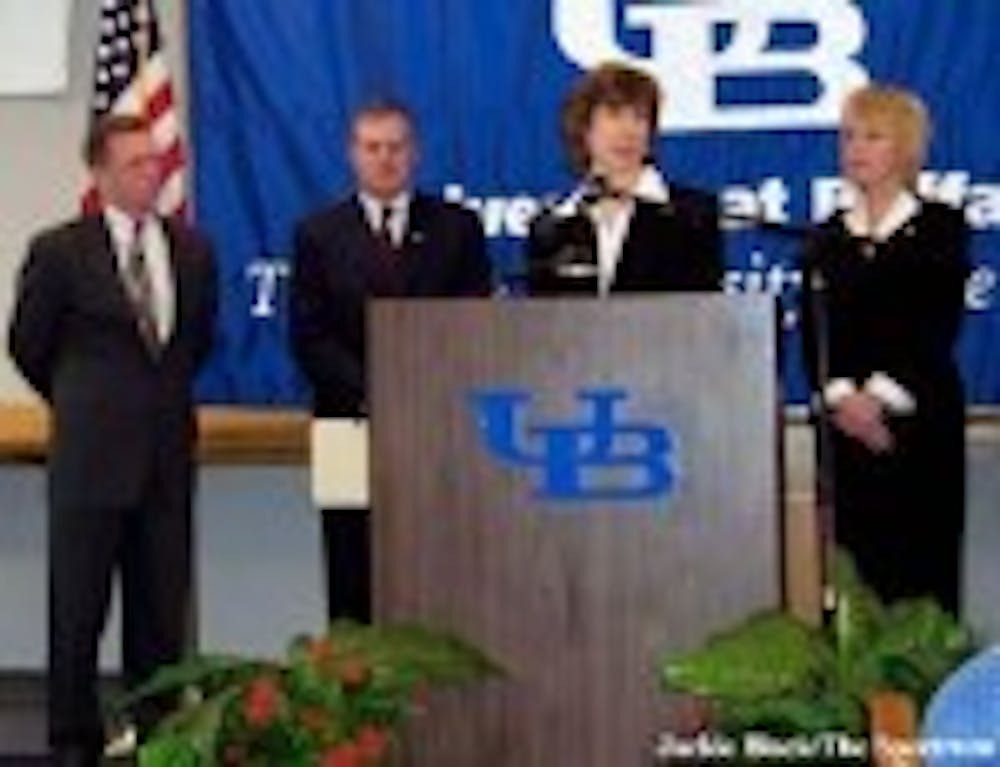
At a press conference attended by Lt. Gov. Mary O. Donohue, university officials announced on Tuesday that UB currently utilizes more wind power than any other institution in New York.
"UB has a very long and proud history of being a leader, not just regarding wind power but environmental issues," Donohue said. "People around the state look to UB in this regard."
According to Donohue, UB is on the cutting edge of technology because it utilizes the two biggest wind farms - a large collection of windmills - east of the Mississippi.
At the conference, Brent Alderfer, the president of Community Energy Inc., presented UB with model turbines as a symbol of UB's commitment to the environment.
"The first ones through the gate are the ones that make the difference," said Alderfer.
UB's utilization of wind power began after Pataki issued Executive Order No. 111 in 2001, which states that all state agencies and departments "shall seek to achieve a reduction in energy consumption by all buildings they own, lease or operate of 35 percent by 2010."
According to Mike Dupre, the associate vice president for university facilities, UB is looking to increase its consumption of wind power in the future, and by next year he said he hopes the university will increase its use to six percent.
Walter Simpson, university energy officer, said UB began working toward utilizing alternative means of energy long before the executive order.
"We have been committed to environmentally operating this campus for many years, and when the governor came out with this order, we were very interested in providing state-wide leadership," said Simpson.
In light of rising oil prices and war with Iraq, Provost Elizabeth Capaldi said UB's environmentally friendly energy advancements could not have come at a better time.
"This energy is in this country, where other energy is not in this country, which makes this a definite plus," Capaldi said. "I think it is a very smart move for UB to invest in the environment and become less dependent on foreign sources."
By utilizing wind power, Capaldi said UB will become more independent, produce more jobs for the state and become more environmentally sound.
According to Simpson, using wind power currently costs UB approximately 1 cent more per kilowatt-hour - a unit of energy equal to the work done by one kilowatt in one hour - than its fossil fuel counterparts.
Capaldi said the higher price of wind power affects only a minimal portion of the budget and the cost of wind power will decrease over time.
According to Ron Kamen, director of New York operations for Community Energy Inc., his company serves as the middleman in marketing wind energy to various agencies. Kamen said UB will become a role model for other institutions in the state.
"This positions you as a leader in promoting renewable resources in the state as an alternative to fossil fuels," said Kamen.
Kamen said New York currently receives 10 percent of its energy from oil, but wind power could potentially account for 20 percent of its total energy use.
Although UB has made significant strides, Simpson said, "We have a long way to go before the majority of the power that we use is significantly green."
After forging an agreement with Community Energy Inc. this year, Simpson said UB will purchase eight million kilowatt-hours of energy, which is 4 percent of the total energy UB consumes.
Kamen said all of the wind power purchased by UB in 2003 will come from the wind farm in Wethersfield, N.Y., and in 2004, all of the university's wind power will be purchased from a wind farm in Fenner, N.Y.
Due to contractual issues, Kamen said switching from Wethersfield to Fenner will enable the university to purchase wind power at a cheaper rate.
"If UB bought all of the (wind) power in New York State right now, it would just be enough to meet our needs," said Simpson.



