
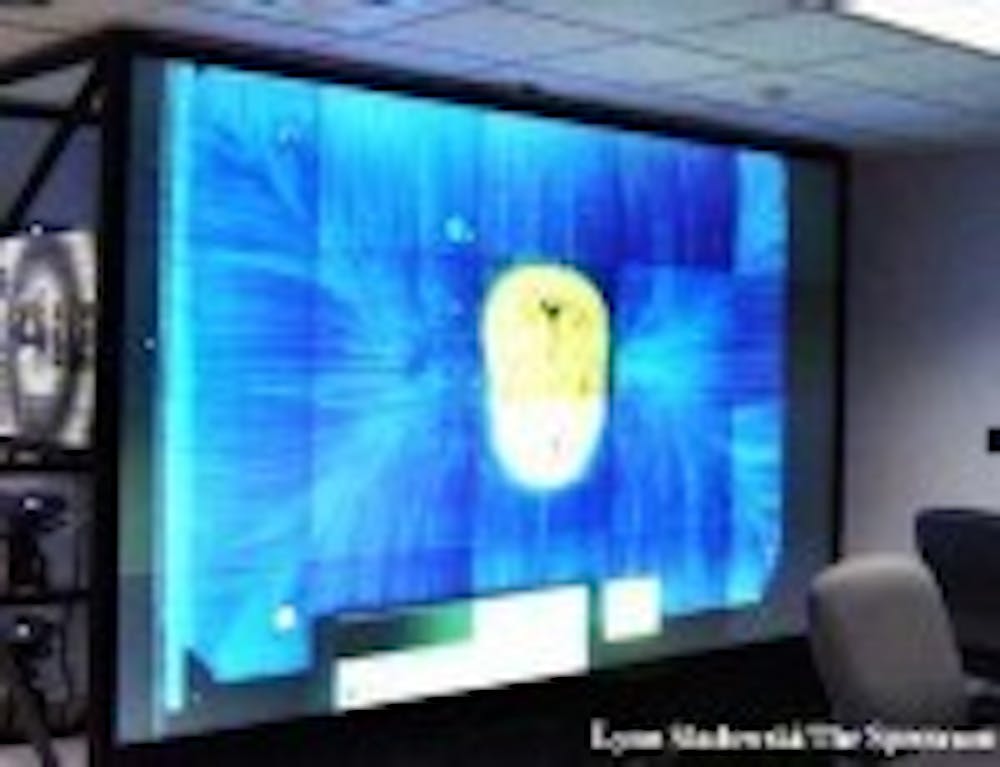
Despite being located in a busy hallway in Norton Hall, the Center for Computational Research - the eighth largest supercomputing center in the world - is not well known among UB's students.
"Is that the place with the open window that has all of the expensive computers and men wearing suits?" said Lesley Crowell, a junior majoring in English.
Through the Center for Computational Research, students can earn a graduate certificate in computational science, or take courses in high-performance computing. The CCR also extends instructional seminars in distinct areas of high-end computing.
The CCR has welcomed many note-worthy people, such as Sen. Hillary Clinton and Sen. Charles Schumer, for tours, and has also been working on significant projects, such as the model for a new Peace Bridge, and innovative medical technologies.
These high-tech computers and equipment may seem unattainable for UB students, but under certain circumstances, some students are permitted to use the CCR facilities.
"The vast majority of people that use the facilities are students," said Miller. "There are hundreds of people who use the facilities, about 90 percent (of) which are students."
Koniak also said some professors teach classes in the CCR, bringing more students in contact with the equipment.
Martins Innus, a fourth year graduate student at UB who majored in computer science, explained that the CCR first designed a model of the new Peace Bridge as a public service.
The Peace Bridge project began around two years ago, and the first model took approximately three weeks to design, according to Unnus.
Russ Miller, director of the CCR, said that because the first model "was so well received" a second model was created with higher resolution and more detail.
Adam Koniak, a UB graduate with a degree in psychology, explained the purpose for creating a model of the proposed Peace Bridge.
"It is so that people can see it and how it will affect the area," said Koniak.
"The Peace Bridge project acts as a visual element for deciding on the problems that may arise from the building of a new Peace Bridge."
The CCR stands at the forefront of research for creating new medical equipment, as well.
Innus is currently working on a medical visualization project known as preoperative planning. According to Innus, a doctor usually refers to a catscan or RMI when observing a patient's bone structure. Innus wants to improve this flat picture to make visualization easier.
"Doctors will be able to make a diagnosis from this 3D view," said Innus. "All doctors will be able to use the same picture for different patients."
Miller acknowledges that many people, even those who are not Buffalo residents, are unaware of the type of equipment in the CCR.
"Buffalo has a reputation as a steel mill," said Miller. "(The CCR) is one of the leading academic institutions in the world."
"There is a minimum of 47 active research projects going on right now," Miller said. "There can be more than that because sometimes groups will work on more than one project."
The CCR computers can keep track of complex statistics, such as what each Tops customer purchases, along with any item that was on sale. The computers at the CCR are helpful because they can store large amounts of information needed for similar research, according to Miller.
Miller explained that while being able to gather this type of correlation, a store may experience better purchasing rates by placing certain products next to each other.



