
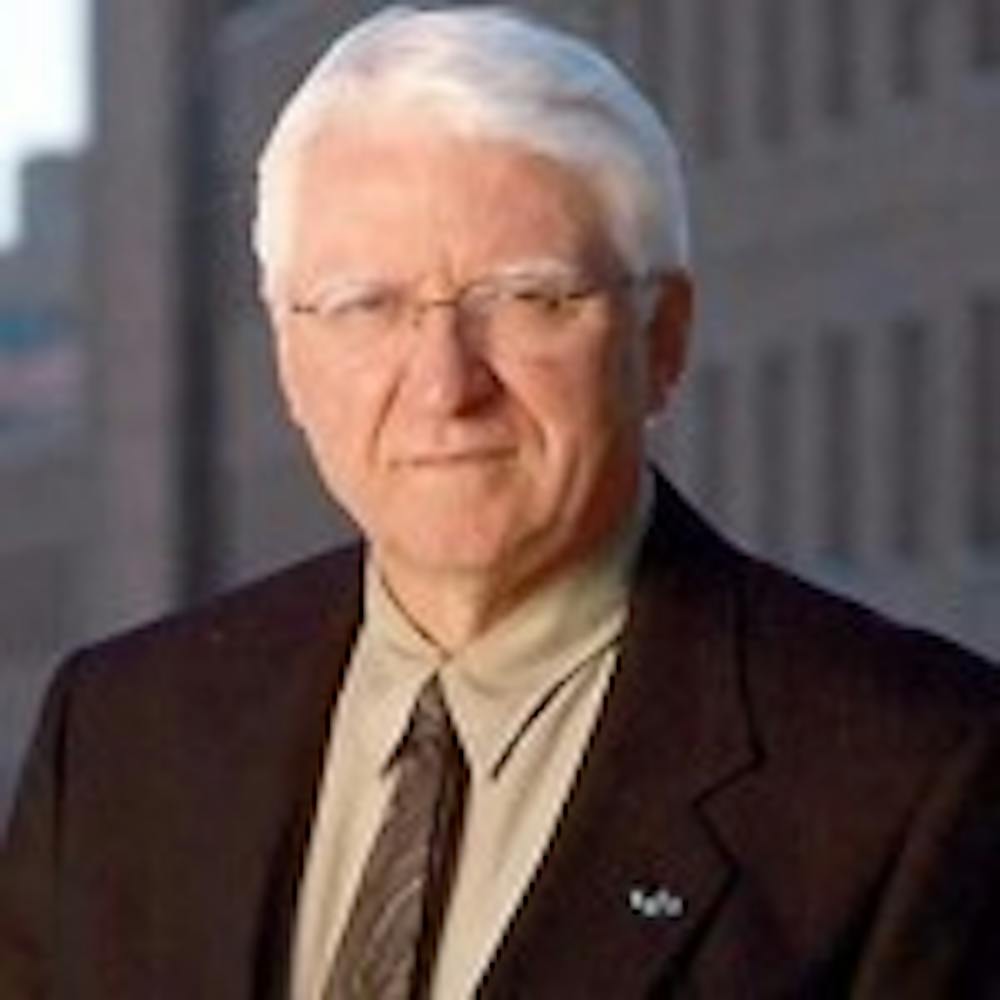
Monday night marked the first broadcast of UB President William R. Greiner's monthly WBFO 88.7 radio address, "Talk of the University," since he announced his retirement from the presidency in June and his return to teaching.
Greiner was joined by his regular co-host, Dennis Black, vice president of Student Affairs, in a discussion that included Greiner's retirement, Governor George E. Pataki's proposed SUNY tuition hike and cuts to financial aid programs such as the Tuition Assistance Program, last spring's parking survey and Division I-A athletics.
According to Greiner, his decision to retire from the presidential office after 13 years was born from a desire to return to teaching in UB's School of Law.
"This job is getting in the way of my future," Greiner said. "Everything that I had wanted to be done had been done, and that's when you know you have been in a position too long."
Greiner said he always knew that he wanted to retire to life as a professor, though he said his experience as UB's president will make him into "a different kind of professor."
Black said he had a "twofold reaction" to Greiner's retirement announcement, the first one of surprise. He said his second reaction was a sense of "looking back and looking forward," that he was prompted to reflect on how far UB has come in the past 20 years and look forward to where the university will be in the next 20 years.
According to Greiner, there are still a few uncompleted initiatives from his presidency about which he is concerned, specifically the Lee Road Project, a proposed commercial and residential development between the Ellicott Complex and the Academic Spine that has yet to break ground.
Despite having served as UB's president for 13 years, Greiner said the "real heroes of the university are the faculty and staff." He said his main responsibility as president was to be a "cheerleader" and act as a guide for students, faculty and staff.
Regarding the athletics program, Greiner said that although it might not be apparent to everyone outside of the university, things are looking positive for UB's role in Division I-A competition.
"(The athletics program) is at a place I hoped it would be," Greiner said.
Greiner and Black then turned the discussion to the results of the parking survey conducted by Chance Management Advisors, Inc., a Philadelphia-based consultation firm.
The firm is expected to send representatives to UB on Feb. 12 to discuss the results of the survey and propose solutions to complaints regarding a lack of parking on both the North and South campuses.
The last segment of the radio show consisted of phone calls from listeners who were concerned over the tuition increase and TAP cuts.
Although Greiner said he was strongly opposed to the TAP cuts, he was in favor of raising SUNY tuition increase between $1,200 to $1,400. The proposed tuition increase is almost double the previous increase in 1995 when tuition was raised by $750.
As a result of the 1995 increase, SUNY enrollment dropped by nearly 30,000 students, according to a report by the SUNY Student Assembly.
However, Greiner said the decrease in enrollment did not really affect UB; rather, the greatest difference was seen in the New York City metropolitan area.
UB will continue to prosper despite the tuition hike and cuts to TAP because, Greiner said, "students have a remarkable capacity to react to difficult circumstances."



