
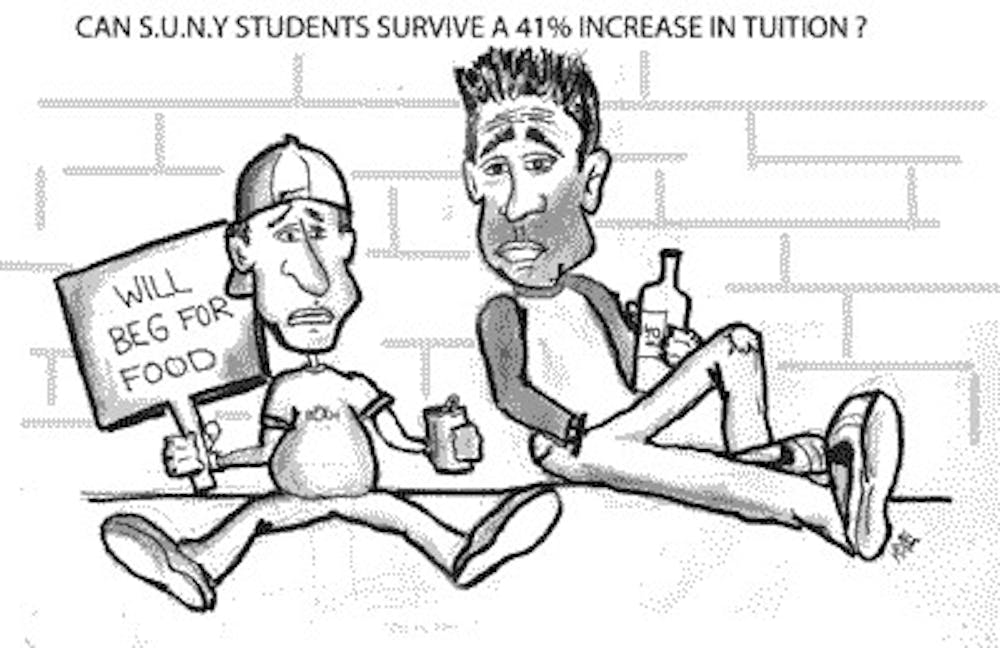
On Jan. 17, SUNY Chancellor Robert King passed a memorandum to the Board of Trustees recommending a tuition increase of 41percent for all undergraduate students enrolled in state colleges. When the 12-member board met to discuss the $1,400 increase that would take effect next fall, it was ratified, despite vocal arguments from two of the members: President of the SUNY Student Assembly and UB student George Pape and Candace de Russy of New York City.
Pape and de Russy are the only two delegates who recognize the inherent hypocrisy of raising tuition 41 percent while making no effort to request further aid from the state or federal governments.
In the recent past, this page has supported tuition increases, but a 41 percent increase is difficult to endorse, especially since a comparable increase in the quality of education cannot be guaranteed. The students are being asked to shoulder too much of a load, too soon, and many may be forced to leave school should the increase be approved.
If a five percent increase had been instituted over the past eight years, then payment would have been spread out and budget woes could have been averted. Perhaps, most importantly, students would have been able to better budget their finances to take into account the higher cost of education. Even this increase, though, would surpass inflation rates.
The larger problem with this issue, however, is that it is a necessary response to the problem of New York State's gaping $2.4 billion deficit. For various reasons, investor confidence in the stock market has gone down, and the misallocation of federal funds has forced state governments to cut every corner. President George W. Bush exacerbated this problem by promoting an economic stimulus package that cuts state funding.
If Bush's federal funds - most of which used to come from the dividend tax on the rich - become scarce, states will be forced to raise taxes and tuition. SUNY, recognizing this, realized an alternative to state aid was necessary. Unfortunately, because the rich are getting a tax break, the middle class students of state universities will be forced to spend more money.
While many students who already rely on financial aide will be able to get more money, the middle class students who are ineligible for loan consideration will be hit the hardest. According to statistics provided in a report from the SUNY Student Assembly, nearly 30,000 students left the SUNY and CUNY systems after the last tuition increase in 1995. A similar outcome can only be assumed with this increase and it will be disastrous for the schools.
Since the decision is obviously not in the best interest of many students, one is left to wonder what the Board of Trustees, other than Pape and de Russy, are doing. The budget will hurt the students much more than it helps them, as the increase of tuition will not provide new services, but will only make up for missing government funds.
While placing the suggested burden solely on undergraduate residents, as the current proposal reads, they decided to leave the door open to possible increases for out-of-state and graduate students. New York's state residents are already paying tax dollars that go (or used to go and/or should go) towards SUNY schools, so if they are forced to pay higher tuition and higher taxes, while out-of-state students' tuition remains level, the plan cannot be seen as fair.
The rising tuition does nothing to counter the continual ascension of various fees. Since tuition and fees cover different things, students will not see a relief or freeze in this area. To consider that students would comply with a drastic increase in costs, without a analogous increase in service, is an insult to every student in the SUNY system.
The burden for higher education should be placed somewhere between students and the government. The success of students leads to a better economy, and if middle class students are being forced out of quality education, it is a terrible day for America.
Students who do not want to stand for being poorly represented are encouraged to contact local and national elected officials, especially King and Governor George E. Pataki. SUNY SA will also be holding a series of rallies for students to voice their opinions and concerns over the egregious violations of their rights.



