
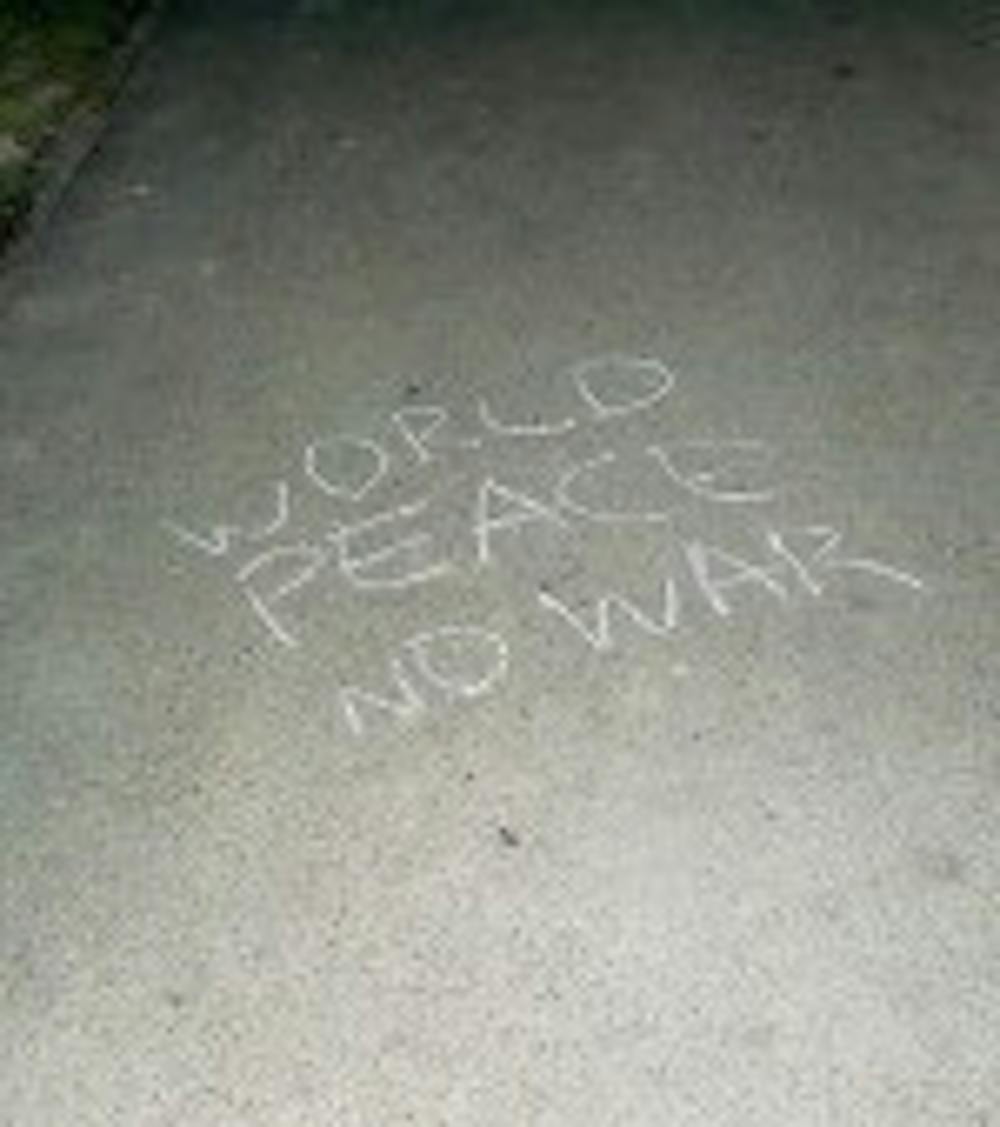
Some see chalking as a harmless and temporary means of getting a message out to a group of people; on college campuses, however, it is considered both an annoyance and a source of potentially offensive messages. Here at UB, the situation is no different.
It is for those reasons that some universities are taking steps to limit the extent to which chalking can be done on campuses. One such university is Wesleyan University in Connecticut, where University President Doug Bennet issued a moratorium making it illegal to make any chalked statements on university grounds last month.
Bennet said he banned chalking because of an increase in sexually explicit and offensive messages and their negative reflection on the university, according to Wesleyan's Web site.
"Although Wesleyan has a recent tradition of chalking, it is not a lofty tradition," Bennet stated in an open letter to students and faculty. "It gives many visitors the impression that Wesleyan lacks high intellectual standards and contributes to the sense that the campus is unkempt."
Following a recent rash of chalking this fall on university grounds, university officials said UB might not be far from placing limitations on chalking on campus grounds.
"There is no real history with chalking so we have never had to consider a policy," said Dennis Black, vice president of Student Affairs. "But the extent and location this semester has been an issue."
Black said measures may have to be taken to amend UB's "no chalking" policy to allow students to chalk on campus, but within limits, as is practiced by other colleges.
"St. Rose University and Albany have policies limiting where students can chalk, when they can chalk and that they have to clean it up. Also, they prohibit response chalking to avoid continuous chalking," said Black. "The chalking that happened this year is cause for concern. If it continues the university will have to talk with students."
The recent chalking at Founders Plaza on UB's North Campus displayed homosexual sentiments, but the Lesbian Gay Bisexual Transgender Alliance claims no organizational responsibility for the chalking.
"We have been told by the Student Association that chalking is against SA policy," said Rachel Parrino, vice president of the LGBTA. "Individuals do go out and chalk, but we as an organization adhere to SA policy."
Other messages that frequent UB's campus are those stating animal rights activists' stance on meat consumption.
"We hoped to increase awareness and get some topics out into the open," said Joseph Menichino, president of the Buffalo Animal Rights Coalition. "We haven't done it since last year, and we haven't talked about it since then."
Derek Heck, a junior majoring in digital studies, said that he was responsible for the somewhat ambiguous "human meat" chalking that decorated university grounds last year.
"Whenever people chalk it's either for gay rights or vegan views. I feel that it shouldn't just be their ideas being displayed," said Heck. "I chalked about human meat because I did a report on cannibalism, and I thought it would be interesting to watch people's response to it, so I got 30 people together and just went about doing it."
Heck said the chalking is a harmless form of expression that the university does not have to incur expenses to remove.
"There is no policy against it but I know the university officials get upset because they have to wash it off. If they would just wait for it to rain or snow it would wash off on its own," he said.
Louis Schmitt, director of facilities and operations at UB, said chalk removal cannot be left to the elements.
"There is a policy at UB that binds us to remove biased graffiti from campus grounds. Some may say their messages are not biased, but one way or another it is offensive to a group," he said. "A pro-homosexual may see one message as acceptable while a member of religious groups might take offense."
According to Schmitt, the removal of chalk is not as simple and inexpensive as some assume.
"For one chalking episode this fall, the university spent $1,039.12 cleaning chalking in various places, but most particularly (in) Founders Plaza," said Schmitt. "This money could have been better spent elsewhere."
John Pernasilice, a sophomore exercise science major, said he does not react favorably to chalked messages.
"To be honest, I couldn't really care less, but if I had to take a position, I do read some of them, and I don't appreciate them at all. I don't see the point mostly. It's just annoying, especially the 'don't eat animals' ones," he said.
According to Menichino, not all students have negative reactions to messages and the chalking by BARC achieved its goal.
"We increased our membership 150 percent since last year, so I would say it worked very well."
"Chalking is an anonymous form of expression that allows you to see people's reactions by walking around afterwards," said Steven Paul, a junior majoring in digital art. "Personally, I prefer verbally voicing my opinion, so I wouldn't use the chalking method if I had something substantial to say."



