
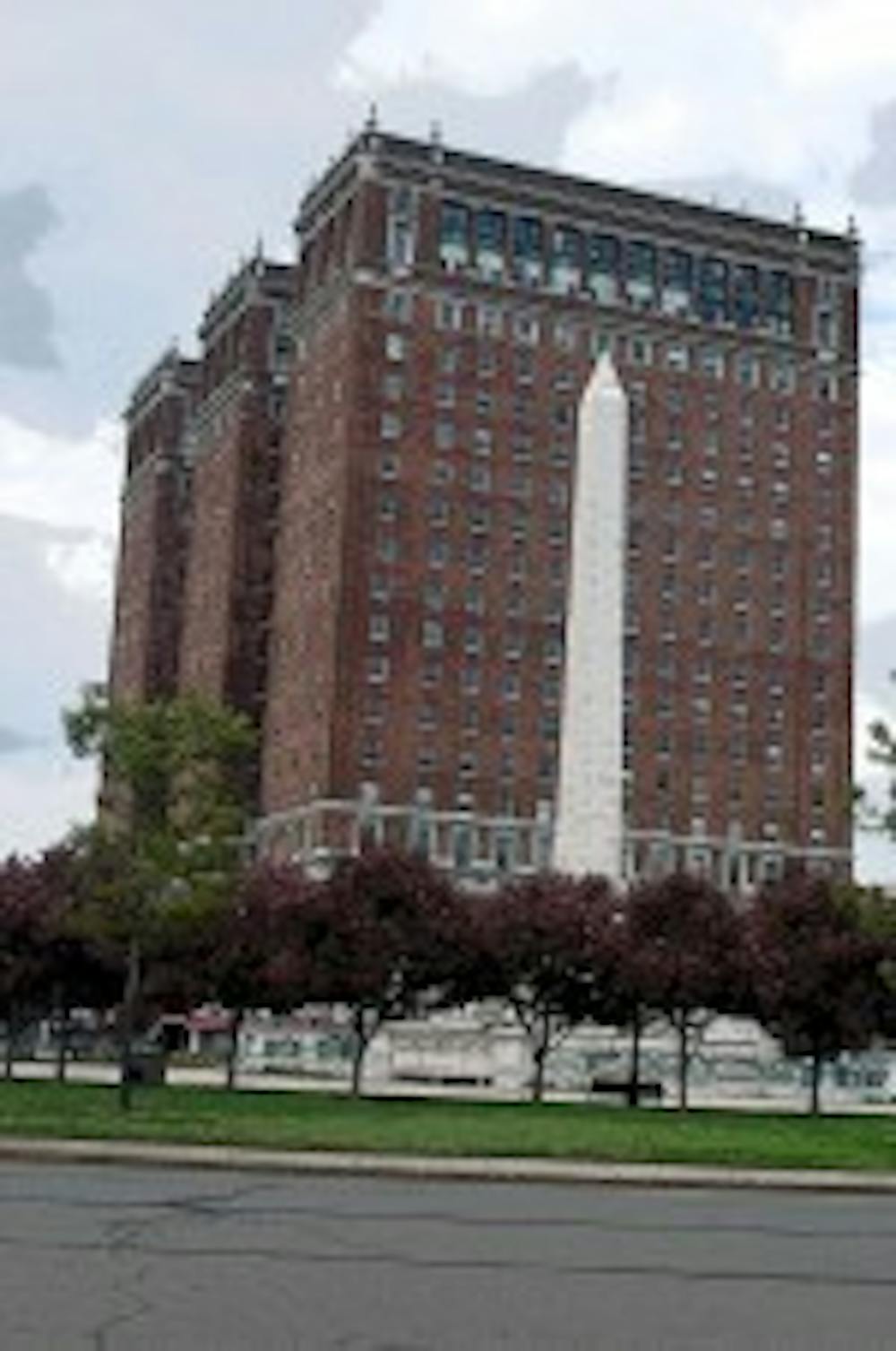
The Statler has been nominated by Preservation Buffalo Niagara to the list of America's 11 Most Endangered Places.
There has been a lot of attention concerning the recent bid made by Mark Croce and his business partner James Eagan of the Statler City LLC to take ownership of the Statler Towers, which has been in a state of financial limbo for the last 26 years.
The Statler Towers is an abandoned, 77-year-old, 800,000-square-foot, art-deco-style building in Niagara Square. Its history has made it a monument in downtown Buffalo.
Croce and Eagan have already announced their desire to invest in the building, which was originally an illustrious hotel at a time when Buffalo was at its economic peak.
Croce and Eagan are now waiting to receive government aid to begin repairing the Statler Towers' lower floors and start restoring the building from the ground up.
The project will require at least $5.2 million just to stabilize the structure. Croce and Eagan are waiting for financial help from the city, which would include waiving unpaid property taxes, to start administering the renovation.
"The building is in a state of disrepair," Croce said. "We certainly don't want to demolish this historic building. We're going to install a long term plan to stabilize [the] iconic [Statler Towers], identify safety concerns to be dealt with, and start renovating, so [that] we can, someday soon, make it open for the public."
Croce, a local developer, restaurateur, and businessman, currently owns restaurants, nightclubs, and other properties throughout the city, including the Buffalo Chophouse, Darcy McGee's, and Laughlin's. Croce considers his business a "labor of love" because of the significant amount of energy he invests in keeping Buffalo's historic restoration alive.
The Statler Towers was built out of a vision of Ellsworth Milton Statler, a shrewd businessman and hotel chain owner.
Statler had built several temporary hotels in the early 1900s, including one for Buffalo's World Fair, the Pan-American Exposition, in 1901. His endeavors yielded a small profit and provided keen business skills, inspiring him to build his first permanent hotels that offered clean, comfortable, and moderately priced rooms to the standard traveler. His hotels were the first to provide running water, a private bathroom in every room, and Statler-brand stationary for each guest.
Statler's success inspired a chain of Statler hotels with the same intent of overnight luxury for the average traveler in other growing cities, including Los Angeles and Dallas.
Buffalo's Statler Towers was built in 1923 as one of E.W. Statler's first permanent hotels, and it was then called the Buffalo Hotel Statler. It was the second hotel that he built in Buffalo after he sold his first hotel in the 1920s, and it was later re-named Hotel Buffalo.
When the Hilton hotel chain bought the building in 1954, only part of it still housed the hotel rooms, as the rest of the structure had been converted into offices.
It was later re-named the Statler Towers in 1984, when the hotel rooms were closed down and only three public rooms remained open. Those rooms were used for public events and banquets.
During the 1920s, the Statler Towers was considered one of the most modern hotels. The building used automatic machine billing for patrons and boasted innovative indoor plumbing, with an interior reminiscent of a grand royal palace modeled after the Italian Renaissance.
The main lobby of the hotel was opulently adorned with Botticino marble and 28-foot-high arched ceilings. The hallways were filled with tapestries, velvets, mohairs, large and striking chandeliers, and Ispahan-Persian rugs.
Nick Musso, a junior art and art history major, attended his senior prom at the Statler Towers in 2008, two years before the lower floors were closed.
"I remember it was a really rich and enchanting atmosphere," Musso said. "With soft lighting and big chandeliers, it easily romanticized the occasion."
Croce states that the renovations include trying to preserve the genuine vision of E.W. Statler. Croce would like to restore the building to its intended state and rejuvenate its former striking appeal.
Morris Horwitz is the bankruptcy court trustee in the Statler's Chapter 11 bankruptcy case. Horwitz is enthusiastic about the renovation and hopes the bankruptcy estate will be freed of the building's tax liability.
"What we've found through talking to people is that everyone has a connection to the Statler," Horwitz said. "Whether they were married there or went to a dance there, everyone's life has somehow touched the Statler. It's our anchor to Buffalo."
E-mail: news@ubspectrum.com



