
Thousands of students every year make the choice to live off campus and not on university property. But the choice comes with many risks.
The houses in University Heights, the neighborhood in the area surrounding South Campus, are years old and can be full of problems that newer houses don't have, such as faulty wiring, lack of smoke and carbon monoxide detectors, and other unsafe living conditions. These problems, if not addressed, can lead to even bigger problems.
In an effort to improve the housing conditions for all students, UB and the City of Buffalo have joined forces to inspect houses in the Heights and to start holding landlords more accountable for violations.
Andrew Wiktor, former editor in chief for The Spectrum, published an article last April that brought the safety issues within the Heights to public attention. Ryan noted that this was one of the factors driving the push to inspect more student houses and make sure students are safe.
"When he first started working on the article, we hadn't done any blitzes yet," said Dan Ryan, director of off-campus student relations. "By the time he published [the article], we had started the blitzes. I think it did a lot in terms of raising awareness among the students and it made the students that much more willing to let us in to take a look at the apartments. A lot of students see tragedy happen and think it's not very closely related to them, but when they see it happen to fellow students, it strikes a chord."
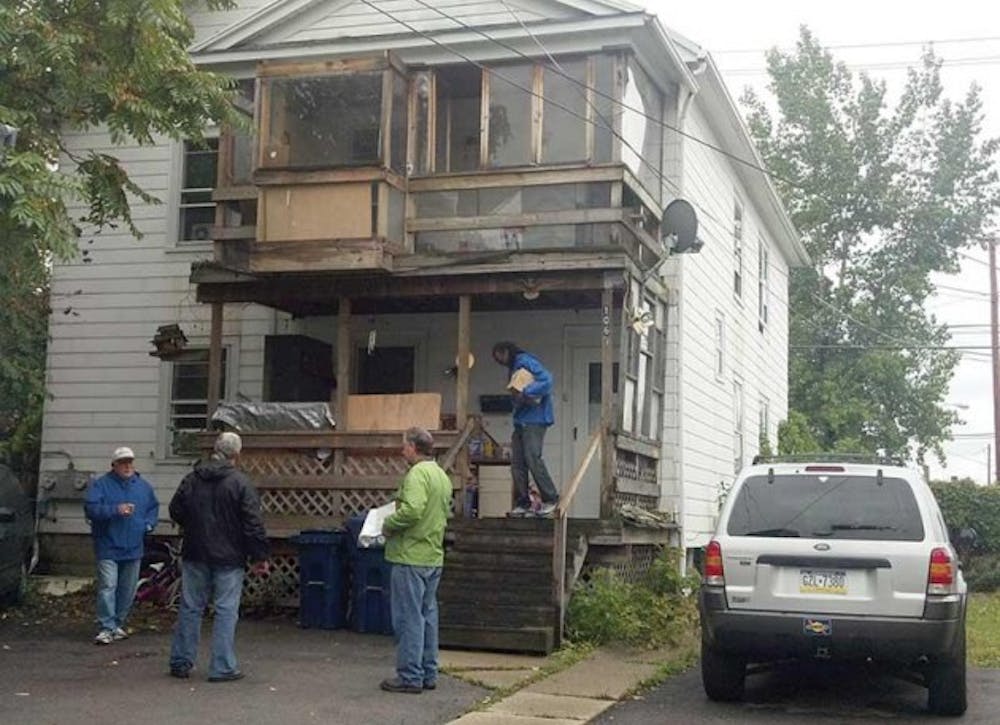
The latest round of inspections was held on Saturday on Minnesota and Lisbon Avenues.
"We're trying to get out and see as many students as we can and get inside the apartments and take a look," Ryan said. "We're predominately looking for safety violations, although any complaint students have, they can share it with the building inspectors and they'll take a look at it."
Ryan – along with Lou Petrucci, chief building inspector for the City of Buffalo, and his team of five to seven inspectors – has done six inspection rounds to date, and will continue to inspect as many houses as possible to make sure students' houses are up to city codes. The main objective is to not only inspect the outside of a home, but the inside as well.
"It's easy to go by and look and see a broken window or peeling paint here or there, but the more dangerous problems are the ones you can only see from getting inside," Ryan said.
Before each round of inspections, Ryan sends out a warning email telling students when inspectors will be in the neighborhood and to be available to let them inside. Students who have updated their addresses in the HUB, as per university regulations, and are living in the Heights will get an email detailing when inspectors will be present on their streets. Additionally, students have the option of calling in a request for inspection if they notice problems within their houses.
Petrucci stressed that students should always make sure that inspectors present a badge or City of Buffalo identification before entering any home, and if they are unable to present a valid form, students should not allow entrance.
Inspectors have a list of common problems to look for inside the houses. The first question inspectors ask students is whether or not they have functioning smoke and carbon monoxide detectors.
"We are always going to ask if they have sufficient smoke detectors; there should be one inside each bedroom, and there should be one in the hallway outside," Petrucci said. "And on the lowest level where sleeping occurs, they should have a carbon monoxide detector."
If students are lacking smoke detectors, Off-Campus Student Services is able to provide detectors free of cost.
Inspectors are also looking for electrical problems, if all outlets are operable, if windows and doors open and lock, if plumbing is adequate, and if students are sleeping in proper conditions and not in basements or attics.
Ryan stressed that they are not looking for aesthetic problems.
"One of the things I said in the email [is] we're not looking to see if there's pizza boxes laying around, [and] we're not checking to see if you made your bed or washed the dishes or if there's paraphernalia lying around," Ryan said.
He also added that they're not going to write up students for having beer bottles or red cups from parties lying around; the inspections are solely for health and safety violations.
Students have been willing to let inspectors in to their homes, and many have even called to place inspection requests, according to Ryan. He added that he could count the number of students who refused inspectors access on one hand.
Jonathan Spergel, a junior business major who lives on Minnesota, heard about the inspections and called Off-Campus Student Services.
"I called them because my TV blew out twice and I wanted to see if it was an electrical problem and not just the TV," Spergel said. "They said there were problems with my outlets, so it's good that I called. I know that there are problems, and they're going to do something now with my landlord."
Casey Bok, a senior geography major, also lives on Minnesota, and was visited by inspectors during their sweep of the street.
"[Inspectors] just came and knocked on the door," Bok said. "I knew about it through an email they sent out, so I knew that people were going to be around. It's free; [students] might as well [take advantage of the inspections]. These old houses come with old problems, and you don't know what could happen. Just look at the house that burnt down last year just across Main Street."
Petrucci and Ryan also stressed that unless the problem has to do with housekeeping or cleanliness, the responsibility for violations falls on the landlords, not the students. The landlords are notified of any violations after the inspection and are expected to respond within a set amount of time. If the landlords fail to respond, the case will be brought to city court, according to Petrucci.
Inspectors noted that many violations have been minor or nonexistent, and most often, the exterior of the property is in worse shape than the interior. But the main objective is to catch violations before they evolve into serious problems, according to Ryan.
"One of the biggest areas of concern [in the Heights] is safety…but it doesn't take just those fires to let you know that students are living in unsafe conditions," Ryan said.
Off-Campus Student Services and the City of Buffalo will continue to perform inspections on homes within the University Heights. Students will receive an email detailing when the inspections will take place.
Email: news@ubspectrum.com



