
In its first year organizing the UB Council election, the Office of Student Life was hoping to break a trend of uncontested elections.
Nearly 2,000 petition signatures later, six candidates are on the ballot to replace Jennifer Tuttle as the sole student representative on the Council.
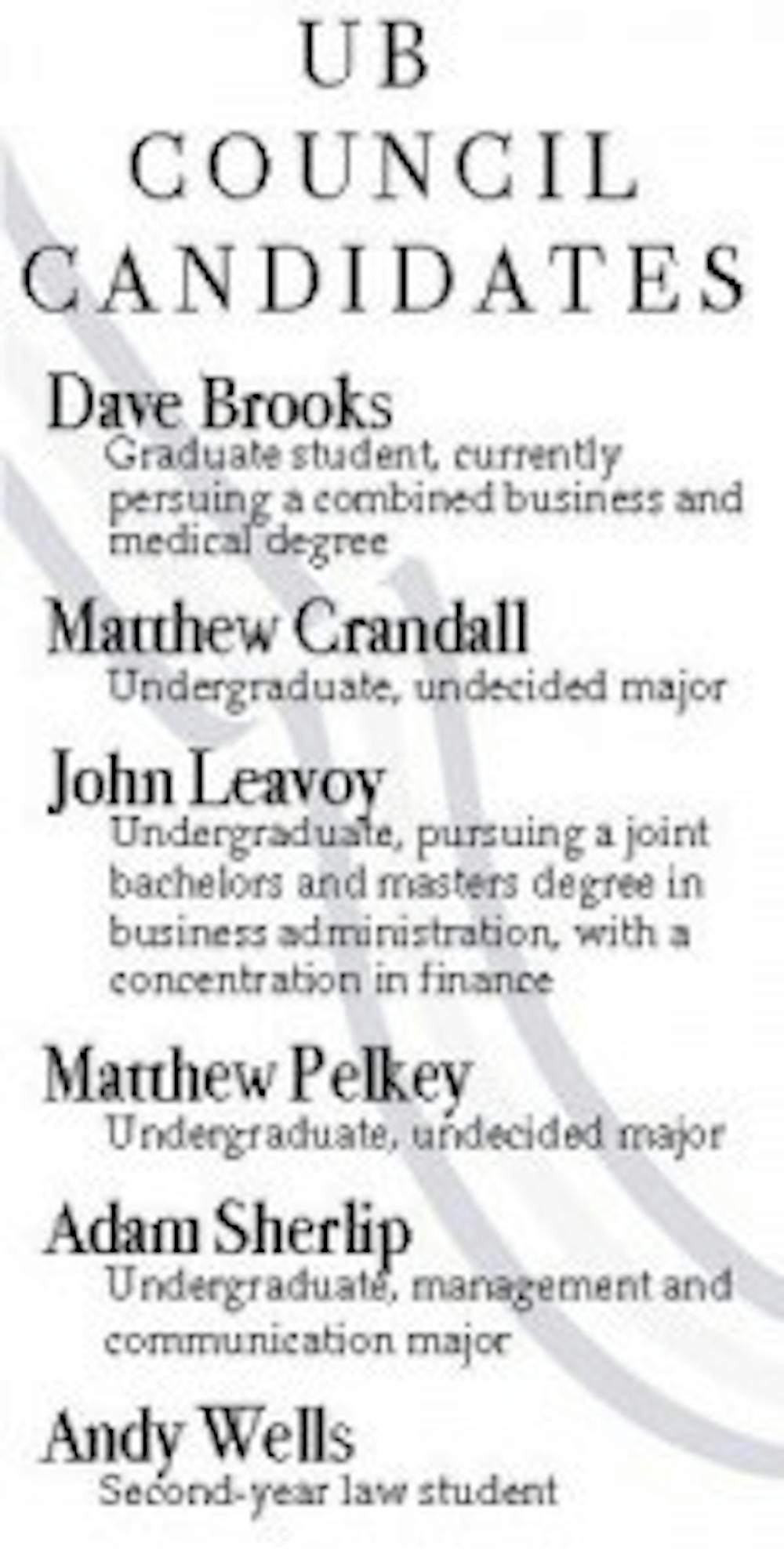
The candidates come from a variety of academic programs and backgrounds. Candidates Dave Brooks and Andy Wells are graduate students, while candidates Matthew Crandall, John Leavoy, Matthew Pelkey and Adam Sherlip are undergraduates.
Brooks has served as president of groups including Medical Student Synergy, the Medical Business Club and the Integrative Medicine Club.
"They make and evaluate important plans and budgets, and I have the business and technical knowledge to make a difference," Brooks said.
Brooks has a bachelor's degree in applied economics and management from UB. He has returned to pursue a combined medical and business degree.
Candidate Matthew Crandall, a freshman undecided major, said he feels his greatest quality is his character. A former Eagle Scout and an active volunteer, Crandall said broad ideals can be applied to an organization such as the council.
"I believe you should always be involved in things you are proud of and things you want to change. The UB community is something that I'm proud of," he said.
Andy Wells, a second-year law student vying for the position, is the sole candidate with military experience. A Staff Sergeant in the U.S. Army Reserve, he was deployed in Bosnia-Herzegovina in 1999 as part of Operation Joint Forge, and has participated in peacekeeping missions throughout Europe and the Middle East.
His experience, however, isn't limited to the military.
"I worked for the U.S. attorney's office last summer," Wells said. "I have a lot of experience both in the business world and the legal world."
John Leavoy, an undergraduate pursuing a joint bachelor's and master's degree in business administration with a concentration in finance, said he feels one of the aspects that makes the position so appealing is its independence from the politics of other student organizations.
"Other groups at UB have the same old issues, the same people and the same turnover year to year," he said. "The council gets away from that."
Current College Republicans President Matthew Pelkey, a sophomore political science and economics major, said he has a well-rounded base of experience to work from that would suit the position well.
"I have a wide range of experiences at the university from Student Life to clubs and athletics," Pelkey said. "I've had my hands in a lot of things, and that gives me a diverse background."
Adam Sherlip, a sophomore management and communication major most visible on campus as speaker of the SA Assembly, said he feels the council is a good chance for him to effect change.
"They're the ultimate administration, and I believe in the betterment of UB," he said.
Sherlip has also served on the Food Service Advisory Board and UB's Alcohol Review Board.
One of the most popular issues among the candidates was UB's parking problem.
"I've talked to a lot of students - both undergrads and grad students - and I hear complaints about parking over and over again," said Wells.
Candidates also discussed ways to bolster on-campus safety for the students - including strengthening the Anti-Rape Task Force and emergency phone systems - and stressed the importance of financial responsibility among student organizations, with financial transparency allowing the students to see exactly where their tuition dollars are being spent.
According to Student Activities Associate Jennifer Wantz, this year's increase of interest in the elections can be attributed to better promotion.
"We have had more fliers and more advertisements in The Spectrum this year than in previous years," said Wantz. "We also have been lucky to have great student government representatives who went back to their constituents and told students about University Council and they could do to make a difference."
Students are now able to access the voting system online through their UBlearns account. There, students can read the platforms for each of the candidates, and can submit their votes electronically.
Online voting was praised by some of the candidates, including Brooks, because it had the potential to get new students to participate.
"I'm hoping more people vote, because it's just more convenient for everybody who is interested," he said.
Leavoy said that online voting compromised the candidates' campaigns.
"Because of the online voting, there is not chance for a formal meet and greet with the candidates," mentioned Leavoy.
According to Wells, online voting could entice the candidates to break rules that prevent them from staying a certain distance from a polling place - areas that now could include libraries and computer rooms.
"The rules for voting are outdated, as far as online votes are concerned," Wells said. "With computer voting, they need to amend the rule about candidates staying 50 meters away from a voting place."



