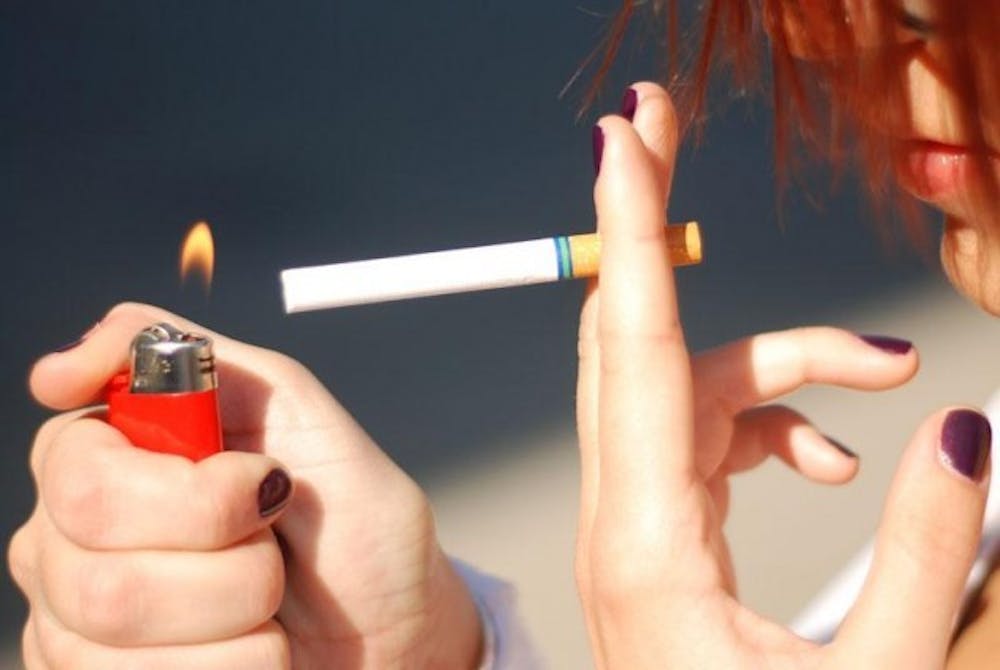
Danielle Villi, a junior communication major, grew up worried for her parents' health. They were frequent smokers and Villi would crush their cigarettes whenever she could. Now, though, three years into her college career, she has become a fellow smoker.
"I would crush their cigarettes, I would throw them out," Villi said. "Finally they quit, but [then I] started, and I don't want to blame them and say that they're a bad influence, but I guess I just grew up around it so I thought it was okay."
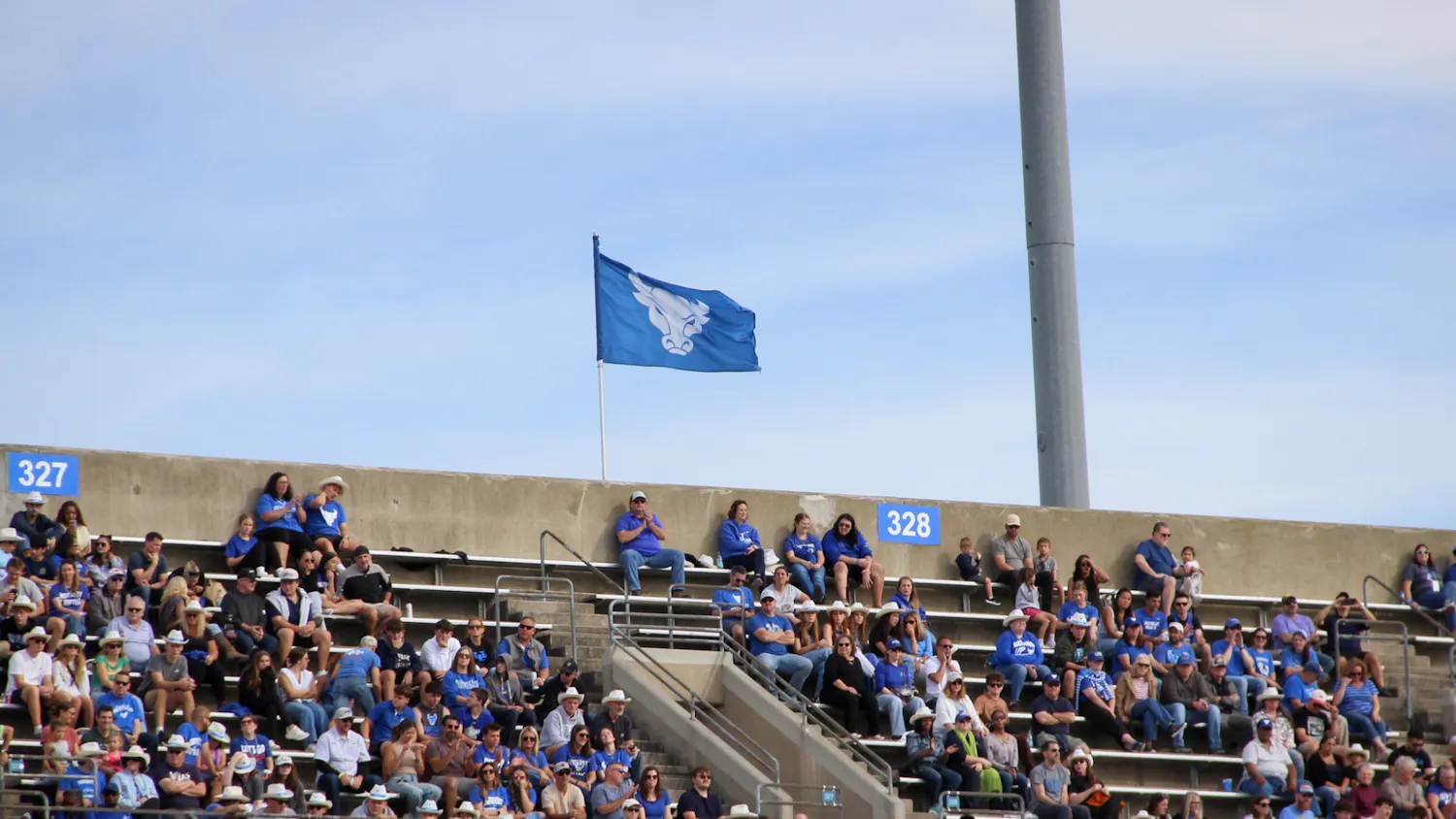
UBreathe Free, which was suppose to ban cigarette smoking on UB's campuses, was instituted in 2010 with the hopes of providing a cleaner and healthier campus for students, faculty and staff. But just one look around and it's easy to see that it's a hazy situation.
Seventy percent of the tars in cigarettes stick to the cilia in a smoker's lungs. This tar, similar to the tar used to pave roads, destroy the cilia and leaves the lungs more open to dangerous substances, such as cancer causing chemicals, according to Ruth E. Stuettgen, a quit-smoking specialist.
"I never thought it was gross," said Samantha Hochstein, a freshman communication major. "I never was the girl who looked at smokers and said, ‘Oh why are you doing that? It's going to mess up your lungs.' But when I first tried it, I thought it tasted disgusting. [But] since I kept doing it, I got more used to it."
Most college students start smoking for the social aspect that cigarettes bring them, according to Sharlynn Daun-Barnett, UB's Alcohol Tobacco and Other Drug Prevention Specialist.
"Just when [students are] out, maybe having a drink or relaxing with friends who might also smoke, they'll have a cigarette, and they don't consider themselves smokers," Daun-Barnett said. "Maybe they just drink alcohol and smoke, but soon the two pair, and because it's so addictive, they start buying their own pack. This eventually leads to them being daily smokers."
In Hochstein's case, friends were the primary cause of her early smoking career. Claire Chapin, a freshman at SUNY Albany, is Hochstein's best friend that shared her first cigarette with her during their junior year of high school.
"[Claire is] someone who can smoke two packs a day if she wanted to," Hochstein said. "She will have a cigarette at any given point in the day. When she has a spare five minutes, she will go have a cigarette. And if she has a spare seven minutes, Claire will tell you it takes her seven minutes exactly to smoke two cigarettes back to back. So of course when I'm with her and she says, ‘oh wanna go outside?' I'll smoke more…I smoke more when I'm with people who smoke."
Although Hochstein's best friend from her hometown endorses her smoking habits, her parents attempt to inhibit them. Hochstein's parents have found empty packets of cigarettes in her garbage and around her room, and have seen pictures of her holding cigarettes on Facebook. Tammy Hochstein, Hochstein's mother, dealt with her own father passing away from a smoking related disease when he was only 50 years old.
"She'll say [to me], ‘someone so close to me died because of smoking, and I can't imagine losing someone else from the same thing'," Hochstein said. "It [affects me] and…I think about it when she's telling it to me, but it's the same thing like when your mom tells you ‘always wear a helmet when you ride your bike', and you still go out and you ride your bike without a helmet, even though you know she's telling you for a good reason and you know the dangers of not wearing a helmet."
Hochstein does not consider the relationship between herself and her cigarettes as an addiction.
"I think it's almost out of habit. In high school it was the same times; I would smoke right when I got out of school and right when I got out of work, and it just followed me here," Hochstein said "I usually [smoke] right after all of my classes are finished, and then probably right after work, and then mostly on weekends."
Hochstein believes that the reason why she continues to smoke – although she says she is not addicted – is because it makes her feel comfortable following the same routine that she followed at home.
"I know when my dad [who was a smoker for 32 years] quit smoking [two years ago], he would tell me the hardest times were in his car," Hochstein said. "You even still see his hand hanging out the window as if he had a cigarette in it, just because that's how it was since he first started driving 30 years ago. Moving from home to college, I smoked at the same times, it's like a safety blanket from back home, it's comforting."
Hochstein needs the five minutes a day that she takes to herself after her most stressful periods, and according to her, would feel uneasy if she stopped doing that. She takes her smoke breaks either right outside of the Student Union or on the terrace of Ellicot Complex.
"I don't know if UB actually enforces a smoke-free campus," Hochstein said. "The signs say they encourage a smoke-free campus, but it doesn't really affect me."
In 2009, the campus became smoke-free when a group of public health students thought it was best to be proactive in encouraging a healthier lifestyle. The UBreathe Free team attempted to create a place where people could go to class and get an education without being smoked on, according to Daun-Barnett.
"It's not strictly enforced because we can't enforce it with the union," Daun-Barnett said. "The unionized employees don't have it written in their contracts and the Vice Presidents here don't want to enforce something on the students that they don't enforce on the employees because that would not be fair."
UB tried to create six designated smoking areas for students. However, national research proved that designated smoking areas did not work on such a large campus. It cost too much money to create enough designated areas for smokers, and the university could not afford it.
Without an administrator standing at every popular smoke area, enforcing the rule, smokers have to look within themselves to find the respect to not pollute the air, according to Daun-Barnett.
"The bigger thing that people say is to just have a blanket respect policy, where a lot of it is just self-enforcement," Daun-Barnett said. "Just like wearing a seat belt [and] getting immunizations, a lot of public health things come about that way for the greater good of people."
Villi usually stands outside of Capen Hall, one of the old six designated areas, to have her cigarette. What started as a means to deal with stress developed into a bigger issue for her.
There are many health risks that come from smoking cigarettes, and Villi never actually suffered from them in high school, "because at that age you think you're invincible," Villi said. However, recently, she has noticed a major change in her body.
"I used to be a runner; I used to run 11 miles a day and all my friends knew that I loved to run," Villi said. "Now I cant even run a mile without getting out of breath, I can't even walk up the stairs without running out of breath, it's so bad…I see how bad my health is now. My metabolism is messed up."
Villi is attempting to cut down because of her health issues. She used to smoke about half of a pack a day and now it takes her approximately one week to finish a pack.
When she first started smoking, she hid it from everyone she knew, even her parents.
Villi explains how her parents' teeth are practically falling out and they've even formed a permanent wheeze. She was embarrassed by her smoking habits because she knew what it felt like to be on the other side of not smoking and asking her parents to stop. She went from smoking only at night, to craving cigarettes during the day, and that's when she realized that she had an addiction. But she didn't have the desire to turn back, she said.
"I'm embarrassed when I smoke," Villi said. "I hate the people that smoke to be cool. That's what I used to do. But now it's an actual problem…it's insulting. I actually can't stop, I have a serious health problem, I have an addiction, and it's like, why are you even trying to start to be in a crowd? You don't need to have to smoke a cigarette to be in a conversation with someone."
Most people decide they want to quit smoking when they realize that their cigarettes are beginning to control them, according to Daun-Barnett.
Villi realizes that the tobacco has been taking control over her life since her senior year of high school. She wants to begin taking steps toward quitting.
"I think I'm going to start going to the gym more, maybe once I get more focused on running, I won't want to light up a cigarette every second," Villi said. "I went to the doctor a lot lately and I've noticed my health problems. That's a big enough sign to make me want to stop."
Smoking not only burns a hole in lungs, but it also burns a hole through wallets. Hochstein spends up to $70 a month, which is approximately 20 percent of her bimonthly paychecks. Villi spends $80 out of the gas money that her parents give her per month, on cigarettes.
"Campus makes it very easy to get cigarettes," Hochstein said. "[UB] encourage[s] a smoke-free campus, but you can go buy cigarettes at the CVS on campus. You can even go as far as using campus cash that your parents put on your UB card. Granted, I don't have campus cash but I'm sure if I did, that's what I would spend it on. If my parents could buy me my cigarettes, I would make sure that happened."
Before UBreathe Free policy went into effect, the committee got the vendors on campus to stop selling cigarettes. However, because The Commons is not campus property, the committee was unable to get CVS to stop selling cigarettes.
"I don't have a car; none of my friends have cars. Going off campus would be such a hassle because we have such a big campus," Hochstein said. "You'd literally have to take the bus to off campus and take the bus back. I'm lazy, I'd choose not smoking over doing that."
Getting rid of cigarettes in CVS would stop a lot of people from smoking because the cigarettes would not be as available, according to Hochstein.
"CVS said it wasn't in their control; it was a corporate decision to sell the cigarettes," Daun-Barnett said. "Students got 600 or more signatures to try and get them to not sell cigarettes on campus. The committee on the faculty staff level also tried to get them to stop, but that didn't work either."
UB is a smoke-free campus, but most smokers fail to follow the policy. Most UB smokers start purely for the social attention, and end up becoming addicted, according to Daun-Barnett.
Email: features@ubspectrum.com
 Photo: Wikimedia Commons | Courtesy of Quintin Soloviev