
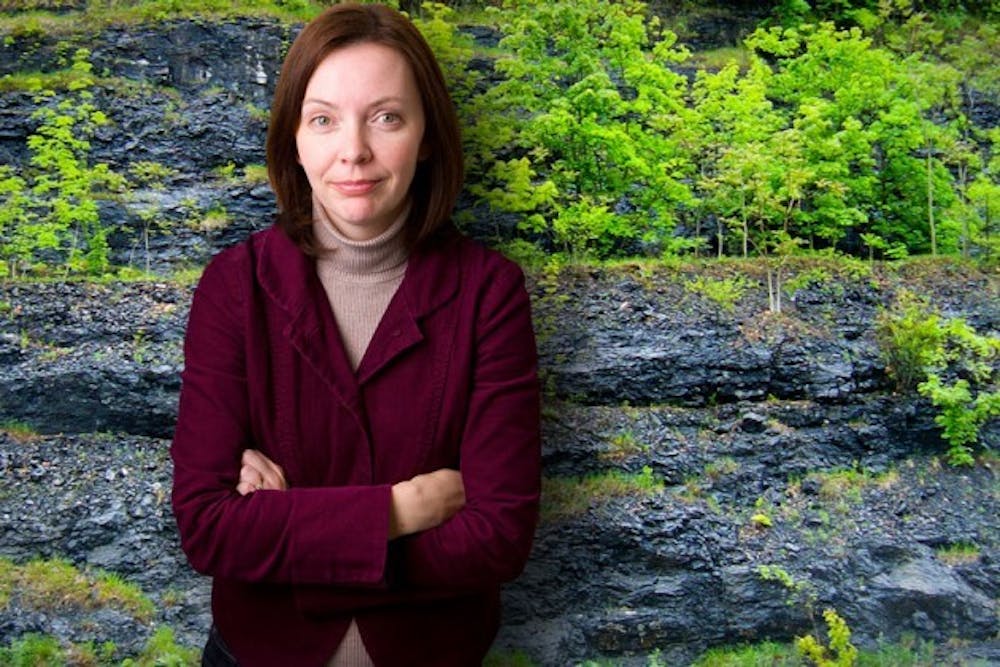
According to local anti-fracking activist Clifford Cawthorne, clean water is a human right.
Local "anti-fracking" activists are concerned about the issue of hydraulic fracturing, or "fracking," as it is commonly called. Activists argue that fracking is extremely threatening to those who live in proximity to the operation because it leads to hazardous conditions.
Fracking is a drilling technique used by gas companies to extract natural gas. The technique involves horizontally injecting millions of gallons of water, sand and proprietary chemicals into a drilled well.
The fluid is then pushed through the drilled well, creating a high-pressure state that forces fractures into the shale, like a mini-earthquake. The result allows for natural gas extraction.
Gas companies have adopted these techniques all over the world. From downstate New York all the way down to West Virginia, fracking is used to extract natural gas from the Marcellus Shale a couple of miles under the Earth's surface.
Samples of the Marcellus Shale have been a subject of research for Tracy Bank, an assistant professor of geology at UB who presented the research earlier this week to the Geological Society of America.
Over the course of two years, Bank and her team of researchers studied fluid-rock interactions from samples of the Marcellus Shale from Pennsylvania and Western New York areas where fracking occurs. From these samples, uranium, a metal that is naturally released from the rock, was found.
Bank says that drilling to extract hydrocarbons could start mobilizing the metal uranium from fluid-rock interactions during fracking. There are environmental concerns about whether the occurrence of uranium solubilizing is hazardous and whether it could enter streams, lakes, riverbeds and drinking water.
"[Uranium] is very weakly radioactive, but it is toxic even if not detected with a Geiger counter," Bank said.
A Geiger counter is a particle detector that measures objects for HYPERLINK "http://en.wikipedia.org/wiki/Ionizing_radiation"ionizing radiation.
Bank would not comment on whether "fracking" is potentially dangerous, stating that more scientific research needs to be done on the dangers of these drilling operations.
"[My research shows that] uranium is being mobilized by fluid-rock interactions that occur very deep below the surface," Bank said. "The fluids into which uranium is being solubilized are closely controlled and not likely to ‘leak' into groundwater. I have not tested uranium in air or water samples."
The process of contamination as a result of fracking is already in effect, according to Lawrence Beahan, conservation chair of the Niagara Frontier Group of the Sierra Club.
Beahan has completed writings on the political history and environmental dangers of fracking based on the research conducted by Chris Bruger, chairman of the Binghamton Sustainability Coalition.
Beahan argues that "frack water" contains a number of substances, including diesel fuel, benzene, industrial solvents, and other unknown chemicals. A number of these chemicals are carcinogens and endocrine disruptors.
"[When the ‘frack water' is pushed down], aquifers are penetrated and [the water running through the aquifers are] in danger of contamination," Beahan argued in an Aug. 21 piece for The Buffalo News. "The fracking water that returns to the surface is contaminated further by radioactive saltwater from [underground]."
Frack Action, a non-profit anti-fracking activist organization, also states that without a doubt, fracking is extremely hazardous and that there have been over a thousand cases of groundwater contamination near fracking sites.
"Of the fluid pumped into areas where fracking occurs, only half is removed by the gas companies, and the rest [is left in the earth]," said Rita Yelda, organizer of the Buffalo chapter of Frack Action.
According to Frack Action, 596 different kinds of chemicals have been identified in "frack fluids." Gas companies will not release the names of these chemicals, but independent researchers have identified many of them.
Along with the issues regarding chemical fluids, environmentalists are concerned with the millions of gallons of water needed each time the fracking procedure is performed in any of the 10,000 wells deep in the Marcellus Shale.
Environmentalists are also concerned about the traffic of heavy drilling machinery, which leaves a large footprint in the environment after the grand-scale operation of fracking is performed.
The issue of fracking has recently sparked interest in the media because of the film Gasland, directed by Josh Fox, recently awarded at the 2010 Sundance Film Festival. Gasland won the Special Jury Prize for Best U.S. Documentary Feature. The film highlights the environmental concerns of the externalities of fracking through striking clips of firsthand accounts of dejected U.S. citizens showing contaminated water and flammable gases being released from their faucets.
Gasland shows that in 2005, Halliburton persuaded the government to exclude hydraulic fracturing from the Environmental Protection Act, stating that there wasn't enough evidence that contamination was in well water. This is known as the "Halliburton Loophole," and gas companies have continued to use fracking ever since.
Yelda encourages anyone advocating for safe environmental conditions to act against fracking.
"Buffalo could be at risk for [hydraulic fracturing], as it is located on Marcellus Shale and Utica Shale," Yelda said. " I encourage anyone to pressure the [New York] Assembly…and [Buffalo City Council] to put a ban on hydraulic fracturing."
E-mail: news@ubspectrum.com



