
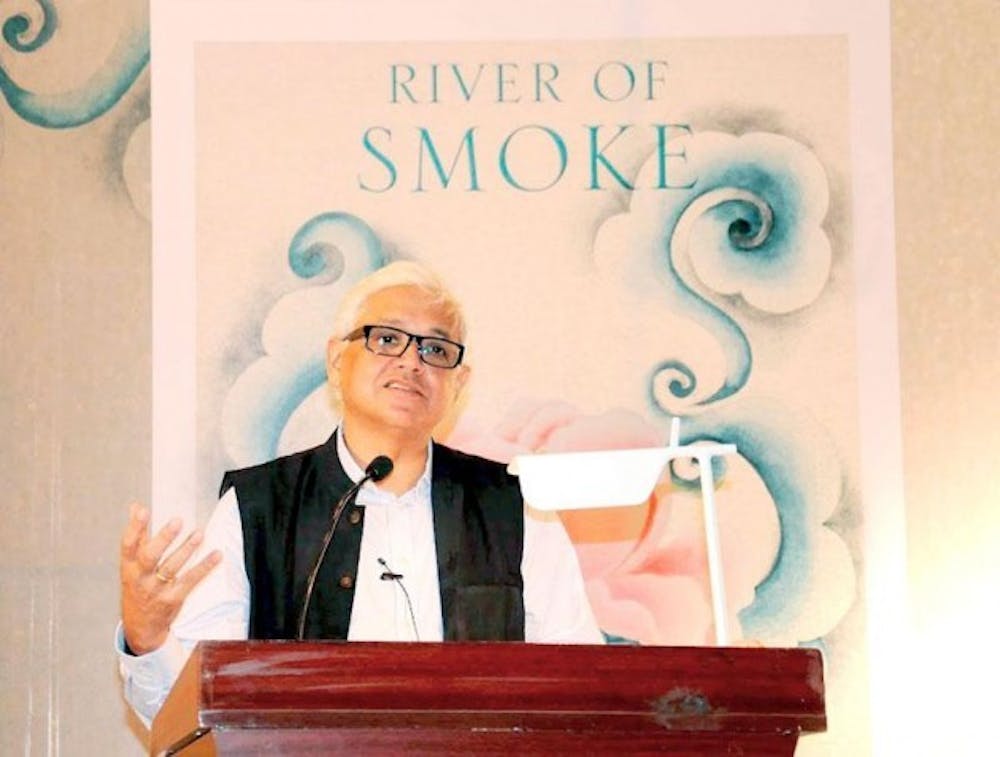
For over an hour, writer Amitav Ghosh captured UB's attention as he painted a picture of Guangzhou, China caught in the center of the opium trade in the 18th and 19th centuries.
Ghosh is an internationally renowned author from West Bengal, India and the recipient of many prizes for his books of historical fiction, which are set in Asia. His most recent work is River of Smoke, the second in the Ibis trilogy after Sea of Poppies.
On Monday night, he visited UB for a lecture entitled "The World's Emporium" in Lippes Concert Hall in Slee Hall.
"It is a place that has vanished from modern memory," said Ghosh, referring to Canton, now known as Guangzhou, located in the southeast of modern-day China.
Eighteenth-century Canton, the setting for River of Smoke, was the destination of ships sailing from India. The ships carried large quantities of opium, which was used by the British to pay off the deficit it had incurred through the purchase of tea and other goods from China. The trade eventually resulted in the two Opium Wars of the mid-nineteenth century, which ended with the burning down of the industrial region of Canton.
Ghosh's address was part of the "Fluid Culture" series held by UB's Humanities Institute. The series "focuses on water, globalization and culture to better understand, analyze and critique the increasingly fluid world we live in."
Connecting his lecture to the themes of culture and globalization, Ghosh spoke about modern-day parallels to China's situation. While he felt the situation in Afghanistan was different because the drugs there are not state-sponsored as they were in China, he saw a similar situation in the "burgeoning of prescription drugs - which is America's substitute for discipline" in schools.
Ghosh drew a vivid picture of the "Thirteen Factories" region of Canton during the 18th and 19th centuries. Each factory was associated with different countries like Britain and the U.S., and they together housed merchants from all across the world. The roads running between these factories bustled with shops and bazaars, and Ghosh speculated that the tradition of making curios and souvenirs originated from here.
The factories housed varied industries like western furniture shops and "image making" industries, which created portraits. Often, these industries produced their goods much more efficiently and at a lower cost than their Western counterparts of the time, according to Ghosh.
Anecdotes from the sailors' lives helped to make their stories more interesting for the audience.
"Every time aship crossed the equator, people who hadn't crossed it before went through a sort of hazing ritual," Ghosh said. "A sailor would dress up as Neptune, and the people would be caught, tied up and dumped in a barrel of horrible things [in a ritual known as] 'crossing the line.'"
In addition to giving the lecture, Ghosh also spoke to students in an informal gathering led by English Professor Walter Hakala on Monday morning at Norton Hall. The meeting provided an opportunity for students to ask questions about the use of language in Ghosh's novels, and the effect of his training as an anthropologist on his novels and projects he is currently working on.
Asked about the creative process that allows Ghosh to translate historical facts into the fictionalized worlds of his novels, he said:
"A story begins with a character, the people. This leads me to ask 'where did he live?' [and] 'what did he eat?' It is a question that historians often do not ask - 'What was it to be like there at that time?'"
Email: news@ubspectrum.com



