
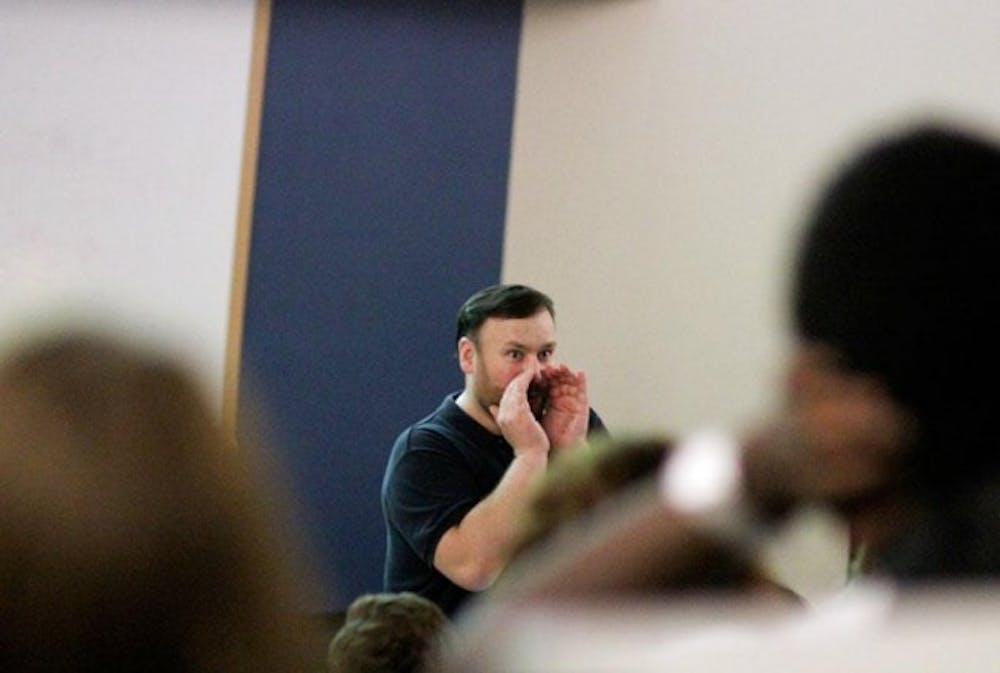
Students looked to the front of the class. Some judged her, while others grew embarrassed as they realized why she looked so familiar. A porn star was standing in front of the over crowded lecture hall. Lance Rintamaki, assistant professor in the Department of Community Health and Behavior, found the secret to attracting students to his class.
Rintamaki taught his first sexual communication course (COM 492) last fall at UB. It was a huge success.
Where it all began
Rintamaki was at dinner with his advisor from the University of Illinois, where he got his Ph.D. in speech communication. His advisor, Dale Brashers, whom Rintamaki considers to be one of his biggest role models, made a suggestion that altered Rintamaki's career. He suggested they write a book about sexual communication together.
Rintamaki thought about it for days.
It was when he thought about his roommate from Illinois that the decision was made. His roommate, Wesley, was a wrestler and was incredibly buff. He graduated in the top 5 percent and was very smart. He owns two businesses and is financially very well off.
"You put this all together and you think this is someone who's going to do really well in social situations," Rintamaki said. "But if you put Wesley in front of a woman that he thinks is attractive, he can't string words together into a sentence."
Wesley would call Rintamaki every other month and say things like, "All right, I just read this new book and this one's called 'Pimpology.' You have to do this and then do this and then be mean to her, and then she'll like you!"
Wesley's desperation to find advice on how to improve his sexual communication skills inspired Rintamaki to say yes to Brashers and to begin writing the book about the science behind all of what Rintamaki calls "nonsense" that most published books explain about relationships.
On July 5, 2010, Rintamaki suffered a tragic blow. Brashers had a massive heart attack in his office. He didn't survive.
Rintamaki is continuing to write the book on his own and hopes to use the proceeds to fund a scholarship in Brasher's name.
He wants to title it "Sexual Communication," because he just wants a simple title to get the point of his writing across.
"I quite literally think of [Brashers] as my second dad," Rintamaki said. "We referred to him as my gay dad because he was a flaming gay man. He was very different from my biological father but they both had these major influences on me.
"Dale was so funny. Whenever he was around everyone was happy. It's just really sad that type of presence is gone from the world. He's the reason why I'm moving forward with this book."
In Sept. 2010, Brashers was supposed to teach the first ever sexual communication class at Illinois. After his death, there was no one to teach the class 500 students had already enrolled within in the first two days of registration. Rintamaki quickly helped one of his graduate students from UB, who was attending Illinois at the time, draft up a class structure. She became the new sex communication professor.
Although she was overwhelmed and had no experience in teaching the course, her class of 500 students ended up being 1,000 - half the students just stopping by to hear the interesting lectures.
Rintamaki took her class as a foundation and knew he could improve it for the UB community. Last semester, he was proven correct.
He said he's never had a learning environment as great as the one in his COM 492 class last fall. Before the semester started, several students talked to him just to say how excited they were for his class.
Inspiration from his past
Rintamaki loves what he does. He was originally studying genetics at Michigan State, which was a very solid and financially satisfying subject of study. When he decided to switch to communication, which was more vague and unsettling, his father was nothing short of excited.
His biological father had just as strong of an impact on him as his "gay father," Brashers.
"My father grew up very, very poor," Rintimaki said. "Their home was the size of a conventional garage. Half of what they ate they either shot or caught in the river or the lake, way up in the peninsula of Michigan. His parents died young. He was taking care of his younger sisters when he went to college and worked his way up. He did really well for himself and I really admire him."
Although Rintamaki is 39 years old, his father continues to tell him he is proud of all his achievements. Rintamaki is thankful for having a family that openly supported all of his endeavors.
Support from a partner & working together
On days life becomes stressful, Rintamaki has a partner to turn to.
"It was Nov. 9, 2007, when I was first contacted by my now-partner, who was a medical student at the time, about one of my articles," Rintamaki said. "It was about why African American senior citizens aren't getting the flu vaccines and how there's a huge disparity between all of the other racial groups when it comes to getting the vaccine.
"He was working in New York City at Jamaica Hospital at the time, doing clinical rotations. So this was an issue for him because he had been receiving a lot of resistance from this population and he was poking around to find information and my paper had just come out."
Rintamaki's partner emailed him asking a couple of questions. His response was: "Bring it on." After emailing back and forth for six months, the two met in person and hit it off. They are together on and off long distance and fall asleep talking to each other on the phone at night. They both have fairly busy academic careers and use Skype to stay in touch and see each other.
Rintamaki's research correlates with and helps his partner's work, and vice versa.
Rintamaki's partner had a patient who had knee problems. He thought what was wrong with her could have been related to the quality of her orgasms, but was unsure as to how he could openly discuss that with her. Rintamaki's current research is highly involved with open communication between physicians and their patients, and thus he was able to talk his partner through successfully discussing his patient's sex life without making her feel uncomfortable.
Spreading knowledge & love
Thomas Feeley, chair and professor of the communication department, considers Rintamaki to be a rock star on campus.
"My first memory of him was his energy and excitement for research and teaching during his interview for a faculty position," Feeley said. "Faculty members aren't typically that animated, and he was elated about being a professor. It was great to see and his positive energy is contagious."
This summer he taught the sexual communication class in Singapore, where prostitution is legal, and said that an extraordinary prostitute lectured to his class. This semester Rintamaki looks forward to bringing in more guest speakers, such as lawyers, prostitutes and porn stars, for his UB students.
Feeley said he's never seen such a positive student response to a class, like the responses Rintamaki has received, in his 10 years of working at UB.
He knows expectations of his class are set incredibly high and hopes to meet all of the good anticipations. He hopes to spread the lessons he's learned: love from his partner, a good work ethic from both of his fathers and happiness.
"There are things about the ways in which [Dale] looked after his grad students that I try to emulate," Rintamaki said. "He's a really generous person. He would take people out to dinner or lunch all the time. There were times where I would feel really uncomfortable because he just wouldn't let me reciprocate it. The deal we made was that I just had to pass it forward when I became a professor. I do the same with my students."
Rintamaki is following up on his end of the deal.
Email: features@ubspectrum.com



