
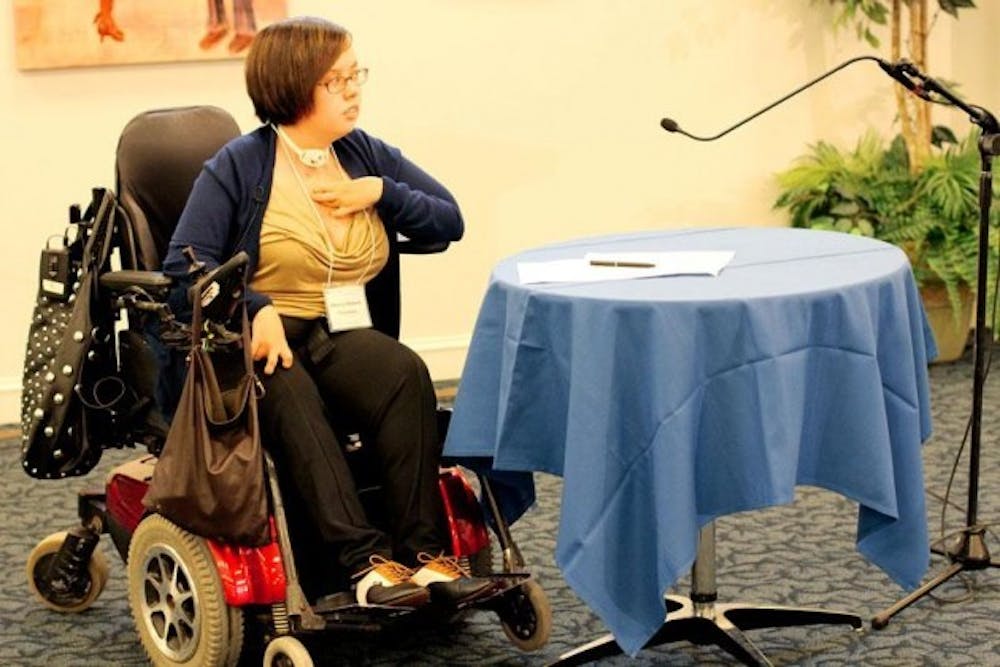
UB is making its campus more accessible to people with disabilities, and this weekend, for the first time ever, it held a symposium opening the conversation about future advancements.
This idea was the center of the "Diversity in Disability" Symposium, held on Saturday at the Center for Tomorrow from 9 a.m. to 4 p.m. UB's Office of Accessibility Resources and the Diversity in Disability Planning Committee organized the event. The symposium brought together over 100 people, including students, disability professionals, and administrators from UB and throughout the country.
David Dodge, a junior English major, served as the chairperson for the Diversity in Disability Planning Committee. Alec Frazier, Hope Supernault, and Carly Skonecki - all UB students - assisted Dodge in planning the symposium.
"The idea for a symposium started out when I transferred to UB and wanted to bring attention to the larger spectrum of disabilities," Dodge said. "I read an article in the Chronicle of Higher Education, and decided to focus on the idea of diversity instead of just access."
Dr. Tammy Milillo, post doctorate research assistant in the Department of Chemistry, delivered the keynote address entitled "Self Advocacy - Opening the Channels of Communication." Milillo discussed her own struggle with accessibility during her undergraduate years, which led her to file a lawsuit against UB. Since then, UB has worked on making its campus more accessible to people with disabilities, although it still has work to do, according to Milillo.
Ari Ne'eman, founding president of the Autistic Self Advocacy Network, lectured on neurodiversity and civil rights. He compared the exclusion disabled people face to the exclusion of African Americans and women from institutions of education and government. He outlined the unfolding of the Disability Rights Movement in the U.S. in the 20th century.
Ne'eman sought to redefine "disability" not as the actual physical or mental impairment a person faces, but as "something which emerges from the interactions between a person with an impairment and the larger society."
Ne'eman is autistic and, because of his disability, he advocates for the concept of neurodiveristy. The idea is to focus on improving the quality of life of people with neurological disorders, rather than finding the cause and cure for their condition.
"Research focused on cure aims to create a world without disabled people," Ne'eman said. "The aim is to make people less autistic, indistinguishable from others, not to make them better off."
He stressed that disabled people need to be involved in advocating for themselves.
"There needs to be a move away from doing 'for' [disabled people] to doing 'with' [them]," Ne'eman said.
Stacey Milbern, president of the National Youth Leadership Network, led a discussion with the audience about "abilism," or the stratification of society based on favoring people who do not have impairments. The discrimination disabled people face in society is similar to racism, according to Milbern.
Milbern - like Ne'eman - pushed for an inclusive, liberating definition of disability.
"People with disabilities often have ingenious and brilliant ways of coping with the world around them," Milbern said.
Milbern looked to the audience for suggestions on how improve the integration of disabled people into the wider community. She referenced The Spectrum's article, "A Shameful Low in Higher Education," which revealed UB's lack of compliance with the Americans with Disabilities Act. Milbern stressed that everyone needs to make an effort to enable diversity in classrooms and the community.
A panel including students from UB discussed issues like wider awareness about disabilities and how language used to refer to disabilities is sometimes demeaning.
The symposium also featured resource tables with representatives from organizations like the Museum of Disability History; UB Wellness Education Services; and UB's Office for Equity, Diversity, and Inclusion; among others.
The symposium provided an opportunity to understand "the personal experiences that people [with disabilities] have gone through," according to Amarja Desai, who works for the Center of Assistive Technology at UB. She also felt she gained a better insight on how people with disabilities understand their own lives.
"Disability is a good thing," Dodge said. "It shouldn't be looked at as a problem, but as an opportunity to experience things in a different way."
Email: news@ubspectrum.com



