
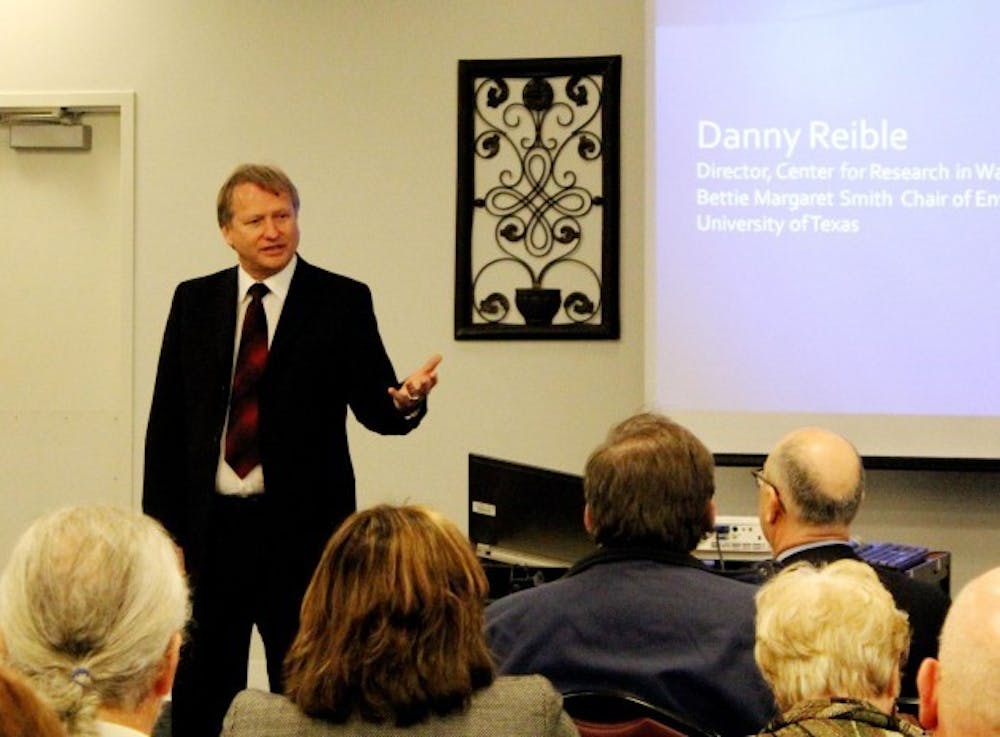
Danny Reible, the last of three provost finalists to visit UB, came here on March 9 to meet with approximately 25 faculty members and administrators in a public forum.
Reible is chair of environmental health engineering and director of the Center for Research in Water Resources at the University of Texas, where he has been since 2004.
Now that all candidates have visited, UB is now ready to select its next provost, the second-highest position at the university. In September, UB established a committee that considered candidates from many premier research institutes and across various disciplines. The finalists included Charles Zukoski, chair of chemical and biomolecular engineering at the University of Illinois Urbana-Champaign; Arjang Assad, dean of UB's School of Management; Joseph Walsh, professor of biomedical engineering at Northwestern University (who was later dropped as a candidate); and Reible.
All of the candidates (besides Walsh) visited campus on different days, beginning March 2, to meet with UB community members at the Center for Tomorrow.
The provost is in charge of developing and implementing UB's long-term plans, and, accordingly, Reible expressed enthusiasm for UB 2020.
"It is the first university plan I have seen that is so comprehensive and refined," Reible said. "The movement of the medical school downtown could be a real win for Buffalo and allow North Campus to be the center of all academic activities."
Reible spoke of his own background and how it would influence his work as provost. He currently leads an environmental research program in which women make up 60 percent of the staff. That has led him to appreciate the need for diversity in academic institutions, he said.
Faculty present at the forum asked Reible about what he saw as the role of the humanities in the plans for UB 2020 and about his take on addressing problems relating to undergraduate education.
Reible said that although the humanities did not occupy a central role in the UB 2020 plans to transform UB into a premier research institute, there would nevertheless be a need for every department to "define an alternative" and continue to seek improvement instead of "settling for mediocrity." Undergraduate education can be made more effective by addressing deficiencies in academic advising and better evaluation of faculty, he added.
The differences between the University of Texas and UB are also exciting for Reible. He sees the diverse demographics of UB's student body as "a real opportunity, a license to find the best students anywhere."
"The reason I am most excited about UB 2020 is the widespread impact it will have," Reible said. "As in my research work with contaminants in the environment, it will have an impact beyond the immediate circle of graduate students."
Email: news@ubspectrum.com



