
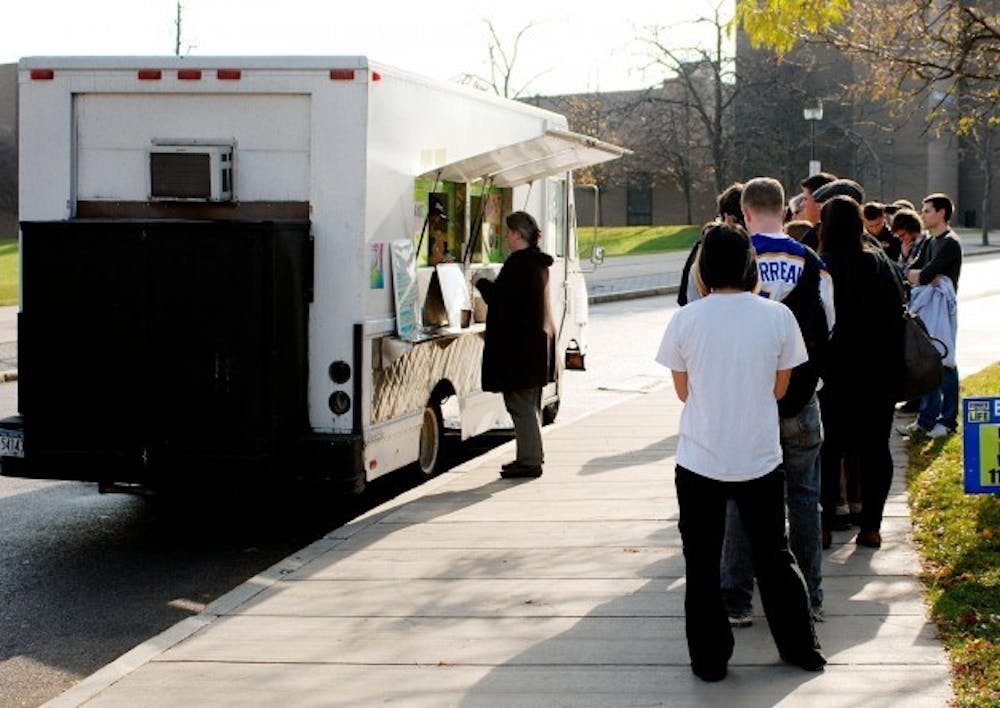
Some of Buffalo's newest food vendors aren't formed on cement foundations or enclosed within four walls.
They're on four wheels.
Food trucks have been popping up all over the Buffalo area. In the past year, what was a rarity has now become a growing and prospering trend.
But with a new trend comes new problems. Lawmakers in Buffalo have passed legislation on the food trucks, limiting where they can park and operate, after restaurant owners complained that food trucks were hurting their business.
On Feb. 6, Mayor Byron Brown signed Buffalo's first set of rules for food trucks. Food trucks must park at least 100 feet away from hot dog vendors and the nearest edge of any building housing an open kitchen. Trucks must also pay $1,000 for a license and permit that will expire in April 2013, along with the law. When the law expires, city officials will review how the law worked and decide if it will be renewed.
But even with the legislation, there is still conflict between restaurant owners and food truck operators.
"The biggest challenge we have faced was when we were parked at Court Street," said Valerie Taylor, one of the founders of The Roaming Buffalo, one of the food trucks that operate in the city. "There's a restaurant that's right around the corner that complained that we were taking their customers. [The owner] didn't like us there. And then it was brought up to the City Hall Permit Office that it was ‘unsafe and illegal' for us to jump the curb to get to our vending spot."
The Roaming Buffalo's permit was not renewed after that instance, even though Taylor and her husband had made an arrangement with the Buffalo Niagara Convention Center to park near the building on Court and Franklin Streets.
It's a common problem on the new food truck frontier. Business owners are afraid the food trucks will steal their customers and their sales will decline, according to Taylor.
"If we wanted to, we could go park in front of these restaurants that are complaining," Taylor said. "But we don't want to be those people. So we're just avoiding the spots; we'll just go find other spots. There's always going to be people somewhere."
Rich Spears, the owner of the Rolling Joe Café food truck, added that it's not so much that the businesses don't want food trucks, but that people are trying to figure out what's the best way for everybody to coexist.
He said the issue is new to Buffalo, and a lot of cities have struggled to figure out the best way to allow food trucks to operate, thrive, and work together with restaurants.
But why would someone operate a food truck instead of a fixed-location restaurant?
Food trucks must meet all the same requirements and health standards set by the Erie County Health Department that apply to fixed-location restaurants. Some food trucks, like Taylor's, have a full-range kitchen on board, complete with grills, fryers, fridges, freezers, sinks, prep tables, and the works.
The trucks are literally "kitchens on wheels," according to Taylor.
"My husband wanted to start a food truck because he always wanted his own restaurant, and he always thought ‘what's good about Buffalo?'" Taylor said. "And the only thing that's good about Buffalo is the food."
Taylor runs The Roaming Buffalo with her husband. They boast serving all "Buffalo" foods; from chicken wings to beef on weck to Sahlen's hot dogs, Taylor's husband wanted to be "the whole Buffalo truck wrapped into one."
The couple mainly parks the truck at Main and Lower Terrace – right under the 190 bridge near HSBC Tower. Her business caters to downtown employees seeking a quick bite to eat because there are few restaurants in the area.
"We're a big convenience for [workers on] their break," Taylor said. "Our food comes out fast enough to where they can have their food and enjoy their break. Our food is good – it's homemade. [Customers] don't have to go to a restaurant [if they] don't have time to go and sit down and eat."
Customers can visit the food truck and eat in less time than it would take to travel to another local restaurant and back, according to Taylor.
But Taylor also stressed that the convenience factor is the only real significant difference between her truck and a sit-down restaurant.
"My husband and I go to restaurants still; we're not against restaurants at all," Taylor said. "We support [them]. It's what you're in the mood for. We're really just there for people for lunch, to help out."
Spears started his mobile café business in March 2011 and officially hit the road last May. When it came time to make the decision between an actual café and a "rolling" one, the choice was easy.
"I like the freedom and the flexibility that the mobile business gives you," Spears said. "When you have a fixed location, you are locked to one place and a set schedule, and I like the idea of being able to cover different locations and different organizations and get involved with different events."
He serves about 100 different beverages, and he also serves baked goods and other treats from local businesses. Spears does so not only to support local businesses and drive the local economy, but to give his customers a chance to sample things from various vendors in Buffalo.
Spears parks his café mainly in Delaware Park – he has a contract with the Buffalo Olmstead Parks Conservancy. There, he spent the summer months attracting park-goers; he was a go-to spot during Shakespeare in the Park performances. He's also been a staple at tours held at the historic Central Terminal on Buffalo's East Side, and at other Buffalo Historical Society events.
Caitlin Manley, 20, of Buffalo, likes the idea of food trucks.
"I like them because they're not only convenient, but they spark an interest in food that isn't your typical burgers/wings/pizza," Manley said. "They would help get some people out in the street and exploring the area – something that's a little rare after 5 p.m. on weekdays. I believe if given the proper chance, they would be amazing for our local economy, especially in a city like Buffalo, where residents have an appreciation for arts."
Food truck vendors in Buffalo have formed a tight-knit, supportive community – they've even established the Western New York Food Truck Association, a group that advocates for food truck legislation. Taylor stressed that all the owners are friends and wish to see all the trucks prosper; there is no competition.
"We want to be there for our customers. We're not going to stop serving because we can't be in one place," Taylor said. "The customers come to us; they find us."
Email: news@ubspectrum.com



