
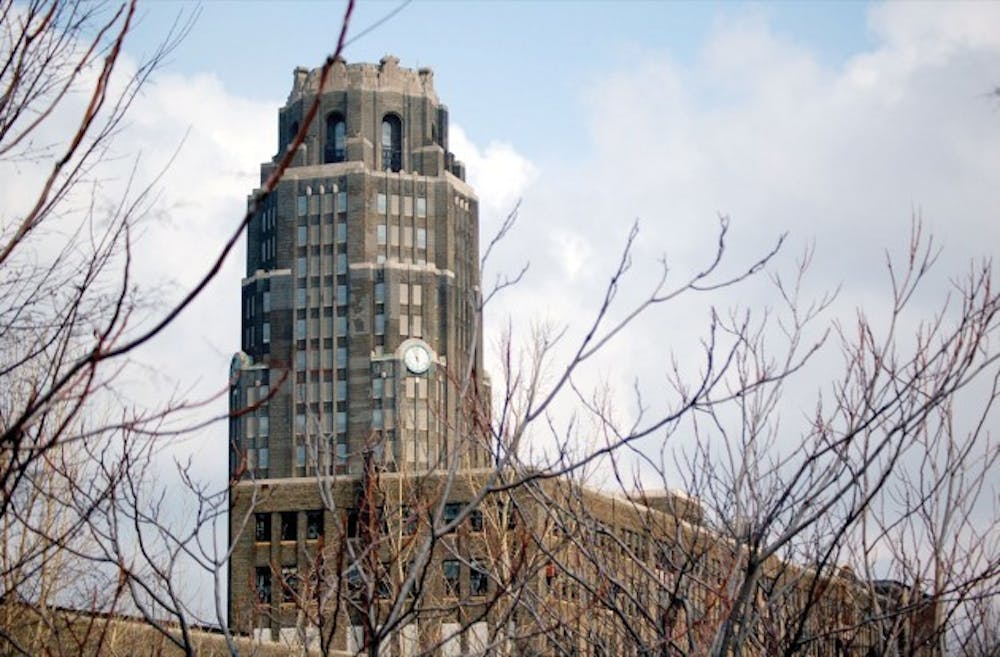
The Central Terminal on Buffalo's East Side is one step closer to being restored to its original grandeur, as leaders released a master plan last month.
On March 10, the Buffalo Central Terminal Restoration Corp. (CTRC) released a $75 million master plan to the public, which is comprised of four projects that can be completed independently of each other and in any order.
"There are many reasons for restoring the Terminal," said Paul Lang, chairman of the Architectural Advisory committee for CTRC. "From a moral or ethical viewpoint, it's an architectural jewel, a Buffalo landmark listed on the National Register [of Historic Places], and most importantly, a place where all Buffalonians have passed through or had some association with."
The plan is focused on returning the Central Terminal to its 1929 status, while bringing it into the future to create a central hub of activity.
The first phase of the plan is to restore and stabilize the building to preserve the historic nature of the remaining features. Recent studies have estimated that $2.6 million will be needed to stabilize and repoint the 17-story masonry tower. An additional $1 million will be needed to replace the vaulted roof of the concourse.
Once the building is stabilized and restored, projects within the master plan can be launched.
"As you look through the plan, we've broken down the building into various parts," said Marty Biniasz, media relations coordinator and marketing committee chair of CTRC. "So when funds become available and when development opportunities arise, we don't have to wait for the one big ‘silver bullet' project to rescue the entire building, but we can develop it in pieces."
The tower of the Terminal is set to be designed as a residential space, with space allotment determined by market-rate analysis. Units could include large work or living spaces on the lower floors, medium-size lofts on the middle floors, and large penthouse suites on the upper floors. The plan also allows for consideration of more affordable living spaces, as well.
The historic elevators and lobbies that connect to the parking garage will be refurbished to allow direct access to the tower.
Plans also include the complete restoration of the main concourse. This would create a public-access space that could support museum exhibits, festivals, rentals, and other community uses. The plan also calls for restoration of the restaurant and allows for other seasonal commercial venues.
The baggage building would become a "green business incubator facility," or a place for small business and light industrial operations. Adjacent to this facility will be the Urban Habitat Classroom, a project in conjunction with the Curtis Urban Farm Foundation that will promote green development principles while building a habitat and learning lab.
The plan also hopes to restore existing rail lines to be used with Niagara Frontier Transportation Authority's light rail system and to incorporate lines into New York State's plans for a high-speed rail system.
"This [plan] pays homage to [the Terminal's] historic pragmatic roots, while creating a self-sufficient and interesting environment demanded by today's market," Lang said.
The CTRC has begun work on this master plan by meeting with developers and trying to secure grants on the national and state level, while also searching for private investors to fund the $75 million needed to complete the project's goals.
The Central Terminal opened for business in June 1929 and was built to accommodate 3,200 passengers per hour, or 200 trains per day. Built by the New York Central Railroad and designed by architects Alfred Felheimer and Steward Wagner, the Terminal is a part of the iconic art deco movement of the 1920s.
The last train departed from the station in October of 1979, as Amtrak abandoned the East Side property to use a new station in Cheektowaga and reopen the Exchange Street terminal.
The CTRC purchased the 17-acre property in 1997 from the city for the price of $1 with the plans to restore and reopen the property to the public.
"[The Central Terminal] is a structure that is monumental and is uniquely Buffalo," Biniasz said. "It's a structure that you're not going to find in any other city in the world, and it's an architectural treasure that we're all looking to preserve and reuse."
For more information on the CTRC's master plan or ways to get involved in the project, visit http://http://buffalocentralterminal.org/ or email any questions to questions@buffalocentralterminal.org.
Email: news@ubspectrum.com



