
The clock at a small gas stop in Brockport ticked past 3 a.m. Most of America was asleep. But passions were running high on the protesters' bus.
"All I have to stand by is my word. And if I stand by my word, I have to stand by my principles," remarked Buffalo artist Bonita Zielinski as the bus, full of UB students and Buffalo activists, made a quick stop on its long nighttime journey to New York City.
Zielinski was riding to New York with the activists, sponsored by the Western New York Peace Center, to protest the Bush administration on the eve of the Republican National Convention.
On Sunday, the 80-person Buffalo chapter would meld with over 120,000 demonstrators who were equally determined to make their voices heard on a long march through the streets of downtown New York, through Broadway, and into Union Square.
Anti-Bush protesters from across the country gathered at 10 a.m. on the corner of Seventh Avenue and 14th Street, buzzed by the enormous presence of like-minded individuals hoping for the chance voice their opinion in the oncoming march.
"Bush and the people who support him are creating division on so many fronts," said Alex Mead, a designer for the Western New York Peace Center website. "I think the only way a tiny minority of people can maintain authority over a large majority of people is to divide them into tiny groups and pit them against one another."
Contrary to Mead's opinion of the American hierarchy, the demonstration in fact joined many separate forces together. Students, parents, children, the blue-collar workers, the suburbanites, anarchists, communists, liberals, fed-up conservatives, and hippies all joined forces for what they said was a genuine concern for America's future.
"These protests bring together a large cross-section of America-men, women, different races and religions," said Richard Kern, a controversial Buffalo journalist and housing activist. "We need to keep holding these sort of demonstrations in such a divisive climate."
At noon, with the sun sweltering and media copters looming overhead, the protesters began their march. Pavement that would have normally been infused with a sea of taxis became instead a river of banners and fists raised in objection to America's current leaders. Drums and voices pulsated like a colonial revolution amidst the high-rise towers of downtown Manhattan.
Signs with messages of "Re-defeat Bush", "Read Between the Pipelines" and more compromising phrases such as "Kerry Sucks Less," sailed above the heads of thousands. Even a seven-foot Statue of Liberty on stilts came tottering by. The crowd booed when it reached Madison Square Garden, where the National Republican Convention was to be held.
James Duncan, treasurer of the College Republicans at UB, said that during many protests, a good number of the participants are there regardless of their association with the cause.
"If you looked more closely at the banners of the marchers, not all of them were there protesting the RNC," said Duncan. "All of your most active protest groups were out in large numbers, NORML, NOW, ANSWER, etc. These people show up at every large political event pretty much regardless of affiliation or relevance to the event. My reaction, to paraphrase Ronald Reagan, was 'There they go again.' "
Another conservative shared an opposite point of view.
"I'm frustrated with the direction this country's taken," said Doug Lewis, a lab director at a Buffalo waste treatment plant. "I'm a fiscal conservative, our president is not. I want to show my discontent for bad administration and protest our current policies peacefully."
Krissy Ingleman, a junior geology and political science major and volunteer for "Rock the Vote!" said she hoped both sides could come together and form a moderate consensus.
"We need a complete reconstruction of the way we're thinking," said Ingleman. "Right now, we're too far on the right. Our country works best in the moderate zone. And for those whose political intentions are aimed to the left, they first need to take on a moderate viewpoint. That's why this election is a stepping stone."
Other protesters offered the idea of alternative political systems.
"Socialism is the basis for democracy," said Don Smith, a social activist who was handing out flyers on a congested side street. "Capitalism exists at the expense of the working class. The workers need to own all of society collectively."
One vibrant group named Code Pink, whose motto was "Pink Slip Bush!" flowed through the center of the street in a stream of fuchsia. Rosalee Yele of Long Island, one of the Pink Ladies, explained her group's intentions.
"Code Pink is not about terrorist alerts or fear," said Yele. "It's about working for good education and environmental rights in our country, not waging preemptive wars or spending billions overseas."
Another group of protesters, "Billionaires for Bush", addressed who they felt Bush favored. Pushing through the crowds in dazzling attire, they yelled to one another, "Come, dear! We must leave no billionaire behind!"
The leader of the pack, a gentleman in pinstripe and bowler hat, instructed to his clan, "Billionaires! Do know what you know best and move to the far right!"
Duncan said that this promenade was misleading.
"More ultra-wealthy people donate to the Democratic party than the Republicans, by a margin of almost ten to one," he said. "Bill Gates gives to both parties, but billionaire George Soros has given millions to MoveOn.org and many other democratic outlets. Let's not forget that John Kerry is the richest man to ever run for President."
Many of the protesters also voiced what they thought was imbalanced media coverage.
"In the media, only the middle-upper class is represented. The working, blue-collar class and the homeless never get a chance to speak," said Tania Brown, alleged vegan and street performer.
Brown expressed herself by means of the fiddle. Reviving the spirit of her ancestral rebels, she struck up themes from the Revolutionary and Civil Wars.
"I think music really makes a strong statement," she said.
Though the sidelines were thronged with a heavily-armed police force, the protest remained almost entirely peaceful. A few exceptions included a paper dragon float being set aflame near Times Square and the occasional street-corner cynic.
"I think we should just bomb Madison Square tomorrow," decried one protester on a street corner. He would not disclose his name, but would only say that he was from New Jersey.
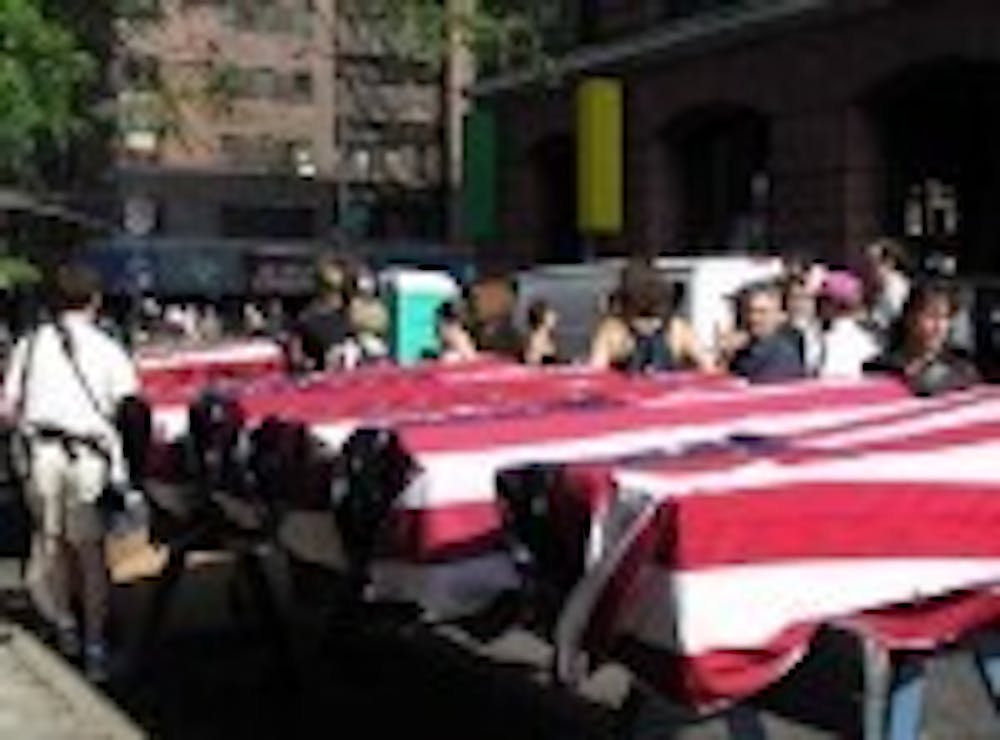
At 1 p.m., participants took a moment of silence to remember those who had died as a direct consequence of the Bush agenda. Six hundred cardboard coffins covered in American flags slowly proceeded through the crowd. Johanna Windham of Texas, apart of the organization onethousandcoffins.org, explained the reason for the ceremony.
"We are sick of the administration not allowing casualties and deaths to be photographed or displayed on TV. It's like parental censorship," said Windham.
The sun-beaten protesters dispersed at the end of Broadway. They rested in the shade of Union Square while enjoying free stir-fry.
At the end of the day, Richard Kern reflected on the event.
"My concern is that a national audience sees how many people oppose Bush's policies, the people witnessing this demonstration from their homes," said Kern.
Duncan remarked that the protest would not have much of an effect on the American public.
"The country is split 50-50 on a lot of issues, particularly hot-button ones like Iraq, the war on terror, abortion and a variety of other issues," he said. "Having 0.03% of the US population protesting in the nation's largest city is not the greatest political movement of our time. That many votes wouldn't have made a lick of difference in any state last election except for a few."
Albert Brown, a Buffalo liberal activist wasn't sure how the general population would react to the event.
"I don't know if this protest will have much effect on the mainstream," he said. "But this experience energized the base, and the faithful. It energized people to go and become active in their own cities."



