
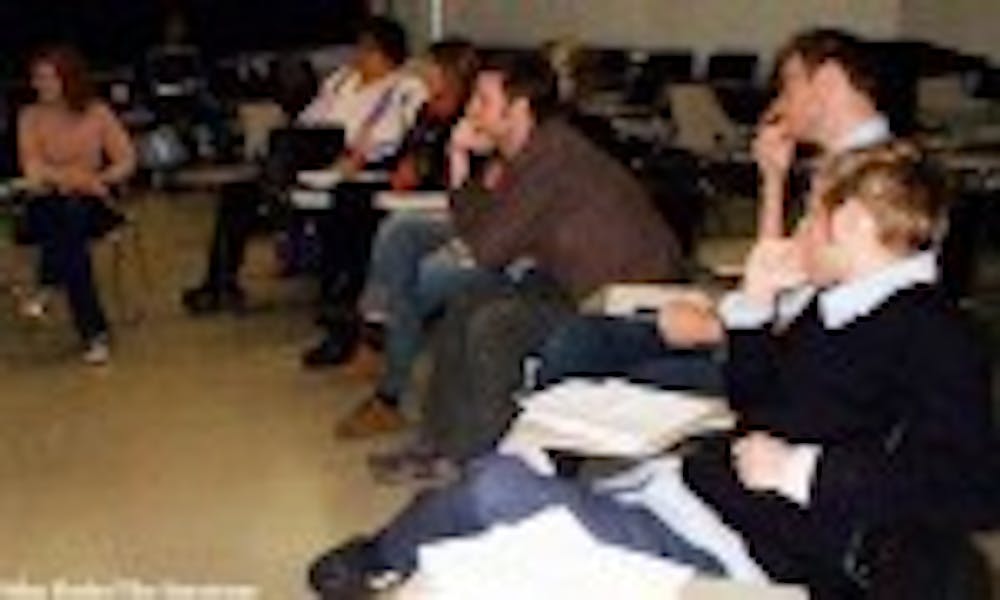
North Campus became a popular international destination this weekend, thanks to the Department of Media Study's international conference "FreeCollaboration."
FreeCollaboration was a four-day long event, running from Thursday night to Sunday afternoon, with dozens of scheduled events taking place throughout the weekend.
Organized by assistant professor of media study Trebor Scholz and University of Queensland, Australia media theorist Geert Lovink, the conference focused on new ways of using technology for communication and collaboration.
"The main focus is on online collaboration," said Scholz. "There is new software online that allows new forms of collaboration. They provide new ways of working together.
"The conference is focused on debate, on exchange, and on discussion," he said.
Besides on-campus events in the Center for the Arts and the Natural Sciences Portions of the conference took place at local media venues including Hallwalls Contemporary Art Center on Main Street, Soudlab on Pearl Street and Sqeaky Wheel on Elmwood Avenue.
One Sunday morning seminar took place in the Alumni Arena saunas and steam rooms.
Scholz and his colleagues said they feel these new means of cooperation could have a major impact on the way information is exchanged.
"Many people compare it to a print revolution, because all of a sudden, everyone can use these means to communicate," Scholz said.
The main purpose of the conference is to express the importance of collaboration in all aspects of life, and also to expose people to new means of communication, Scholz said.
Certain sessions during the conference focused on connections between artwork and science, collaboration between women media practitioners, attribution and reuse of media and the role of mass media in education.
One point of the conference that was stressed by the organizers was a sense of equality among those in attendance. Extra effort was spent to make sure no hierarchy existed between students, speakers and organizers.
"We tried not to have any superstars," said Scholz, "but rather, very interesting people during the whole weekend. We only used rooms where people would be on one level. There are no keynote speakers, no lectures, and no panels."
The idea behind this setup was to have students feel less intimidated, so they were more likely to become part of the free exchange of ideas during the course of the conference.
"Many students present will find themselves shoulder to shoulder with international scholars," said Scholz.
The conference drew visitors from all corners of the United States, as well as Canada, Germany, Amsterdam, and even Australia.
One international visitor was Doroth?(c)e Gestrich from the Merz Akademie in Stuttgart, Germany.
Gestrich's passion for the topic of online collaboration led her across the Atlantic to UB, where she stayed for five weeks, assisting Scholz in the process of organizing the event.
"I'm very interested in the social aspects of meeting people, especially net-based collaboration," Gestrich said. "This was a good place for me to gain insight, and also to meet interesting people."
"Without her, planning everything would have been a heart attack," Scholz said with a laugh. "Also, we had strong support from the Center for Applied Technologies in Education."
In addition to the hundreds of guests in attendance, there were also around 100 speakers from diverse fields, including teachers, writers, virtual reality artists, critics and museum curators.
All of the information that was discussed was thoroughly documented, according to Scholz.
"There will possibly be a DVD coming out. We have a large team of people here filming things," said Scholz.
There is already an in-depth Web site dedicated to the happenings of the conference, http://FreeCooperation.org. The site includes a variety of information, including a copy of the conference program, a message board - also known as a "wiki" - and a downloadable version of the FreeCooperation newsletter. There is even a song about cooperation, downloadable in mp3 format.
Another method of spreading the ideas discussed at the conference is through a printed FreeCooperation newsletter.
"We printed 8,000 copies of our publication," said Scholz. "Then, everyone takes 200 home in their suitcase and distributes them. They spread around the world. It's great."
The publication is essentially a newspaper filled with the latest theory available in the field of collaboration, and it's free, he said.
"It's like an avalanche effect," Scholz said. "People are really excited by these topics."



