
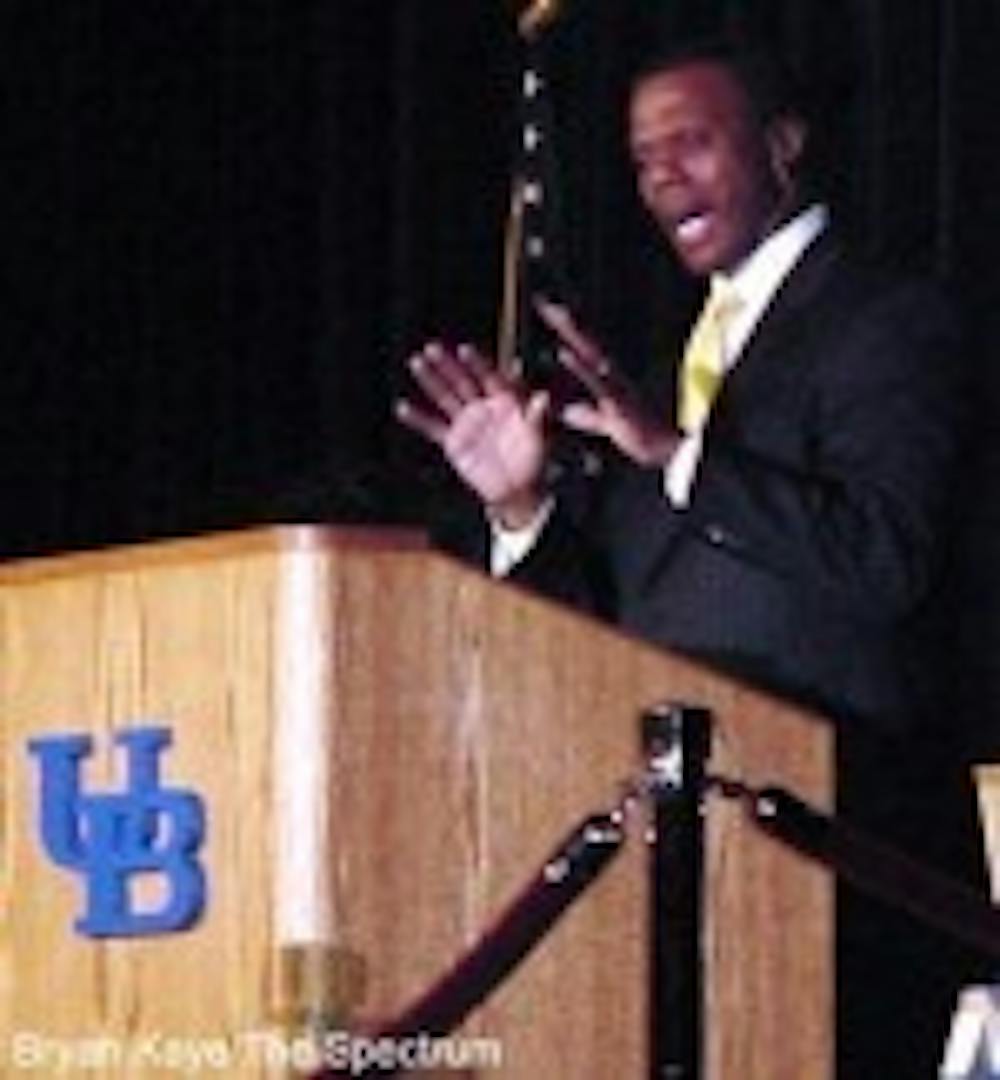
In the spirit of the "table of brotherhood" described by Martin Luther King, Jr. in his March on Washington speech, two leaders on the opposite ends of the political spectrum engaged in a debate over several hot issues Wednesday night at Alumni Arena.
Kweisi Mfume, president of the National Association for the Advancement of Colored People, and former Congressman J.C. Watts discussed racial and social issues affecting American society at the Martin Luther King, Jr. Commemoration Event, a presentation of the Distinguished Speakers Series.
"I hope by the time we conclude this evening we have strategies that are not black strategies, not Latino strategies, not Asian strategies, not white strategies, but American strategies to close the gaps that do exist," said Mfume, a Democrat.
The two debaters were allotted 15 minutes to express their views on issues like civil liberties and affirmative action. Then they were allowed five minutes of rebuttal each.
Afterward, six Western New York civic leaders questioned both speakers on the topics they discussed and other pressing issues.
In keeping with Watts' athletic connection - he was a football star at the University of Oklahoma - a coin was flipped to see who would speak first. It was Mfume who took the stage.
Echoing a key message from John Edwards's campaign in the Democratic primary, Mfume addressed the idea of "two Americas," that the United States is a place where society is still divided by wealth, race, gender, and beliefs.
"There are still disparities that haunt us. Government, military, family, church, are all under attack for real or imagined defects," he said.
Mfume called into question the progress toward equality since Martin Luther King's era.
"We have to ask ourselves, what have we done to deal with the disparities that have existed over the last 50 years?" said Mfume. "Dr. King would turn in his grave if we came here to be celebratory without talking about what's wrong in this society, without recognizing the individual responsibility that we all have."
Mfume put the weight of responsibility on every citizen's shoulders.
"In order to even the playing fields, we as individuals have to fight for what we believe in, what is guaranteed by the Constitution, for the best of what is represented in America - we have to do that day in and day out," said Mfume. "But we have to do it in such a way that we fight fair and openly so others realize that it is not our fight, but an American fight."
J.C. Watts also addressed the issue of a divided America, but claimed it is divided for different reasons. With personal stories to support his ideas, Watts' roots as a Baptist minister emerged in his remarks.
"The government has contributed to our inequality. We've been using all the wrong models," Watts said. "We can't do the same old thing the same old way. We can't try to fix education, poverty and welfare with the same old construct and expect different results."
Before his speech, in an interview with The Spectrum at the Buffalo Niagara Marriott, the Republican leader addressed what he felt is a defect in the current affirmative action program.
"We should create a system based on need. Race can be a factor, but we should focus more on academic factors," said Watts. "All people, regardless of their heritage, should be able to continue their education if they're motivated."
Watts also tried to dispel what he says is a bad rap about Republicans.
"Republicans often get a bad brand. Beyond rhetoric, we've actually done some good things. For example, Bush is the first president to have a policy on personal profiling," said Watts.
While their views clashed during the debate, Mfume and Watts occasionally praised one another.
"In my opinion, (Watts) is one of the ablest legislators this nation has ever produced," Mfume said.
Watts showed a mutual respect for Mfume.
"We're friends and we can respect each other so much that we can talk about our views with one another," said Watts.
One of the people on the board of Western New Yorkers was Clotilde Dedecker, executive director of the Erie County Commission on Status of Women.
"I thought it was a thought-provoking evening that challenged each of us as individuals within our own spheres of influence," Dedecker said.



