

NEWS
It's all good
By JENNIFER GOOD | Feb. 24, 2010In the past two weeks, I received a ticket for using my cell phone while driving, which caused me to miss a quiz.
In the past two weeks, I received a ticket for using my cell phone while driving, which caused me to miss a quiz.
Losing a friend at an early age is one of the most painful experiences one can go through, but one thing I have certainly learned throughout the past four years of my life is that it is inevitable. Like little mementos meant to reopen old wounds, I have a stack of prayer cards from the wakes of the many people I have lost throughout recent years. Three distinct cards stick out in my mind as being particularly painful. These three men were only 24, 21 and 19 years old when they lost their lives. One life was lost due to icy roads, another to driving too fast and the last to a drug addiction. It is always said about someone when he or she passes away, but each of these three guys was really incredible. Joey was one of the funniest kids I had ever met and you were guaranteed to have fun anytime you were around him. If Luke had one thing, it was integrity; he was a standup guy that was extremely loyal and trustworthy. Mike was one of the most talented piano players I have ever heard. When he played, it sounded like he should have had an orchestra accompanying him. Now Moe. At the young age of 24, my friend and colleague at The Spectrum lost his life to pneumonia. As anyone who knew him would say, he was one of a kind. He was always happy, never had a bad thing to say about anyone and just enjoyed life. 'God loves me, so it's only right I share some of that love with you!' That is a quote from Moe, which is probably the best way to sum up his outlook on life. He accepted anyone with an open mind and heart, and left the impact of his huge personality everywhere he went. Coming from a small community that mourned the loss of young lives together, I morbidly thought as a freshman that the death of a student at UB would go unnoticed. But I soon learned how wrong I was. As unfortunate as the deaths of UB students have been, losing kids like Jonah Dreskin, Javon Jackson and Nick Orrange brought the UB community together. Seeing people unite in a time of sorrow puts a face and heart to what is usually seen as a cold bureaucratic system. The reactions of students, faculty, staff and alumni to the deaths of students shows those who attend UB that they are not just a number; rather, they are a part of our school and therefore our lives. Moe was no longer attending our school and was at graduate school in Florida when he perished, but we here at The Spectrum have still received many condolences for the loss of our friend. Those who knew him and heard of his death had many kind words, and just showed how members of the UB community do not let the loss of one of their own go by with no attention. Despite the pain that being reminded of our lost friends brings or how much we just want to stop everything, we want to ask why. Why did we have to lose our friends? We must go on; I am sure that is what Moe would want. As difficult as it is, and as many questions as could be asked, what is important is honoring their memory and never forgetting what they have done for others. If there are students that have passed away during my time here that I failed to mention, I am sorry and hope that their loved ones are not too upset. For the many students at our university that have lost other friends during their time here, just remember that you are not alone. It will get better. E-mail: chris.dimatteo@ubspectrum.com

The 2004 film Hotel Rwanda was nominated for three Academy Awards, and continues to be widely rented. The American Film Institute has named it one of the 100 most inspirational movies of all time. Yet fifteen years after the Rwandan genocide, details of the event are still causing controversy. Dispute has arisen concerning the validity Hotel Rwanda and the credibility of its title character, hotel manager Paul Rusesabagina. In most public appearances, Rusesabagina prefers to be introduced as a man who 'single-handedly prevented the slaughter of more than 1,200 refugees' during the Tutsi genocide in 1994 at the Milles-Collines Hotel. Edouard Kayihura, a native Rwandan, survivor of the genocide and resident of the hotel, sees things differently. 'I was in the hotel. Mr. Rusesabagina did not save my life. Mr. Rusesabagina saved less lives than anyone who was in the hotel,' Kayihura said. United Nations General Romeo Dallaire also met Rusesabagina during the genocide. 'Indications are that the hotel manager [Rusesabagina] did everything in his power to have U.N. soldiers removed from the hotel. I also received unconfirmed reports that [Rusesabagina] had given General Bizimungu [a chief architect of the genocide] a list of hotel guests and room numbers,' Dallaire said. Fortunately, the U.N. altered the room numbers of those who were in the most danger. Another army member, General Dallaire, also had no knowledge of the film's existence until after it was released. Yet, there was a character in the film that was based on him, played by Nick Nolte. Within the walls of this 'Hotel Rwanda,' other travesties are said to have occurred. '[Paul Rusesabagina] cut phone lines … forced us to pay for rooms and food, and those who had no money to pay were removed from their rooms. That money either went straight into his pocket or else was used to buy high-end liquors, which he then tried to sell back to us for even more money,' Kayihura said. The film Hotel Rwanda, starring Don Cheadle and Sophie Okenedo, depicts Paul Rusesabagina as a politically connected but neutral Rwandan who defied the Hutu authorities and fearlessly provided shelter to Tutsi refugees without considering the consequences. 'Rusesabagina was [not only] both politically active in Rwanda, but a member of the Democratic Republican Movement, the ‘Hutu Power' party that carried out the genocide … given his proximity to these radicals, it is reasonable to conclude that he knew more about the events to come than the movie would suggest,' Kayihura said. In the years since the genocide, Rusesabagina has established an international reputation as a figure of peace and inspiration for the oppressed. He is frequently requested to make paid appearances in the United States and abroad. However, to Kayihura and other survivors of the genocide who have kept track of Rusesabagina's career, facts both past and present are still being overlooked. 'I want to throw up because he's using [the movie] to forward his own political agenda,' Kayihura said. '[Since 1994], Rusesabagina has used his platform to champion and reinvigorate those same ethically divisive Hutu Power politics, raising money for causes that have less to do with helping survivors than revenge … most flagrant is his attempt to paint the murders committed by the Hutu Power extremists as simply a byproduct of civil war and not genocide.' However, Kayihura expresses good sentiments about the movie's creation, regardless of the future of Rusesabagina's career and historical legacy. Nevertheless, Kayihura still feels that people should know his story. 'I am happy the movie was made because it bought awareness to what happened, but [Rusesabagina] has used it to run his own political career. No one who was [at the hotel] can say he was a hero,' he said. Kayihura promises that he will continue to spread his story and make sure that 'people know the truth.' E-mail: features@ubspectrum.com
Dear Diary, City of Buffalo, Buffalo Police, University Police, and anyone else who will listen: I've got a bone to pick with all of you, and I know I'm not the only person who wants these questions answered. The second amendment and the Queen City would appear to be on a collision course. The past month has shown more than enough evidence of that. The shooting in the Allentown restaurant Merge in January by a deranged dishwasher left the proprietor wounded and his 18-year-old son dead. Not long after that, there was a shooting outside of the Hotel Marriott in Amherst, right outside of the University at Buffalo's doorstep. Trinity Place, also in Allentown, was the site of a nearly four-hour hostage situation that left Eric Ocasio, 27, of Buffalo, dead. Ocasio succeeded in shooting and injuring a police officer before committing 'suicide by police' by pointing his gun in the wrong direction – at the remaining SWAT teams and police officers. Four days later, Jason Ocasio, brother of the aforementioned deceased, took his own gun to Buffalo's police station and pointed it at an officer. After a wild car chase, James Bond-style, he was apprehended and remains in custody. And of course, who could forget last week's complete fiasco right here on North Campus? No one could forget the disaster that wasn't – the frantic search for Lockwood Library's invisible gunman with his magic bullets. The drama of the downtown Buffalo area would not appear to be contained within the city limits. It's been a crazy week, an exhausting month, and a grueling round of fear and anxiety, and it all goes back to one thing – guns. Frankly, before all of this drama happened, my interest in a person's Second Amendment right to possess weapons of the firearm variety was minimal. Of course, I cried when hearing about the massacres at Columbine High School and Virginia Tech, and make jokes about the card-toting members of the National Rifle Association who mostly reside in and around the Texas border. My modest proposal, however, is this: leave it at home, everybody. All of it – especially your guns. And if that doesn't work, then maybe we should do away with the entire Second Amendment. One of the most absurd sayings I've ever heard is the tag phrase, 'Guns don't kill people, people kill people.' Yeah, people do kill people – with guns. What a revolutionary concept. What use does a resident of urban Buffalo or a student at UB have for possessing a firearm? We live in a society where information is so easily accessible you can order a gun off the Internet and find blueprints for a bomb on Google. All of these avenues for information would seem to be used as more avenues for the crazies to plot their next act of insanity and murder against innocent people. Guns belong to a certain demographic of people. Those people are members of law enforcement, whose job is to protect innocent civilians. I'm not saying that people should blindly and senselessly hand over all of their freedoms to police and other authorities. That is a recipe for disaster and a dystopian universe. What I am saying is that those with power also have a responsibility to protect us. Therefore, the police and other law enforcement officials, who have been specially trained, should have the Second Amendment reserved for them. Seriously, people, the school and street-shooting craze has really gotten old. It's time to take a progressive step toward a more peaceful society by eliminating a threatening object from restaurants and school libraries and investing real faith in those who can and will be able to protect us. It's a step I'm willing to take. E-mail: shane.fallon@ubspectrum.com
To the Cheerleaders and the UB community,
This spring, IRS-certified accounting students from the University at Buffalo will provide free tax preparation services on North and South Campuses for individuals with annual incomes below $49,000. The student-run tax service includes preparing tax returns and ensuring that all tax deductions and income tax credits are accounted for. In 2009, according to a press release on the UB School of Management Web site, volunteer accounting services brought nearly $640,000 in tax refunds back into the Buffalo community. Around $120,400 of that sum came from the Earned Income Credit, which helps to direct additional financial support to low income families. 'It's called the Volunteer Income Tax Assistance program, sponsored by the IRS,' said Jeff Bassen, a senior accounting major. 'It's the same thing as getting taxes done by a certified accountant, but we save our patrons up to $300 in fees that they would otherwise have to pay for the services.' Bassen is the president of the UB chapter of Beta Alpha Psi, an international accounting society, which annually spearheads the volunteer work at the university. The accounting program at UB also recruits and accepts volunteers to assist in the program on both campuses and on their weekend time. The accounting students must complete an eight-hour training program and pass an online exam in order to participate in the VITA program. The program is almost entirely student-run. 'The students involved are typically undergraduate students in the accounting program,' Bassen said. 'Some volunteers are in their sophomore year at UB.' The services are on a first-come, first-serve basis. Patrons need to bring with them wage statements, W2 forms, interest and dividend statements and 1099 forms, along with banking information and standard identification documents. The length of time required for each tax service depends on the complexity of the return. 'The biggest thing, in the past three years of this project, is the move to the South Campus, closer to where more of the target clientele lives,' said Cynthia M. Shore, senior assistant dean of external relations at UB. 'One of its most significant purposes is to make sure that the people who are eligible for the Earned Income Tax Credit get their money, because some don't even know they're eligible to save several thousand dollars in taxes.' The EIC helps to reduce income taxes by refunding taxes already withheld from wages, saving a family with two children up to $5,000, according to the press release. 'Most of the South Campus clients are from the Buffalo community,' Shore said. 'I think it's more gratifying for the volunteers when they can get people the money that they would have otherwise lost in paperwork.' According to Shore, the project typically recruits around 200 students each year, grossing thousands of hours in tax services and hundreds of thousands of dollars in tax returns. 'The whole point is to give back to the university and the city of Buffalo,' Bassen said. The School of Management encourages the entire UB community to take advantage of the opportunity for free tax services. The services are available in 109 Allen Hall on South Campus and in 106 Jacobs Management Center on North Campus. Times and dates can be found on the UB School of Management's Web site. E-mail: news@ubspectrum.com

Artist: Alkaline TrioAlbum: This AddictionLabel: Heart & Skull/EpitahGrade: B+

University at Buffalo students leaving for spring break often think about the sun, the beach and having fun with their friends. But they rarely think about the alcohol poisoning, violence and sexual assault that can happen on their vacation away from the Queen City. Luckily, Sub-Board I, Inc. held its annual spring break fair in the Flag Room on Tuesday to educate students about being safe while having fun on break. The fair focused on sex, sun and safety, with various booths set up to provide information about each subject. 'Being in the sun is usually equated to having fun, which is equated to alcohol,' said Jane Fischer, director of SBI Health Education. 'Sex is historically a part of spring break, and alcohol is the number one sexual assault drug. We want students to be safe while having fun.' Fischer realizes that fun means different things to different people, so there were a variety of activities as well as pamphlets and other literature available for students and passersby. Wellness Education Services also had a booth at the fair to further educate students, through games and pamphlets, about being safe with alcohol. '[WES] is here because we thought that they have greater experience with alcohol-based programming,' Fischer said. Sharlynn Daun-Barnett, the alcohol, tobacco and other drug prevention specialist at WES, explained that men have more water mass while women have more body fat, which means that women reach higher blood alcohol levels with less alcohol than men. 'Even though [women] want to think of [themselves] as equals when playing drinking games, [they] have biology against [them],' Daun-Barnett said. Daun-Barnett offered tips for all drinkers, such as only consuming one drink per hour, eating before and during a drinking session, staying with friends, not mixing alcohol with dehydrating energy drinks and alternating between alcoholic and non-alcoholic drinks. Another purpose of the fair was to teach students about how to remain safe when having sex. Booths like 'Eroticizing Safer Sex' attracted many of the students who came to the fair because it had interesting displays and information about sex. 'I learned that oil-based lubricants can pop a condom, so I guess I'm not going to use them anymore,' said Chelsey Lonberger, a graduate student in the Library and Information Studies Department. Lonberger was on her way to get lunch when she stumbled upon the fair and decided to check it out. 'This fair is really useful for undergrads. When I went to Canisius as an undergraduate, they never had anything like this,' Lonberger said. 'They didn't even give out condoms.' What differentiated the fair from the others is that it offered a variety of safe-sex options like condoms, dental dams and lubrication. It also had emergency contraception (the Plan B pill) on sale for $25. Students like Lonberger appreciated the chance to think ahead. Courtney Bauer, a sophomore psychology major and assistant supervising counselor for SBI, ran a table called 'Shark-Infested Waters' that allowed students to prepare in advance for things that could possibly happen while on break, like getting separated from their friends or waking up after a night of heavy drinking next to someone they didn't know. 'This game is about preparation and getting ready for what could happen while on break,' Bauer said. 'People going on spring break are just thinking about having fun; they don't think about anything bad that could happen. This table makes people think in advance in case unfortunate circumstances happen to them.' Bauer believes that the fair was useful for students because many have a lot of bad misconceptions about sex. This was a chance for SBI to honestly answer questions and provide information. Additional information about the fair, alcohol and sex can be found on the SBI Web site, healthboard.buffalo.edu, or the WES Web site, http://www.student-affairs.buffalo.edu/shs/wes. E-mail: features@ubspectrum.com

Student protests against the proposed budget cuts for the Latina/Latino Studies program appear to have paid off.
Health care reform has been the Obama administration's top policy priority for almost an entire year. If Senator Edward Kennedy had lived longer, or the election for his replacement had turned out differently, maybe Congress would have done something. The president has been on the sidelines for the debate over how to fix America's health care system. This week's live health care television summit between the President and Congressional leaders will shape American politics for years. It may provide the political turning point this year. If the meeting fails to shake things up and doesn't lead to real reform, Democrats and the president are in for a miserable time. President Barack Obama unveiled a new plan on Monday. Here are the basic facts to keep in mind: the bill would provide coverage for up to 30 million people who are currently uninsured, the future government deficits will also be reduced and medical costs will be brought under control. Perhaps the flashiest new measure is to give the federal government, along with state insurance regulators, the power to halt excessive premium increases. Last week, customers of Anthem Blue Cross saw their rates increase by 39 percent. Such actions would no longer be tolerated. The proposals are far from perfect, but the administration estimates the cost of the plan will be $950 billion over 10 years, which would reduce the deficit by $100 billion over the next decade and about $1 trillion in the decade after that. If Republicans threaten filibusters, let them. Democrats should use a budget reconciliation procedure that requires a majority vote for passage in the Senate. It's time for the gloves to come off. The United States ranked No. 37 in the World Health Organization's latest rankings. Countries like Oman, Cyprus and Finland all rank ahead of the United States. If that doesn't upset Americans, what will? Just saying no to everything without any counter-proposal doesn't carry weight anymore. The point of having the summit televised is to allow all Americans to see what their leaders are actually doing. Republicans need to start putting their own ideas on the table. Then the debate will no longer be about the flaws in the Democrats' plan – whether they are real or made up. It will become a debate about what the Democratic and Republican plans consist of. That's a fair debate. To anyone paying attention, Democrats have included many Republican suggestions in these proposed bills. If the only way to gain Republican votes is for Democrats to enact only conservative Republican ideas into law, that isn't bipartisanship. That's blackmail. Republicans were outraged over 'backroom' deals in forming the bill. The Democrats have made their plans public, let the Republicans do the same. Let the American people decide for themselves. Republicans have the right to be as conservative as they choose to be. They have justifiable political reasons to oppose health care reform. But just saying no and providing no alternative plan is unacceptable. This may be the last chance to fix the health care system. A loss for President Obama and the Democrats is not an option.

2/2 ? A network cable was cut at Clement Hall.2/10 ? An iPod was taken from a Roosevelt Hall dorm.2/12 - A computer was stolen from an office in Harriman Hall overnight.2/15 ? A wallet with credit cards was stolen and recovered on the fifth floor of Lockwood Library.2/15 ? An unattended wallet with credit cards was stolen from Lockwood Library.2/15 ? An unattended laptop was stolen from Diefendorf Hall.2/15 ? A person injured his eye in the Center for the Arts and sought his own aid.2/16 ? Criseily Paulino was arrested and charged with petit larceny and shoplifting from CVS.2/16 ? A person was sent to Millard Fillmore Suburban Hospital from Diefendorf Hall for feeling light-headed.2/16 - A suspicious person was reported possibly carrying a long gun on Putnam Way.
Monday night, a forum was held that allowed students the chance to voice their opinions and concerns about the UBreathe Free initiative, something that student leaders felt that was never looked into prior to its implementation. Nicole Jowsey, president of the Graduate Student Association, spoke first, saying that the purpose of the forum was to garner information about the program and how it can be improved. Ernesto Alvarado, president of the Student Association, then clarified that the SA and GSA were neutral parties who were concerned about the lack of student voices in regard to the policy. Alvarado then introduced the main speaker – Dr. Gary Giovino, the chair of the Department of Health Behavior. Giovino started out by letting the audience know that the deaths of several close friends and relatives, including his mother, led to his rejection of smoking as a valid lifestyle. Giovino advocated for UBreathe Free and believes that it can be very effective in helping people quit smoking. 'Policy-based initiatives are the ones that make the most difference,' Giovino said. As proof, he cited the changes in sanitation that have come about over the years as hospitals have instituted certain policies to prevent the spread of germs. Giovino feels that the best way to get people to quit smoking is to change the culture of acceptance, or 'default' attitude, that currently exists. '[UBreathe Free] is not meant to be punitive … it's meant to change the default,' Giovino said. According to Giovino, the policy has three main goals: protecting nonsmokers from secondhand smoke, encouraging smokers to quit and protecting the environment. When asked about how the policy is being enforced, Giovino said that he feels the best way to change the default is for individual students to respectfully remind smokers they see that smoking is no longer allowed on campus. 'I quit [smoking] when I realized I was up against a chemical,' Giovino said. 'It won't work to nag people to quit.' In terms of official enforcement, Giovino said that signs have been placed around campus, events have been held to help smokers quit, and around 400 volunteers have been recruited to give smokers cards reminding them about the policy, as well as to pick up any cigarette butts they see on the ground and educate the people around them about why they are doing it. In response to a question about the repercussions for students caught smoking, Giovino said that everyone is subject to a 1994 law that prohibits people from smoking in, or at the entrances to, buildings. 'UBreathe Free expands that law to all of campus,' Giovino said. Therefore, theoretically, people should be 'subject to judiciary processing.' However, this has not been enforced. In regards to designated smoking areas, which many students have advocated for, Giovino was opposed. 'The more exceptions you make, the less compliance you get,' Giovino said. When asked whether a plan is in place to enforce the policy among the staff, Giovino said that one had been discussed, but offered no further details. Amanda Ayler, a graduate student in the Department of Health Behavior, supports UBreathe Free and feels that forums such as this one are important. 'It's good for students to keep talking to policy makers,' Ayler said. 'I think UBreathe Free has been effective; I've definitely noticed a change. I intern in the Wellness Center, so I know the things they know. No one notices the people who aren't smoking anymore because they aren't standing [around campus] anymore.' E-mail: news@ubspectrum.com
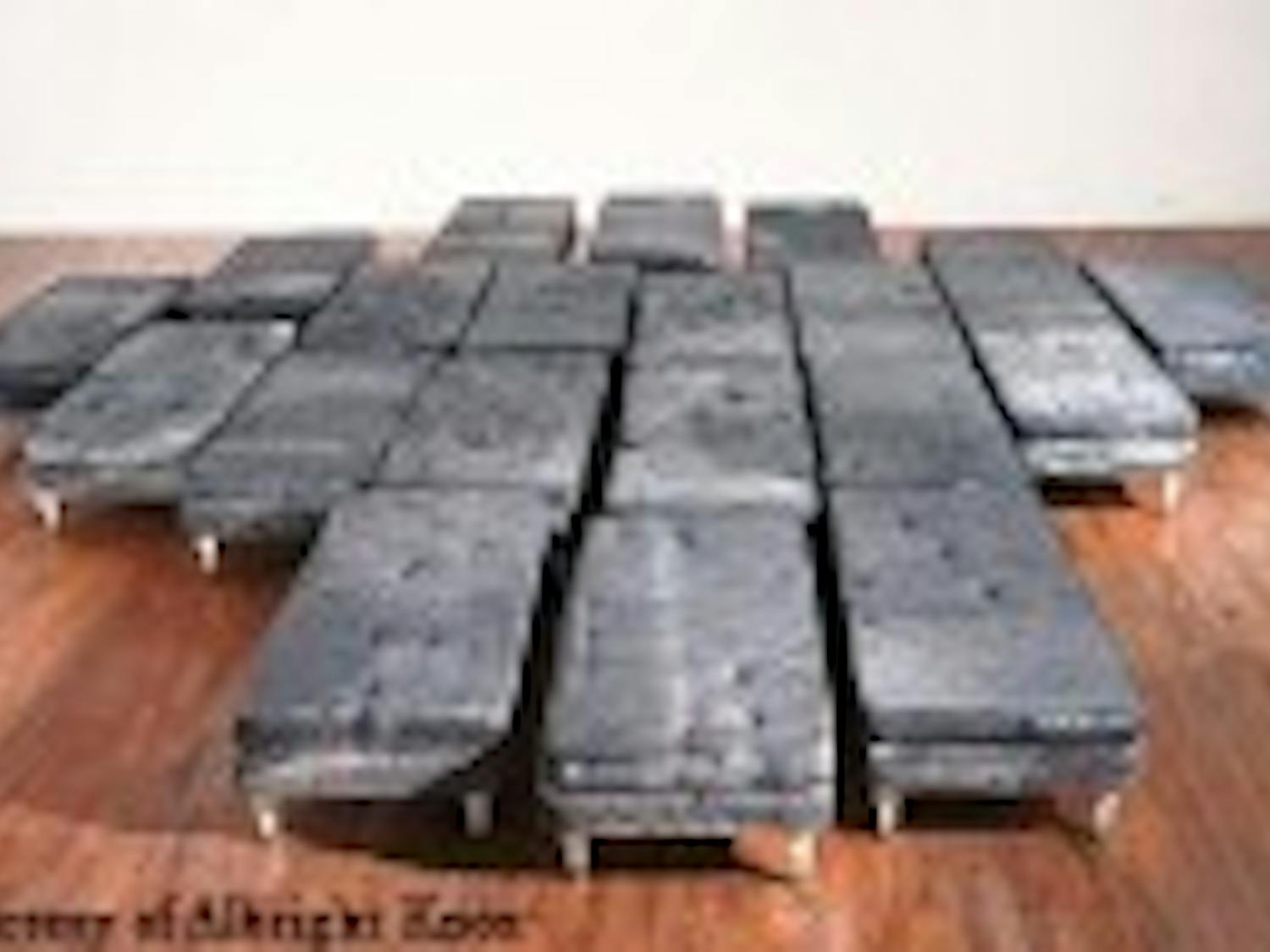
On Friday, the Albright-Knox Art Gallery premiered an exhibition on the works of Argentine artist Guillermo Kuitca. Spanning 28 years, Kuitca's career showcases an acute sense of the great philosophical and physical action that is art. 'Kuitca likes to explore the dynamics of space,' said Douglas Dreishpoon, chief curator at the Albright-Knox. 'He finds space an active component of our lives and something that we take for granted.' The exhibit, roughly three-and-a-half years in the making, was painstakingly organized by Dreishpoon. It contains more than 50 paintings and 25 drawings, and has works that have been imported from all over the world, including London, Puerto Rico, Chicago, Buenos Aires, Barcelona and New York. Maria Morreale, director of public relations and marketing, is ecstatic about the new exhibit. 'We are quite lucky to have this,' said Morreale. 'We deeply appreciate Kuitca's work and have been adamant in bringing them here.' Kuitca, born in Argentina in 1961, has been drawing and painting since he was six. He had his first gallery exhibition when he was 13 years old and became an internationally known artist in his early twenties. His works have been displayed in prestigious art galleries such as the Museum of Modern Art, the Metropolitan Museum of Art, the Smithsonian Institution and the Tate in Great Britain. Kuitca's artwork focuses on public and private interactions, emotional drama, political and social systems, and the exploration of space. Morreale describes his work as 'visual poetry.' 'He likes to use metaphoric and symbolic images,' Morreale said. 'There's a message of human interaction and dislocation in his work.' Kuitca, who was present at the opening, was amiable and very straightforward when discussing his work. He describes his approach to art as a point-of-view oriented process. 'Without the point of view, you can't make art,' Kuitca said. 'My point of view is hard to describe. I would say that it's a physical reaction. Art is essentially a physical action.' He considers art to be more physical than cerebral. He brushed aside idealism when asked about the philosophy of art, describing it as a 'fake equation.' However, Kuitca still believes that emotional contradictions are what his work is about. 'I like to shift the scale,' Kuitca said. 'There are active emotions, opposites, and contradictions present in my work.' In terms of space, he differentiates between the presence and absence of matter. The contrast of the two fuels his ideas, particularly his depictions of humans. He has not drawn human figures for nearly 20 years, claiming that he is more interested in the remnants that humans leave. Indeed, the two most prominent objects in his works are beds and maps. 'The bed contains an incredible amount of the human condition,' Kuitca said. 'Some of the most important human experiences occur on the bed, including life, death, dreams, lovemaking and sickness. It is simple, but rich with experience.' Not only does he draw and paint beds, he uses them as materials. At least five of his works, including 'Heaven' (1992), have used bed mattresses as the surface material (which he claims are not much different than canvases). In addition to mattresses and canvases, Kuitca also likes paper. He uses mixed media such as graphite and pastel in his work. Paper, for him, has a certain vitality not found in anything else. 'Paper always has charisma,' he said. 'It is much different than canvas and I like to explore ways on how to make paper drawings.' The gallery also displays works that portray conveyor belts, architecture, literature, music, politics (particularly the politics of the Argentine military dictatorship in the early 1980s) and society. Kuitca can turn images such as beds on fire and overturned chairs into abstract works of art. For that, the Albright-Knox is astounded and grateful to have the exhibit. 'His works contain metaphors for a lot of things,' said Dreishpoon. 'His works are poignant and pregnant with meaning.' The exhibition will be on view until May 30. Visit www.albrightknox.org for more information. E-mail: arts@ubspectrum.com
There's no denying that the 2010 Winter Olympic Games in Vancouver have been as competitive as ever. Many people consider the games to be a gathering of the greatest athletes in the world, but is this true? Are these really the world's greatest athletes? I don't think so. Geographic location and socio-economic status limit the exposure of many of these winter sports. Athletes that partake in these games – for the most part – were born into an ideal situation that allowed them to find success in their event. I don't want to take anything away from these athletes, because they dedicate their lives to their sports, but they are only the best of a small percentage of people around the world. Many Winter Olympic events require athletes to spend an unfathomable amount of money on expensive equipment and specialized training that is necessary to achieve great success. Not everyone has the means to even think about being involved in such sports at a young age. The cost of picking up snowboarding can run someone around $1,000 on equipment alone, not to mention the additional expenses that arise every time the boarder grows. Just to get on a mountain alone costs no less than $50 for a lift ticket, unless you buy a season pass for about $500. Now imagine how much it would cost for one to be good enough to compete in the Olympics. Expenses aside, geography limits many would-be competitors too. Only people in certain regions of the country have the ability to participate in certain winter sports, limiting the competing population even more. Sports such as figure skating require a lifelong commitment. Think about male figure skater Johnny Weir, who is considered to be one of the best figure skaters in the United States. Weir picked up figure skating at the age of 11, which is considered very late for an Olympian. By the age of 12, his family had moved from Pennsylvania to Delaware so he could be closer to his coach and training rink. This demonstrates not only his parents' dedication to establishing a figure skating career for Johnny, but also proves that location matters. They moved to another state with the hopes that their son would someday hold a gold medal on an international podium. But what if they couldn't afford the training or the taxes in Delaware? Another sport I question is curling. For those of you who aren't familiar with curling, it's nothing more than heaving a heavy stone down a narrow ice rink toward a target – similar to shuffleboard. Two teammates use brooms to sweep in front of the stone to direct its path towards a strategically targeted spot. Exhilarating. But seriously, who curls? At what point in your life do you realize that you are good enough to be in the Olympics for curling? I personally think our curling team is recruited from the country's best janitors. I overheard during the curling broadcast that a lot of our team's training takes place in a bar. If that's really the case, there's a chance I could be the best curler in the world – but no one would ever know. Furthermore, the competition for an athlete to qualify for the Olympics in sports such as skiing, speed skating or luge is nowhere near what it is for a sport like basketball. I don't mean to disrespect these athletes and their abilities. What Shaun White did this year in the snowboarding half-pipe competition was amazing. But who's to say there is not someone out there that is better, but just hasn't had the means to pick up the sport? The competitors in these sports emerged from such a small population that it would be ignorant to call them the greatest athletes in the world. Throw me some money, put me in skis and give me a mountain. I'll be representing the red, white and blue come 2014. E-mail: sports@ubspectrum.com


When Charles Bonham received a frantic e-mail from the Native American People's Alliance listserv stating the possible end to the organization at UB, he felt compelled to reach out to the club for the first time. 'When I was informed that the NAPA was dissolving, I was at first deeply saddened,' said Bonham, a freshman undecided major. 'Here was an organization that sought to reach out to a community that, in my experience, often needed a unifying force to truly be recognized.' Kristie Martin, the president of NAPA, sent that frantic but heartfelt e-mail to the 100 or so Native American students who were placed on the listserv. 'NAPA has been around since 1970 and used to be a really prosperous club with many community ties and a large influence on campus,' Martin said. 'I've tried really, really hard to spread cultural awareness about Native Americans and open membership to everyone … but I'm at a loss.' Garnering interest among the native and non-native community has been difficult for Martin. There are many misperceptions that exist about Native Americans and Martin has been exposed to such stereotypes while attending UB. 'A guy once [asked] me, ‘You guys actually exist?' Martin said. 'A lot of people think that we are cartoon characters. It makes me feel fictionalized.' Kristie's desperate cry to the small Native American population on campus was also heard by Steve Demchak, a graduate student in the department of American Studies. He, too, can identify with Kristie's struggle to keep her organization alive, as he is facing a similar struggle for survival. Demchak has worked with NAPA for the past two years and took on the endeavor of forming a Native American Graduate Student Association, which was recognized by the Student Association this past November. The process involved a lot of patience and relentless searching, according to Demchak. 'Getting any Native student to come together in some united form here at UB has been like pulling teeth,' Demchak said. 'I'm Navajo enrolled, and I had to chase down Native grad students and others to get our paperwork in to get recognized by the GSA.' According to Martin, the university's effort to recruit Native American students has been minimal and the overall lack of outreach to the Native American community has been disappointing. '[Our club] doesn't have the numbers that clubs like the Latin American Student Association or the Black Student Association have,' Martin said. 'It's tough trying to get those numbers.' Martin is a Daniel Acker Scholar, the only merit-based scholarship program at UB that gives special consideration to underrepresented minority students. Martin believes that if more incentives like this were offered, especially to those students who live on reservations, the university could attract more Native American students. 'Syracuse University offers full scholarships and free housing and Cornell and Potsdam also have large Native American communities,' Martin said. 'The belief is that most Native Americans don't attend college, and [NAPA] wants to dispel that.' According to Donald Grinde, chair of the American Studies program and a specialist in Native American research, UB cannot compete with private universities like Syracuse in the aggressive recruitment race because of the school's state status. Grinde, however, agrees that the university could do more to make UB welcoming to Native American students. 'UB could do more to make the university a better place for these students in terms of a more diverse curriculum, a better campus climate, and more programs,' said Grinde. Martin plans on working hard to spread awareness about NAPA and Native American culture. She has several events planned, such as panel discussions, social dances and cultural cooking lessons. Additionally, for the first time this year, her organization will hold a welcoming celebration for accepted Native American students in the fall. 'I don't want NAPA to dissolve while I'm in presidency,' Martin said. 'I want this club to succeed.' E-mail: features@ubspectrum.com
The road to the Mid-American Conference Tournament is reaching its conclusion and the women's basketball team is hoping to recreate the magic it experienced just a season ago. Before the Bulls (7-19, 3-10 MAC) get a chance to play at Quicken Loans Arena, they first have to close out the regular season. Up next are the Bowling Green Falcons (21-6, 11-2 MAC) at Alumni Arena on Wednesday. The Falcons are the best team in the MAC this season and dominated the Bulls in their first meeting this year, 78-60. Head coach Linda Hill-MacDonald knows how good of a team Bowling Green is, but has confidence in her squad. She felt the performance of her team in the first half of the first meeting needs to happen for the entire contest this time around. 'We played [Bowling Green] very tough, particularly in the first half,' Hill-MacDonald said. 'Although they won that game. they had to work hard to do it. It's our home court and we hope to take what we've learned the first time we played them and correct some of the things we could have done better for the entire 40 minutes.' Ringing through the halls of Alumni Arena are the memories of last season, when the Bulls surprised everyone by making it to the semi-finals of the MAC tournament before falling to Ball State, the eventual winner. Recapturing that drive and focus is essential for the Bulls down the stretch and Hill-MacDonald welcomes the change; however, she expected it sooner. 'We certainly talk about the way we finished last season,' Hill-MacDonald said. 'Each game presents a new opportunity and players have to come into each game with that mindset. We don't want to wait until the MAC tournament to finally play the way we're capable of playing.' The three games left on the schedule for the Bulls will gauge how far the team has come this season. Even though they have played poorly at times, they have a lot of talent and need to finish on a high note to have success in Cleveland. Hill-MacDonald attributes the Bulls' struggles to inconsistent play and the inability to put forth a 40-minute effort as a team. 'If we could play 40 minutes like we play three-quarters of the game, that would have made a difference in a lot [of our losses],' Hill-MacDonald said. 'That's the biggest problem – the lack of consistency in our performance.' An essential component to the Bulls' success is contributions across the board. The Bulls got beat down by the Miami RedHawks on Saturday afternoon, 67-52, in part because of the lack of support for junior forward Kourtney Brown. She scored 20 points in the game and grabbed 10 rebounds for her 15th double-double this season. The play of junior forward Jessica Fortman was solid as she scored nine points and grabbed nine boards, but she shot 3-for-14 from the field. Hill-MacDonald knows that to end their current three-game losing streak, the Bulls will have to show up on the defensive end against the Falcons. 'We need to get out and defend,' Hill-MacDonald said. 'We know we have to defend the perimeter, as they have some great shooters.' At the end of the day, this is still a very young team. The Bulls have five freshmen and four sophomores and the team is still learning how to win. 'We would have liked to see some lessons learned a bit sooner,' Hill-MacDonald said. 'But I think what we've been through this year and the playing time some of our young players have received has great potential to pay great dividends for us next year.' Tip-off is scheduled for 7 p.m. against the Falcons. E-mail: sports@ubspectrum.com

Album: Of Men and AngelsArtist: The Rocket SummerRelease Date: 2/23/2010Label: Island RecordsGrade: A

Amanda Hansen was just 16 years old when she died in her friend's West Seneca home last year. She died from carbon monoxide poisoning as a result of a leak from a defective boiler. Her tragic and accidental death sparked a movement in New York state for the passing of Amanda's Law, which requires all homes to have CO alarms. The alarms must be installed on the lowest floor of the building having a sleeping area, and they must be clearly audible in all sleeping areas, especially over background noise. Gov. David A. Paterson signed the act into law in August 2009, while the law went into effect on Monday. This leaves UB Residence Halls and Apartments planning as to how they will comply with the new law. 'Today acts as an important reminder for all New Yorkers to check that their smoke detectors and carbon monoxide detectors are installed properly and are in good working order,' Paterson said on Monday. 'Ensuring the safety of New York's families is a responsibility I hold most dear, and this law will do its part to help prevent future tragedies involving carbon monoxide poisoning.' The law states that homes and residences built before Jan. 1, 2008 can have battery powered CO alarms. Homes built after that date must have alarms hard-wired into them. This leaves a tricky situation for residence halls: many of the dormitory-style living spaces aren't exactly laid out like normal homes, apartment buildings or hotels. Residence Halls are seeking expert opinions and advice as to how best comply with the new law. 'We're waiting for state clarification as to how we need to react to the new law,' said Don Erb, director of Residential Facilities. Since officials from the University Residence Halls & Apartments is already aware of what needs to be done, Erb said that CO alarms will be installed in the on-campus apartments. Many apartments, including those in Hadley Village and South Lake Village, already have the alarms and it's just a matter of making all of them comply. 'Because of the way the apartments are heated and laid out we can already work on making all the apartments comply [to Amanda's Law],' Erb said. 'The [dorms] are laid out differently and we're waiting for clarification on what we need to do.' Complying with the law also raises money questions. With the ongoing SUNY budget cuts residence halls may have to find creative ways to attain the money needed for compliance, but Erb isn't worried. 'As with any renovation, installing these alarms is going to cost money,' Erb said. 'But it's necessary and will be done.' Erb wants students to know that the residence halls are safe and that they will comply with the new law as soon as possible. 'Students shouldn't be alarmed or concerned. The alarms are an added safety precaution,' Erb said. 'They will be installed as soon as we get state clarification.' Some students, however, are raising the question as to why it took a passed law to install these alarms into living spaces. Katie Searing, a freshman undecided major living in Goodyear Hall on South Campus, feels that carbon monoxide is a big threat that UB should have looked into installing alarms in residence halls long ago. 'Carbon monoxide is a silent killer,' Searing said. 'Without having detectors, many students could be unsafe in the dorms.' E-mail: news@ubspectrum.com
 Solutions by The State News