
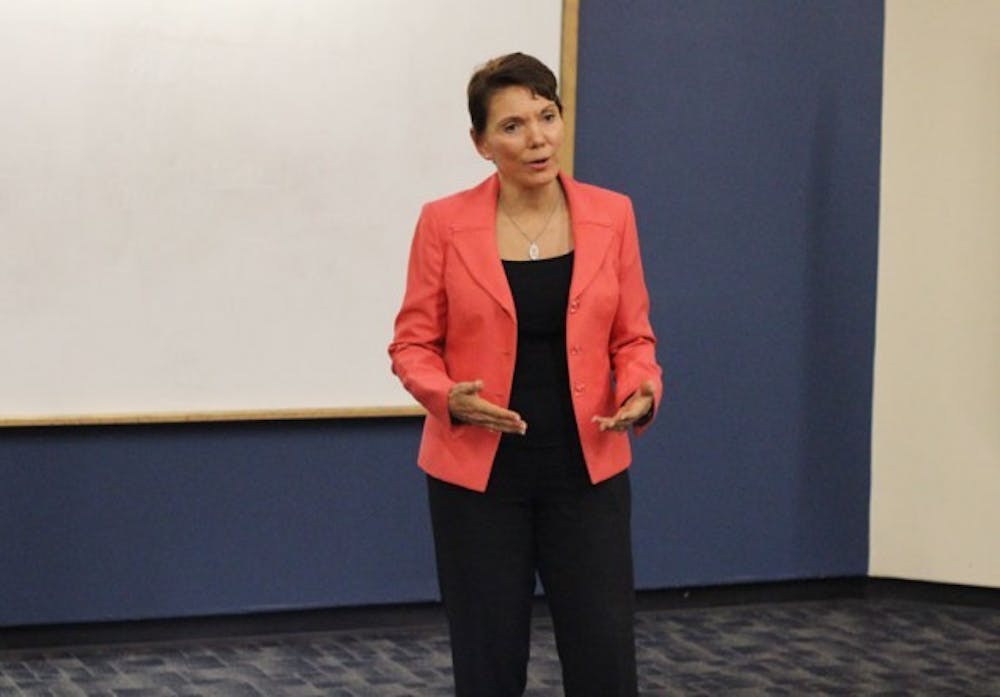
Reggie Littlejohn has made it her mission to inform people about what she sees as the truth of China’s one-child policy.
The activist came to speak at UB on Tuesday about the work of her non-profit organization, Women’s Rights Without Frontiers (WRWF). UB Students for Life hosted Littlejohn, founder and president of WRWF, who spoke about “gendercide” – the act of sex-selective abortions based on the gender of the unborn child – forced sterilizations and forced abortions in China.
Littlejohn said WRWF is a “voice for the voiceless.”
Before she created WRWF, Littlejohn was a litigation lawyer in San Jose, California for eight years. As a litigation lawyer, she also handled political asylum cases of refugees in the United States. Littlejohn’s first asylum case in the mid-1990s involved a refugee from China who was forcibly sterilized.
“At that time, I knew China had the one-child policy, but I did not realize that it was enforced through forced sterilization,” Littlejohn said.
Soon after, Littlejohn became ill and had to stop practicing law.
After five years of hospitalization, Littlejohn decided in 2008 she wanted to give a voice to Chinese women and children. Having already familiarized herself with China’s one-child policy, she said she wanted to dedicate her life to informing people about the policy.
“During that time when I was really sick, I felt I needed to evaluate my life and make a decision about whether I wanted to continue the way I was living my life,” Littlejohn said. “I wanted to dedicate my life to something that had a value beyond myself and help other people.”
During her talk, Littlejohn expanded on the history of China’s family planning policy, which was introduced in 1979 by the Chinese Communist Party and allows one child per family. She said the policy states if a family lives in the countryside, it is allowed a second child if the first born is a female. In November of 2013, China announced if one parent was an only child, the couple is allowed to have two children.
The Chinese government said the family planning policy has prevented 400 million births, which it views as positive for a country whose large population poses economic challenges, according to a November 2013 article by The Washington Post. The same article states forced abortions, infanticide and involuntary sterilizations are “banned in theory by the government.”
Littlejohn said males are traditionally the preferred sex in China because they are able to provide for their family.
In most cases, ultrasounds lead to “culturally forced abortions,” she said. If the gender of the baby is revealed to be a female, women are often forced to abort by their husbands or in-laws, she said.
Littlejohn refers to the situation in China as “war on women.”
Women in China who become pregnant after their firstborn are in direct violation of the one-child policy, according to Littlejohn. She said these women would often have to have a forced abortion or sterilization because they violated the policy.
“In that case, it doesn’t matter whether that baby is boy or girl – the government will force the woman to abort the baby if she doesn’t have a permit,” Littlejohn said.
Christina Lauria, a senior health and human services major and marketing director for UB Students for Life, said it is scary that this topic is not discussed often. She said she also said the United States care more about its “strong economic connection” with China than the issues with the family planning policy.
Littlejohn said she stays away from the abortion issue in the United States because she said her organization is trying to rally anti-abortion and pro-choice supporters together in support of this cause.
“It doesn’t matter whether you are pro-life or pro-choice,” Littlejohn said. “No one is for forced abortion.”
Littlejohn mentioned that since the Roe vs. Wade decision in 1973, the United States has had over 53 million abortions. China has had over 400 million abortions, most of which were forced, in a shorter time period since the one-child policy started, she said.
“Because of China’s population, one out of every five women in the world is suffering under the one-child policy,” she said.
Christine Schaefer, a double major in German and history and vice president of UB Students for Life, said the presentation brought her closer to the women and children affected by the forced abortion in China.
“It brought me face to face with them,” Schaefer said.
Littlejohn’s organization does more than spread awareness. Her Save a Girl Campaign allows for anyone to donate to families who are being affected by the one-child policy.
“We have had an overwhelming success rate,” Littlejohn said “We’ve saved over 100 baby girls in China.”
The campaign puts field workers in China to go door to door asking mothers to keep their baby and not abandon or abort them. The program will also give the family a monthly stipend for a year to help raise the child.
Supporters can sign a petition on WRWF’s website, which asks the Chinese government to stop the enforcement of China’s one-child policy.
“This is the biggest women’s rights issue and the biggest human race issue,” she said.
email: news@ubspectrum.com



