
The Center for Computational Research recently unveiled a technological system that will allow UB faculty and students to meet with people across the globe without ever leaving campus.
According to CCR Director Russ Miller, the Access Grid (AG) node is a system of cameras and microphones that capture the natural activity of a meeting or lecture.
"It's very close to being in the same room with people across the country," said Miller.
Views of other AG nodes across the globe are projected on a 12-foot screen and can be arranged to fit the needs of the user, said Miller.
"The idea is to build a facility where you can be comfortably seated for many hours with colleagues around the world," said Dr. Jeffrey Tilson, a CCR computational scientist.
According to Tilson, multiple cameras are installed around the $40,000 AG node facility, offering many different views of the room. This allows a freedom not normally experienced in regular videoconferencing.
"If you are at a lecture, you only see the speaker and the back of the audience's head," Tilson said. "With the AG node, you can look at several different views of the speaker, and of the audience, all at once."
Miller said a major advantage of using an AG node, as opposed to regular videoconferencing, is that the AG node utilizes a high-speed Internet2 connection.
The AG node has already been put to use. Miller said that recently, a CCR staff member wanted to attend a training seminar in Hawaii, something the AG node made possible.
"The chances that I would have the funds to send her to Maui are less than zero," Miller said. "But now, she can use the AG node and get trained. So, it pays for itself."
According to Miller, there are currently 150 AG node sites around the world, but the number is rapidly growing.
"After Sept. 11, people started to cut down on their travel because they didn't want to fly," Miller said. "That is when the number of sites really began to grow."
Miller said most AG nodes are located at academic or government facilities and can be assembled at a low cost and with relative ease. This is due to the fact that "commodity equipment" is used, meaning the equipment can be purchased from any electronics store.
"(Since) the hardware is commodity equipment, one can assemble an Access Grid node with kinds of equipment and numbers of components that fits within your budget," said Tilson.
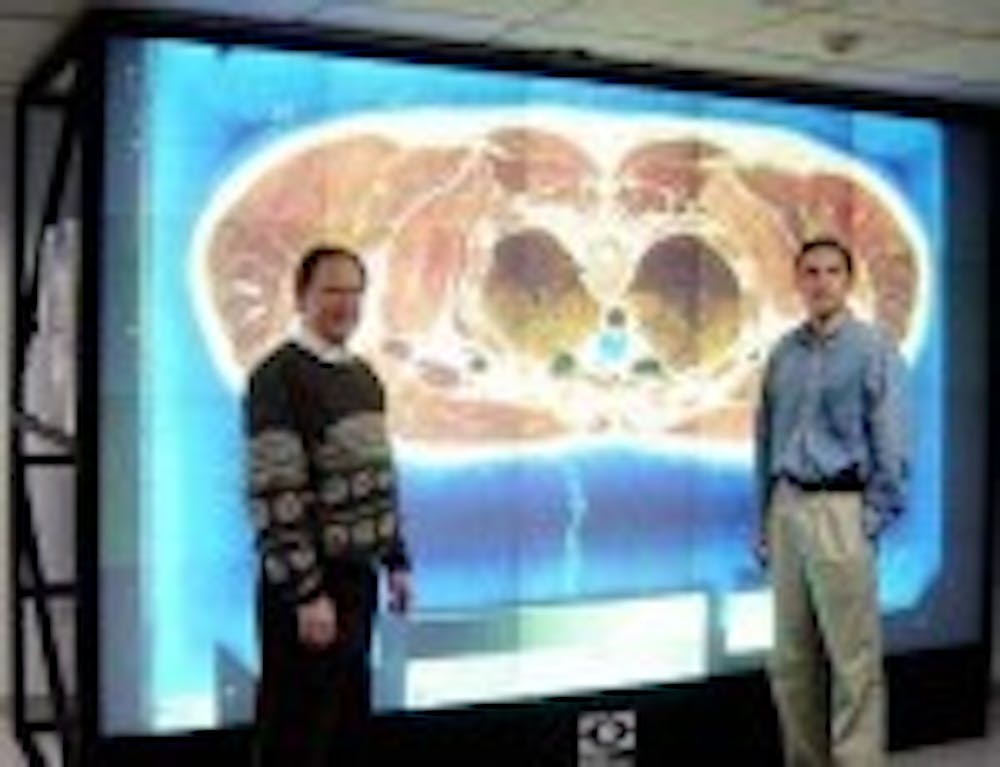
The CCR installed the AG node in November, along with another high-end technological device called a tiled display grid, an 88-square foot screen that can display 15.7 million pixels, rendering the screen 20 times sharper than a regular computer monitor, Miller said.
Applications of the tiled display grid include visualizations of human anatomy and the structure of molecules, which, according to Miller, can be useful to doctors and researchers.
Martins Innus, a scientific visualizations specialist at the CCR, said the tiled display wall is also used in urban visualization, which creates models of urban areas in order to aid public planning. One such project involves the proposals for a new Peace Bridge between the United States and Canada. It is the largest urban visualization project that has ever been done, said Miller.
"The Peace Bridge project involves a lot of public input, so this helps the public gauge the situation accurately," said Miller. "With the right equation, we can even show how traffic jams and lane closures may affect different neighborhoods around the bridge."
According to Innus, computer drawings of proposed bridges and all of the structures in a one-mile radius were drawn, and photographs of the actual area were laid over the drawings.
"This is a way for the public to see what kind of effect a really high bridge might have on the skyline, for example," said Innus.
Students and faculty can also use the tiled display grid and AG node for classes and independent study. The bridge simulations are available for viewing by the general public by appointment.



