
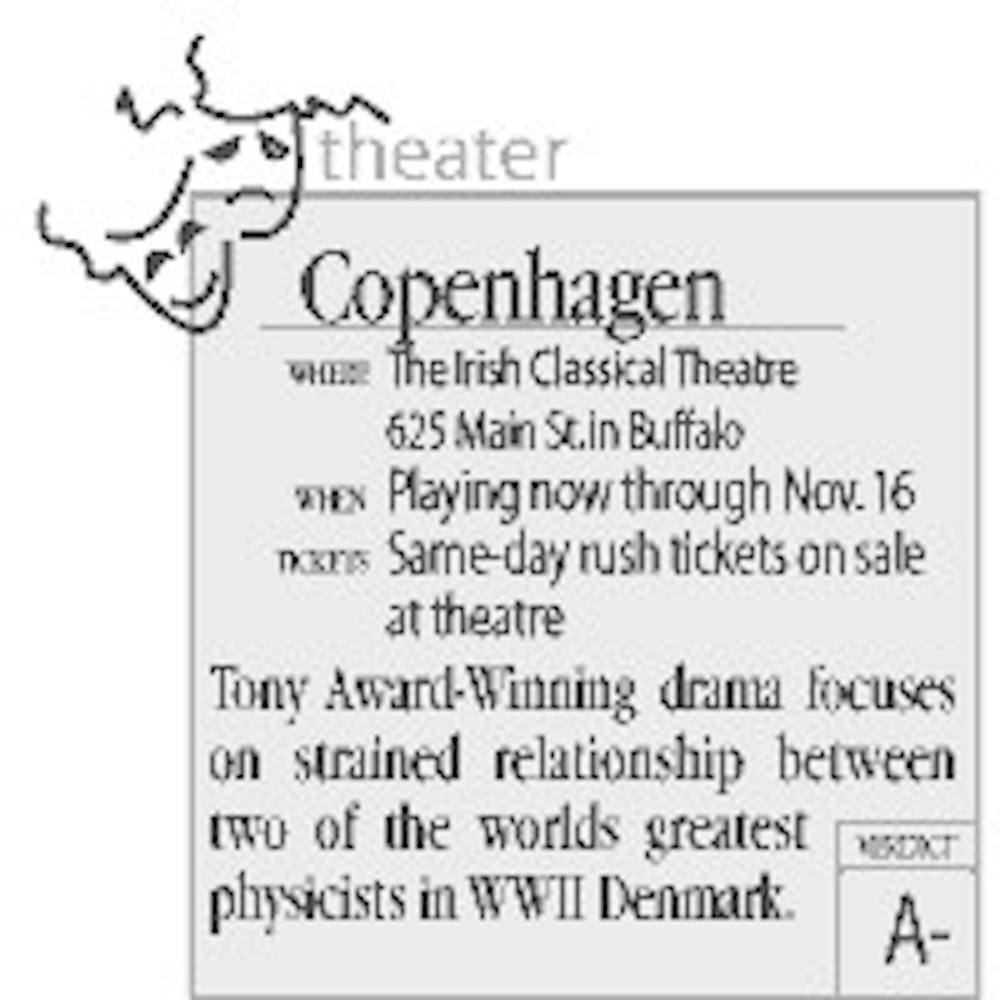
Copenhagen, Denmark, 1941: Two of the world's great physicists meet to discuss friendship, politics - and, most importantly - the atom bomb. Their conversation will have a profound affect on the outcome of World War II, and will hold dire repercussions for all of mankind for decades to come.
Michael Frayn's Tony Award-winning drama, "Copenhagen," the second production in the Irish Classical Theatre Company's season, centers on that controversial conversation between Neils Bohr and Werner Heisenberg, while examining their lives before, after and during that uncertain time in history.
Bohr and Heisenberg were leading forces behind advances in Quantum Mechanics in the 1920's and both received Nobel Prizes for their work at different points in their careers.
The two worked closely together, with Bohr often acting as teacher, mentor and father to the younger but incredibly brilliant Heisenberg. Their friendship was strong, but the war changed it all. Bohr, a Jewish Dane living in Denmark, and Heisenberg, a German working for his country's bomb program, suddenly became worlds apart.
Fortunato Pezzimenti, chair of UB's department of theater and dance, and ICTC's associate artistic director, directed the intense play and subject matter with a minimalist approach.
Three wooden chairs are the only props set up on a bluish-red circular stage. The stage is slightly elevated and encircled by a thin strip of chalkboard, which is scribbled with equations and calculations. The final component of the set is four smaller light blue circles, shaded in such a way that they appear to be spheres. These circles are positioned in the four corners of the theater.
The subtle set coupled with the intimate Andrews Theatre (a square theater whose center stage is surrounded by the audience) places the audience in the nucleus of a volatile atom. Only three actors compose the cast, but the energy between them could barely be held within the tiny space.
Bess Brown Kregal played Bohr's wife, Margrethe, and was the most powerful force within the atom. Margrethe shifts back and forth from a stable, complacent and loving wife to a woman wrought by emotion and pressures too heavy for her to bear. Kregal's tears and desperate demeanor convey the consuming emotions Margrethe must have felt.
Local veteran actor/director/playwright Paul Todaro played the anxious Heisenberg, a man struggling with loyalties to his country, his friend, himself and his fellow man. Todaro's manic approach to Heisenberg alluded to the pace of the play, the instability of the atom in which they're encompassed and the way many people around the world have felt in 1941.
The most impressive quality of the production is the actors' grasp of the scientific terms and history of an incredibly demanding script. Each actor had numerous soliloquies, often following one after another, with only their memory of the script to use as timing. The fluidity and ease with which the actors performed their roles demonstrated a comprehensive knowledge of science and history.
In the end, the play became too repetitive and it seemed as if the actors were discussing the same issues over and over with no conclusion or concession in sight. Though this may have been Pezzimenti's goal to illustrate the gravity of this conversation and subject, the play becomes cumbersome in the latter half of the second act.
What "Copenhagen" ultimately reminds the audience of, though, is the horrific and depraved affects war has on people's lives and friendships; something to which today's audiences should be able to relate.
"Copenhagen" is now onstage at the Irish Classical Theatre through Nov. 16. The theater is located at 625 Main St. in the downtown theater district, and offers same-day rush tickets.



