
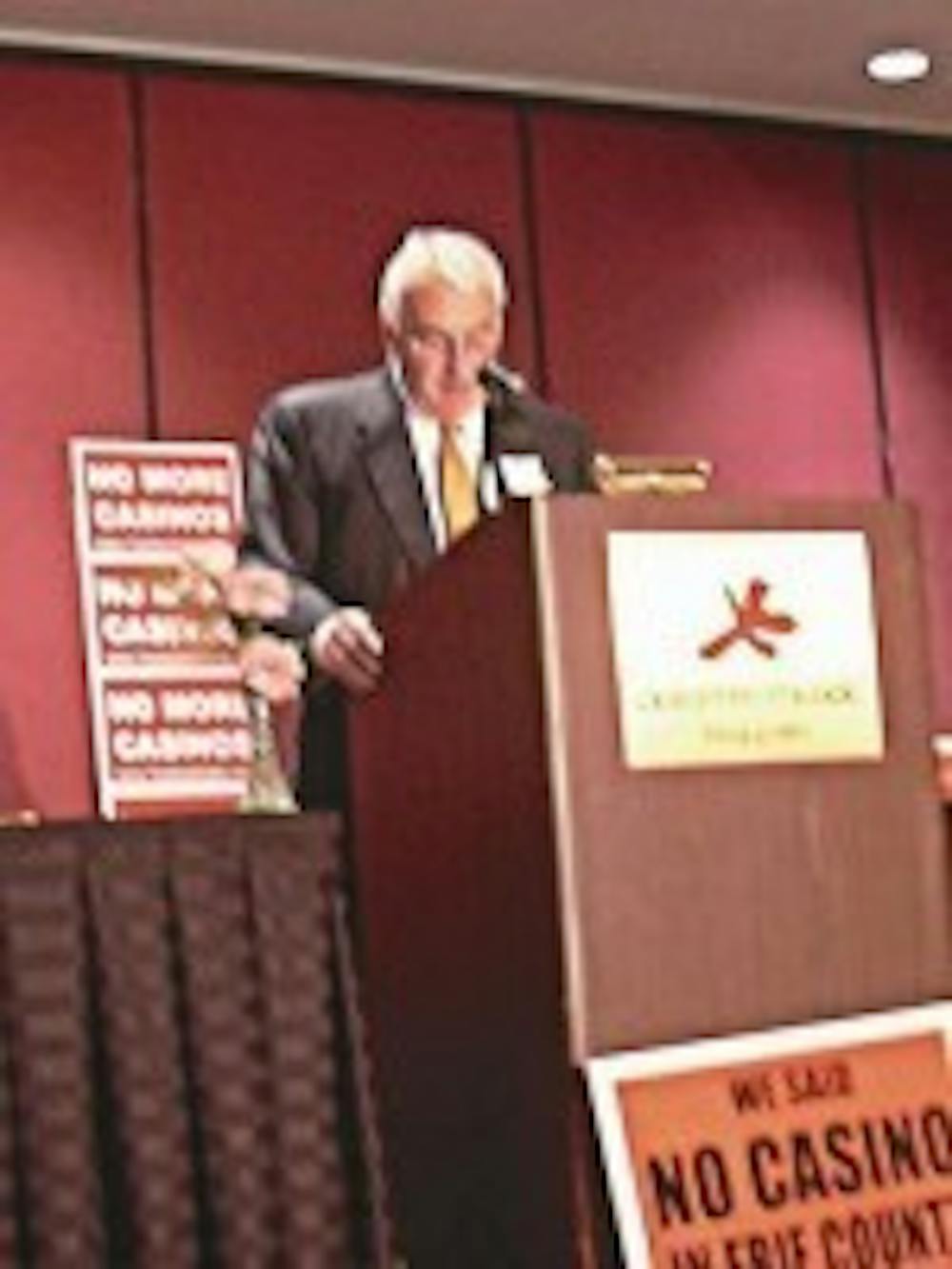
This weekend, the National Coalition Against Legalized Gambling (NCALG) held its regional conference at the Adam's Mark Hotel downtown, promoting organization in the fight against the establishment of a Buffalo casino by the Seneca Nation.
The conference opened Friday with a speech by Buffalo Sabres owner Tom Golisano, who said he is opposed to all forms of gambling.
Golisano has also put an end to any New York State Lottery advertisements at Sabres games, and referred to slot machines as "video crack."
Mary Bartley, co-chair of Citizens Against Gambling in Erie County (CAGEC), said that she was impressed with Golisano's speech.
"He is the first person of that stature to make a significant financial contribution," she said.
Judy Metzger, CAGEC secretary, said that Golisano also aided the cause by lending his voice.
"He will help other people understand the issues," she said.
The conference focused on three platforms against the casino: legal, economic and moral.
The legal platform presented and discussed consists of a lawsuit filed in federal court as well as one filed in state court.
Joseph Finnerty, coordinating counsel for the team of attorneys challenging the casino, spoke about the legal issues involved.
"Our focus on the lawsuits is strictly legal and very technical," he said. "I feel very optimistic that we are right on the law. Does that mean we will win? I won't go that far."
Proponents claim that a casino will bring 1,000 new jobs the Buffalo area. Dr. John Kindt, professor of business and law at the University of Illinois at Urbana-Champaign, disagrees.
Kindt has studied the effects of gambling on local business, and discovered the cost-benefit ratio for cities containing casinos. The ratio he found was 3:1, or three dollars spent by the city for every dollar earned.
According to Kindt, a casino in the Buffalo region would lead to an overall loss of over 2,000 jobs.
As far as the promotions offered by casinos, including free drinks, hotel rooms, and food, Kindt said that local businesses "can't compete with free."
Anna Kay France, former associate professor at UB, said she attended the conference out of concern for Buffalo's cultural community.
"People have maintained most of the theatres (in the area), but I know that they are functioning on the edge," France said, "and I really feel that a loss of disposable income could send them over. It's part of what makes Buffalo a vital place to live, and I don't want a casino to take that away."
UB professor Dr. Henry Taylor said that in addition to moral issues, the possible fall-through of Buffalo's economy should be enough to discourage the construction of a casino.
"The big question, morality notwithstanding, is will this type of economic development activity generate the type of prosperity advertised? In the real world, will the economic benefits outweigh the social costs?"
The conference came on the heels of Mayor Byron Brown's decision to support the sale of Fulton St. to the Senecas, a step back for those in opposition of a casino. Participants, however, were enthusiastic and optimistic about their chances.
"We're winning - we really are winning," Bartley said. "We're hoping to get other groups involved. From a young person's point of view, this is the future of Buffalo, the future of their region."



