
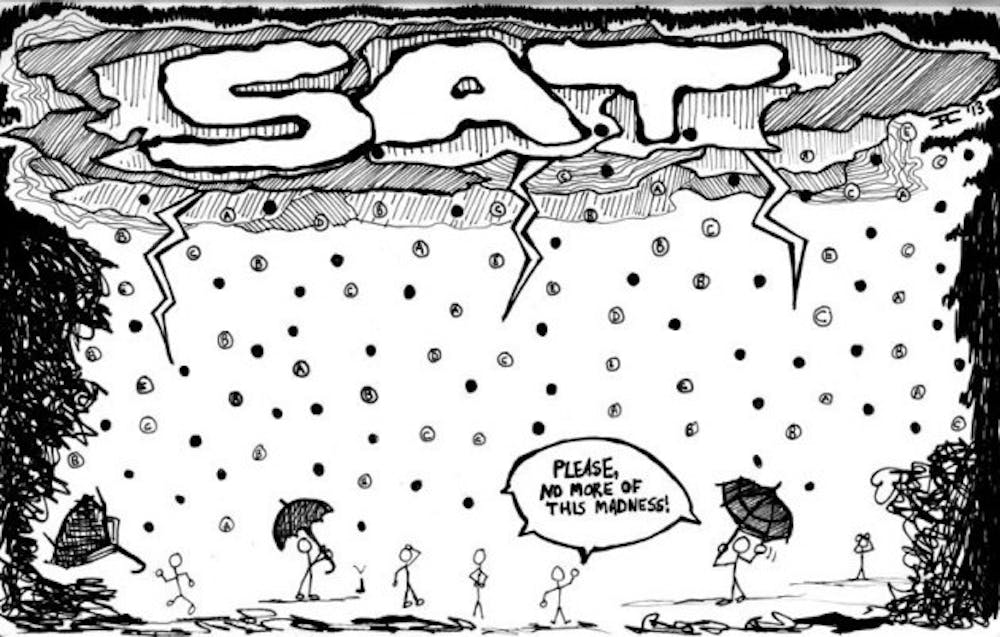
You will take hundreds of exams and quizzes during the course of your education. Some will be to test your general comprehension of a topic; others will be more in-depth, focusing on parochial themes and material delved upon in class discussions. What is important, however, is that each of these tests are different for different classrooms, different age groups and different schools.
And then there are standardized tests.
For the last decade, the importance of standardized tests in American education has steadily increased starting with No Child Left Behind, a law with good intentions - that being to make sure all students get the education and attention they deserve, even if they have been ignored in the past - but ineffective in execution. In more recent years, good performance on the tests has been vital, as the Obama administration has linked good grades with teacher evaluations.
In states like New York, you have to take a series of mandated exams (the Regents exams or your state's equivalent) at the conclusion of your coursework that tests your knowledge on a given topic, and then to get into college you have to take a couple more (the SAT and/or ACT, plus SAT II exams). After several hours of recollecting months of specific facts and function, you have a grade on the best intelligence scale our country could come up with.
Much like The Spectrum's editorial board, people currently protesting across the country know the standardized testing system needs a serious overhaul.
High school students, teachers, parents and college professors around the United States have recently begun a movement after a Seattle high school decided to unanimously refuse to administer standardized tests "on ethical and professional grounds." From Portland to Providence, groups brought attention to "high-stakes testing," which requires students to pass or they don't graduate, even if they pass the class.
So what exactly is wrong with the standardized testing system?
The overuse and misuse of standardized testing across the United States is one of the most important conflicts in the education system, and it seems like everyone is jumping on board to criticize it lately. Scholar and Duke University professor Cathy Davidson describes today's youth as "assembly line kids on an assembly line model," each part of a one-size-fits-all model.
But one of the most unfortunate parts of the system is the fact our "one-size-fits-all model" doesn't really serve all. Exams that require payment, such as the SAT, already set an unfair advantage for people without the financial means to not only pay to take it but also for additional tutoring, study supplements and other materials.
For that, college-entry standardized tests are frequently considered to be tests only for the white middle-to-upper class. So if standardized tests are actually a valid measure of intelligence, then does that validity hold for all ethnic, age, gender and income groups?
The current system isn't really a triumph for anyone - not the white middle-to-upper-class, not the teachers and certainly not the education system as a whole. Because good scores will give good teacher evaluations, teachers will narrow and mold their curriculum around the tests (also known as "teaching to the tests") a good majority of the time, and what is not tested is not taught. The curriculum omits complex social problems and creative instruction, and in their place leaves a robotic system of education. Listen, remember, repeat. Then wipe the slate clean.
For this reason and many more, the SAT is the stuff of high school students' nightmares. It's nothing more than a collection of random facts that you can only hope you didn't rub out of your memory completely. An empty acronym with a big meaning, the infamous exam helps determine where you're going to go for college and how much money you're going to get to go to that college.
Admission, merit-based scholarships and placement are all based on how high on the scale you place. And as important as it is, you would think you'd be able to focus on getting the best possible score on it while not having to worry about anything else.
Wrong. An exam that has no weight on your actual schoolwork and doesn't affect your final grade or graduation status has to be studied for and taken while you worry about the classes that do have weight. And you have to pay for it - from preparation to testing.
The education system has created an industry based around preparing for the SAT, a terrifyingly manipulative move to profit on students trying to move onto college and become the profitable member of society they've been told they have to become. In its current state, the SAT is only beneficial to colleges as a way to compare apples to oranges. Ask any college student (or consider it for yourself): did the SAT (or ACT) prepare you for college in any way? You don't even have to answer - we know it already.
Surely this isn't the best way to measure intelligence, but nobody in the United States has thought of any other way. Other countries like Finland - which ranks consistently near the top in math, reading and science - take very few tests and are all low stakes, using assessment as a tool for development and not accountability.
The National Center for Fair and Open Testing lists nearly 850 four-year colleges that don't use the SAT I or ACT for admission. Some of these schools exempt students who meet grade point average or class rank criteria, while others only use SAT or ACT scores for placement or research. Two Buffalo universities fall into this list: Medaille College and Villa Maria College. Out of all the options, there's only one SUNY school: SUNY College of Technology at Delhi.
It is clearly possible to assess student intelligence without using standardized test scores, as 850 schools and multiple countries have proven. A serious problem with the tests is it forgets the margin of people who are brilliant thinkers but terrible test takers. The measure of a man is not determined by a spot on a 0 to 2400 scale, but with standardized tests, school is where testing rules and only the good testers matter.
Exams like the SAT only measure a few key components: math, reading comprehension and writing, which is rarely even looked at by universities. What it can't measure, according to education theorist Bill Ayers, is "initiative, creativity, imagination, conceptual thinking, curiosity, effort, irony, judgment, commitment, nuance, good will, ethical reflection or a host of other valuable dispositions and attributes." Instead, it measures "the least interesting and least significant aspects of learning."
But an additional question to ask is if the tests add anything significant to what admissions officers already know about applicants, and that all depends on a case-to-case basis. Imagine you have two students - one who does great in school but is a poor test taker, and therefore does not do well on the standardized tests, and the other whose grades aren't up to par for whatever reason but does phenomenally on the standardized tests. Can you, without a question or a doubt, pick who should be admitted?
Instead of eliminating standardized testing (unless it's completely necessary), it's imperative our educators and the Department of Education work together to create a new, fair system that focuses on teacher evaluations in the appropriate context and doesn't teach for the tests. Perhaps the focus can be shifted to the test subjects that correspond most with the student's major. Is that even a possible goal? Difficult to tell. But the system is too broken to keep it as is and important enough not to eliminate it all together.
Email: editorial@ubspectrum.com
 Photo: The Spectrum Archives


