
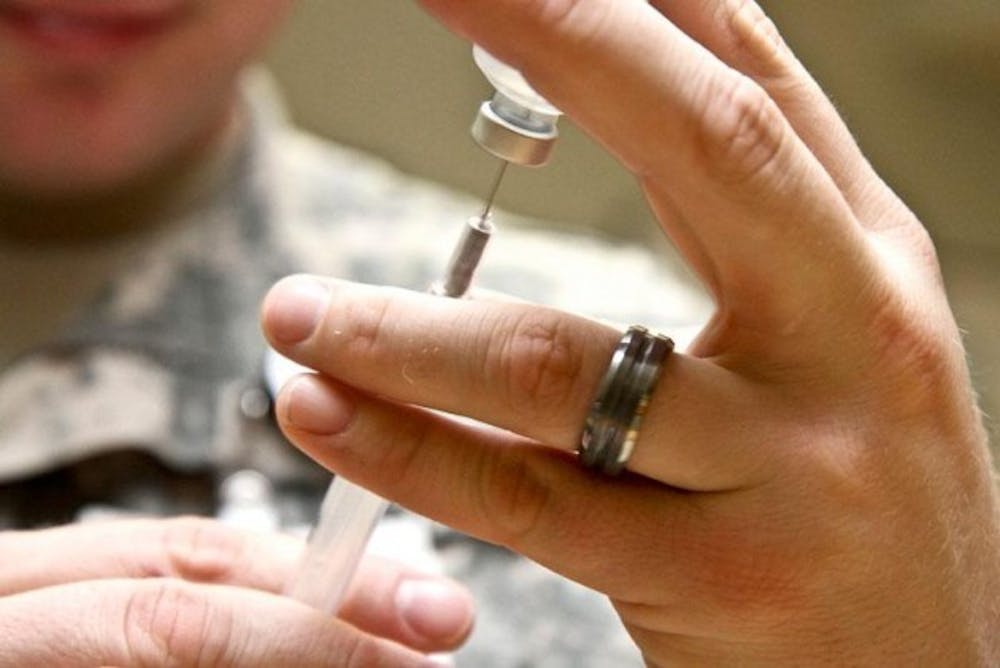
The Center for Disease Control (CDC) estimates the influenza virus hospitalizes 200,000 people and kills 23,600 more each year. Still, most college students will not get the flu shot, according to research done at UB.
Janet Yang, a UB communication professor, ran the study. She theorizes that a primary cause of the low rate of student influenza vaccinations is students' tendency to overestimate their own knowledge about the dangers and benefits of the influenza vaccine.
College students are particularly susceptible to influenza because they generally share close living quarters. But despite, the danger most students will risk both their health and their attendance grade and not get vaccinated this fall.
After the 2009 outbreak of the H1N1 strain of the influenza virus, better known as the swine flu, Yang surveyed 371 UB students about their knowledge of the virus in 2010. The answers revealed a discrepancy between what students knew and what they thought they knew about the flu, according to her recently published study, "Too Scared or Too Capable? Why Do College Students Stay Away from the H1N1 Vaccine?"
"Students are overconfident about their health and their ability to make decisions for their well-being," Yang said. "They say to themselves, I'm young, I'm fit, it's not going happen to me. That happens to younger kids or to elderly people. And not knowing the facts certainly contributes to this."
Yang believes that the result of this lack of knowledge is the low rate of vaccination among students.
Even after the swine flu killed over 14,000 people globally, according to the European Center for Disease Control, only an estimated 10 percent of college students received vaccinations.
"Students were asked to rate their knowledge of the [H1N1] virus from one to 10," Yang said. "But they were also given 10 questions gauging their knowledge of the H1N1 virus. There were students who put down seven or eight [to indicate] their knowledge of the virus, [but] were only getting two or three questions right about the virus."
Laurie Plewinski, a junior biological science major, however, knows a lot about the flu.
When Plewinski was 5 years old, she didn't get the flu vaccine. She contracted the virus and her left lung collapsed because of her asthma. Her asthma attack from the flu caused her to be in the Intensive Care Unit for two weeks.
She now gets the flu shot every year.
"I learned early on that I never wanted to get that kind of flu again," Plewinski said. "Though most people have it in their mind that every time they get the flu shot they get sick - it's not the case. The 'flu' they get is not as severe as if they had gotten it without the pre-exposure to the virus."
According to Yang, a cause of students' misinformation about the influenza virus is their faith in unreliable sources. Some students reported learning about possible negative side effects of the influenza vaccine from watching YouTube videos.
Student concerns about the harmful effects of the vaccination were a dominant factor preventing them from getting flu shots, according to the survey. Yang believes these concerns are indicative of a lack of student knowledge about the vaccine.
"Look at statistics and studies from the CDC, and it seems that the flu shot is perfectly safe," Yang said.
The CDC states the flu shot is the best method of protection against the flu, and the most recent statistics indicate that young adults who receive the vaccine are 30 percent less likely to contract the flu than those who don't.
"[Students] should definitely get flu shots," said Dan Azzinaro, a junior history major. "It's a vaccine and vaccines are pretty much always beneficial. The idea that vaccinations are harmful is ridiculous."
Students appear to view the flu as a minor ailment, which causes some to think the flu shot is an extra precaution, not a necessity.
"I don't see the difference between the flu and the common cold and I don't take the common cold too seriously," said Melanie Frazier, a freshman math major. "So I don't see why I should put myself through needles."
The CDC admits the effectiveness of the flu shot varies significantly both from year to year and from person to person, depending on the strain of flu which effects a population and the health of the individual vaccinated.
Even some students who get their flu shot regularly do so more out of habit or parental pressure than genuine concern for catching the flu.
"I'm getting my flu shot because my parents want me to," said Courtney Lowinger, a freshman biology major. "I don't really know a whole lot about the vaccine itself."
Students who wish to get vaccinated can do so for free on Nov. 6 in the Student Union Social Hall between 9 a.m. and 3 p.m.
Email: news@ubspectrum.com



