
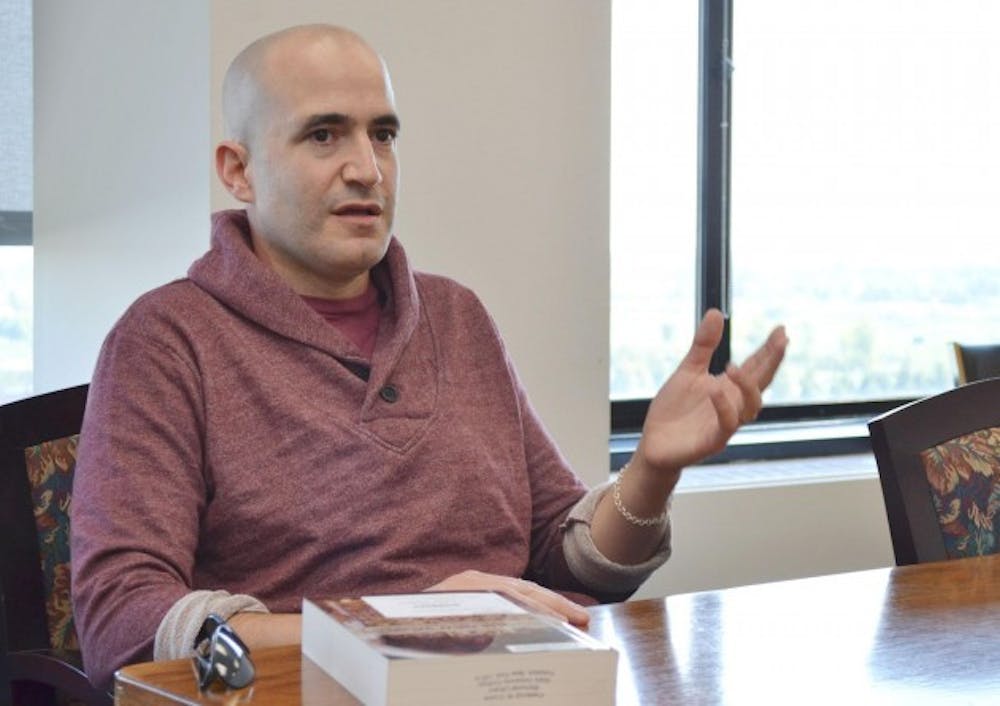
The importance of culture, for some, is buried underneath their exterior. Some people keep their culture tucked behind their conscious and only express it on selective days on the calendar. Others, such as UB professor Justin Read, wear their culture on their sleeves and allow it to reign supreme in every element of their lives.
Last Friday, Read discussed some of his research included in his current work as well as his other book, Modern Poetics and Hemispheric American Cultural Studies, at Hallwalls in downtown Buffalo as part of The Scholars at Hallwalls lecture series.
Read is a Mexican-American associate professor in the department of romance languages and literatures whosedefinition of culture has stemmed from his Mexican heritage. His face breaks into a smile when he begins to speak about his culture and his definitions of the word.
"For me, the smell of fresh tortilla is culture," Read said. "It's the simplest thing you can have but it smells like culture and just the thought of that smell makes me smell as if the tortillas were here right now. That smell shapes our existence, brings back memories and anchors how we live in the world. It provides you a sense of place in the world."
Read grew up in a bilingual home in Southern California and visited Mexico often. The cultural differences and enrichment he encountered in his life led him to consider teaching in areas of cultural studies. After obtaining his Ph.D. in comparative literature from the University of Michigan, Read said UB chose him. He had stayed in Buffalo briefly and was already familiar with the culture of The Queen City.
His family consists of many educators and artists. Both sides of his family surrounded a young Read with art, books and music for as long as he can remember. With this upbringing, Read reminisces and thinks maybe he was born to immerse himself in cultural studies.
While his family helped shape him, Read mentions Julio Ramos - his Latin American literature professor at University of California, Berkeley - as a huge inspiration.
"[Ramos] did a lecture one day where he read a poem by Pablo Neruda next to a song by Lou Reed, and it fully altered my consciousness," Read said. "Julio is pound for pound the smartest human being I've ever met."
Read is currently on a leave of absence for a fellowship from UB's Humanities Institute. The institute links different departments in humanities, funds research groups and provides scholarships and fellowships.
"I was fortunate to get this fellowship and it allowed me a break from teaching so I can just concentrate on my research," Read said. "I've been working on this research for almost 10 years and I need to finish this book."
Read is currently working on a new book, that is yet to be titled, about several sites in Mexico City. He is looking at several architectural models in the city and connecting how those landmarks make sense to the people and environment and how they relate to the city's culture.
Making connections is one of Read's largest strengths. He makes intricate connections through his teaching, literary works and even outside of the university.
Last year, Read worked with Colleen Culleton - another associate professor in his department - on the Fluid Culture lecture series. The lecture aimed to make connections with water and how waterways in the city of Buffalo shaped the culture. During the lecture, local art was showcased while environmental scholars took turns speaking.
"In his work on Fluid Culture, [Read] showed greatdedication to the Buffalo Community and to UB's role as a public institution," Culleton said. "He is an advocate for both the arts and the humanities in and out of what we think of as the traditional bounds of intellectual life."
Professor David Castillo, chairman of the romance language department, can also vouch for Read's passion for connecting cultures. According to Castillo, Professor Read embodies cultural studies through connections with institutes in Buffalo outside of UB. Castillo also commented on Read's ability to carry out projects like Fluid Culture while being able to have an impact in the real world.
Professor Read's impact in the real world translates to his classes that he teaches at UB. His application for tenure was met with positive responses with letters from students, according to Castillo.
All of Read's classes are taught in Spanish, which is standard for language courses. He attempts to connect with all of his students and help them all succeed in his courses.
"I like to set a high benchmark for my students but by engaging them and helping them meet that goal," Read said. "Communication is a key component especially in a second or third language and I'm here to communicate with my students."
Past students have commended Read on his teaching skills and his ability to relate culture to all aspects of Latin American cities - no topic is off limits.
Senior Spanish and biomedical studies major, Karina Vattana, has taken classes taught by Read. She commends Read for touching on themes in class that the typical Spanish professor might not think to discuss in class, such as the drug trades and street gangs of Latin American countries such as El Salvador and Brazil.
"A good professor takes risks in what he teaches and doesn't shy away from 'ugly' or 'taboo' topics," Vattana said. "Those topics of discussion and lectures are lectures that I've never forgotten, because they taught me more about the world than a book ever could."
Vattana is currently studying abroad in San Jose, Costa Rica due to Read's influence and said she would definitely take another class with him if given the opportunity.
While Read's Mexican heritage aided him in pursuing a career in Latin American cultural studies, he still acknowledges other forms of culture. He states culture can be as simple as looking at the Mona Lisa, but he considers it much more than that.
"At a certain point in life, you have to expand what your notion of culture is," Read said. "Culture is the symbolic universe that we live in like hard tangible objects but it's also a world of symbols and meanings around us. From Shakespeare figuring out the world around him to poor people in Rio who are cultured also trying to make sense of the universe around them, both figured out their place in their environments."
Email: life@ubspectrum.com



