
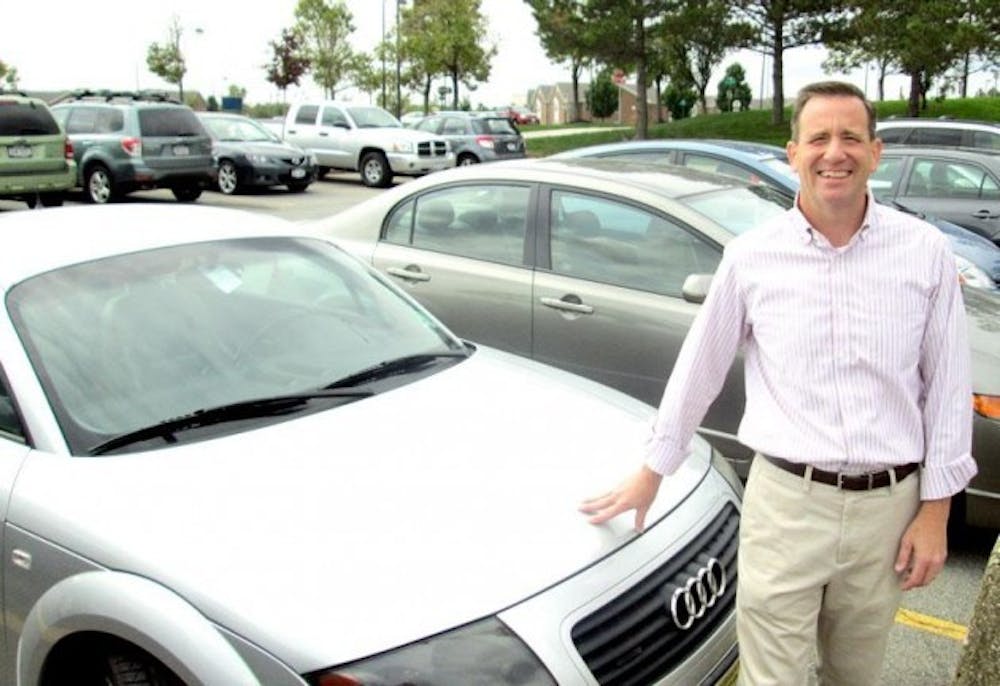
Airport security procedures have become second nature to Professor Robert Wagmiller. He barely notices the pressure change in his ears as the plane takes off and lands. It's no big deal to him; he does the same thing every week.
He has to since he commutes to class from New Jersey.
Wagmiller, a professor of sociology at UB since 2003 and resident of New Jersey since his wife took a job there in 2007, commutes to Buffalo every week from Mountain Lakes, N.J. - a small town a half hour outside Newark.
He takes a 5:30 a.m. flight out of Newark on Tuesday, stays at an apartment near the Buffalo Zoo until Thursday night and flies back to Newark that same night.
This way of commuting is less time consuming than driving, but much more expensive. An average round trip flight from Newark, N.J. to Buffalo, N.Y. can be anywhere from $200 to $330, according to expedia.com.
Prior to this semester, Wagmiller would drive for five and a half hours - 341 miles - to UB from his house every Tuesday and drive home every Thursday.
Since the average car in 2012 gets 23.3 mpg - according to a study done by Truecar.com - and the average gas price from Mountain Lakes, N.J. to Buffalo, N.Y. is $3.75, the average amount of gas Wagmiller would spend commuting one way is $59.15. This commute costs, on average, $3,783.35 per academic year.
But Wagmiller isn't complaining.
"If I were to work in New York City I'd spend an hour getting there and an hour or an hour and a half getting back every day," Wagmiller said. "So me driving [to Buffalo] once a week really saves time."
Wagmiller said the commute has grown on him, and he is beginning to see its hidden blessings.
"At first [the commute] was tough, especially when I was driving it," Wagmiller said. "But after a while I got used to it. It became the routine. Like my students have heard me say, I'm more popular in two places than I would be in just one. Because this way people don't have to deal with me every day."
Wagmiller initially considered leaving UB for universities closer to his home but his affection for UB, particularly his colleagues in the sociology department, convinced him to stay.
His wife supports him the most when it comes to his job. She convinced him to stay by saying, "'you love where you work, you love the people you work with, they work with you to succeed and celebrate success. Who knows if you'll find that somewhere else?"
Since then, Wagmiller has led a double life while school is in session. He jokes around about one life where he lives alone and is a professor and another life where he has a wife and a dog and stays at home.
The distance hasn't stopped Wagmiller from being active at UB. As of this semester, he is the director of graduate studies for the sociology department, and he recently organized a 5K charity run beniftting cancer research.
Professor Robert Adelman, head of the sociology department, said Wagmiller is thouroughly dedicated to UB and his students.
"Graduate and undergraduate students often talk about how much time Professor Wagmiller spends with them and how much energy he devotes to them," Adelman said. "The distance he lives from Buffalo has made no difference in his ability to connect with students because Professor Wagmiller is the consummate professional."
Wagmiller is relieved the university had been so supportive about his commute. He makes sure he is always involved in campus activities in his department. Wagmiller manages to stay active in the university by keeping a hectic schedule while in Buffalo.
On one day, Wagmiller will go to a three-hour graduate seminar, meet with his hiring committee (which he is the chair of) and he makes sure to meet with his students.
The commute from New Jersey hasn't prevented Wagmiller from connecting with his students. Professor Elizabeth Gage, a former student of Wagmiller's who recently collaborated with him on a grant proposal, said both as student and colleague Wagmiller's distance from UB hasn't been an issue.
"He lathers attention on his students, and he pushes students to go outside their comfort zone," Gage said. "When I was a student I guess he was commuting [from New Jersey] but I didn't notice. He was on my dissertation comittee which is a pretty close relationship, and I didn't even know [he was living in New Jersey] or if I did know it wasn't like a big deal.
"In some ways because he commutes he makes a bigger effort to connect with colleagues when he's in town than the rest of us. He's not always here so he definitly makes a point of making interactions happen when he is."
Wagmiller attributes his ability to connect with students to his effort to make his course work as interesting as possible. He tries to make the content of his leacutes relatable to his students. He wants to develop close relationships with them, even though he isn't available every day of the week.
"When I first started out, I wanted to be serious and I gave boring lectures," Wagmiller said. "But after a while I got more comfortable and was able to tell jokes and my lectures got better. Now I do things which, I hope, are more interesting for the students. Like right now I'm doing a study on movies, because students, at least most students, enjoy watching movies."
Wagmiller hopes to continue teaching at UB for years to come, despite his unconventional commute.
Email: features@ubspectrum.com
 Photo: Courtesy of SUNY

 Photo: Courtesy of UBNow Graphic Designer Kristen Kowalski
