
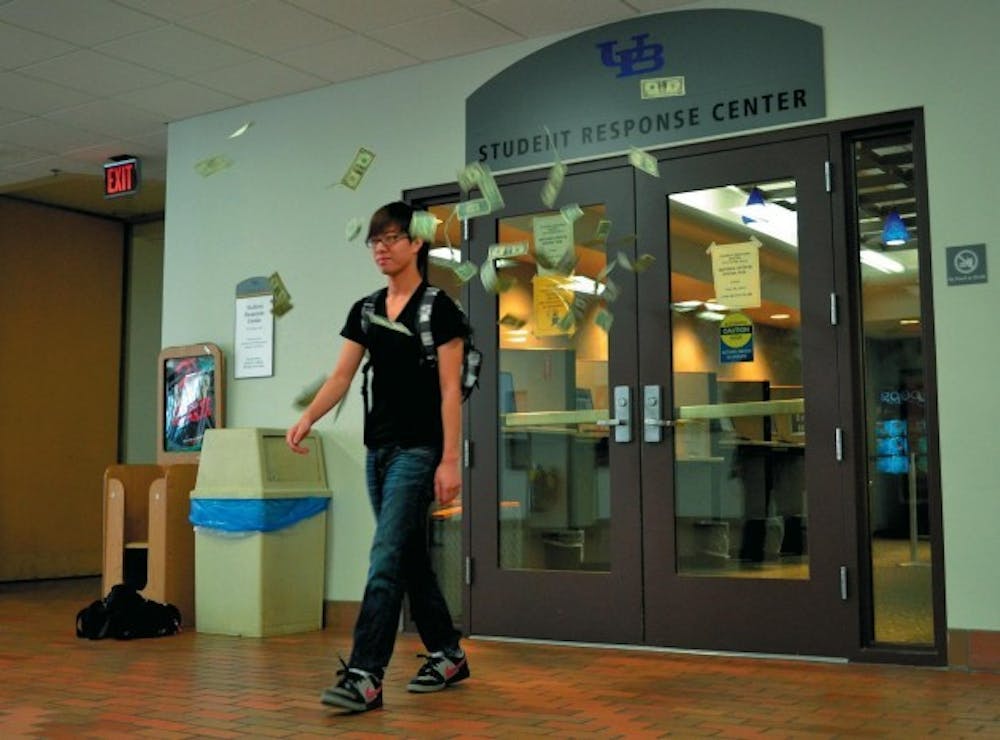
UB's new financial aid office is hoping to ease student financial aid problems through the use of advisers during the upcoming school year, but some incoming freshmen are not aware of the new program.
UB implemented a new financial aid system in which each student is assigned to one of 11 financial aid advisers who will be familiar with the students' cases, instead of the previous first-come-first-serve basis.
"The Office of Financial Aid has been developing this new way to advise students over the past several months," said Jennifer Pollard, UB's interim director of financial aid in a press release last spring. "With a university of UB's size, it is very important that students have a personal point of contact for their financial aid needs and that they feel the service and information they receive is efficient and accurate."
Pollard, who has implemented these same programs at major universities such as Northeastern, Columbia, and Jacksonville University, said that UB has already notified incoming students applying for financial aid of their advisers. The office sent postcards with the name of their adviser and contact information listed with an email address.
William La Shomb, a freshman biomedical sciences major, said that he has yet to receive any information of his adviser or the new program.
"I did not know that UB has financial aid [advisers] and I haven't yet been notified of mine," La Shomb said in an email. "As I do not know who my financial aid [adviser] is, I have no way of contacting him/her."
La Shomb said that since he hasn't used his adviser yet, he believes many other incoming freshmen are in the same situation. La Shomb thinks that the idea for the system is a good one but has been poorly publicized to freshmen.
Marlee Rothschild, a freshman undecided major, believes that the new program can be useful in answering questions that she or her parents may have about financial aid, but also has yet to receive information about her adviser.
"Both myself and my parents were not aware that there are financial aid advisers assigned to students," Rothschild said. "Now that I'm aware, I do think it's a great idea. It makes financial planning easier when you are guaranteed to speak to the same person every time."
Pollard said that the time that students were admitted or submitted their FAFSA would have affected whether they were notified or not.
"6,840 prospective students were identified and sent a postcard at the end of March, 2012," Pollard said in an email. "This was a one-time mailing for all the prospective students that were packaged at the end of March. Prospective students that are still being admitted (transfer) or students that did not have their FAFSA on file by March 27 when the file was created would not be in the mailing."
Brandon Gilliland, one of UB's financial aid advisers, said that advisers have been reaching out to their caseloads regarding federal policy changes, deadlines, and other important information, giving a more one-on-one experience to the students.
"With the caseload approach, our goal is to continue helping students to the best of our ability," Gilliland said in an email. "By implementing this new program, the financial aid advisers have been able to establish relationships with students that will follow them through their educational career."
Gilliland said that advisers and the financial aid office encouraged students and parents to meet with them to put a face to a name and to become better acquainted with each other. Gilliland feels that the financial aid department has become interactive with the entire student body to educate them about their financial aid.
"For the incoming freshmen, we offer a variety of information regarding the financial aid process," Gilliland said. "Financial aid advisers also attend open houses, orientations, and other new student programs to answer any questions or concerns that the incoming class may have."
Each adviser is assigned to approximately 1,000 to 1,200 students, divided by last name or academic program.
Financial aid advisers were put into place during the spring semester of the 2011-12 school year, after disbursement of financial aid money and student loans in the fall was given out almost three weeks later than in previous years.
The financial aid office used to employ 21 staff members with 10 advisers and 11 staff members to help the more than 28,000 students solve their financial aid issues. The changes to the disbursement of money angered students, Pollard said last spring.
Pollard believes that the financial aid office being located in Porter Hall this coming year will also help answer questions that students have.
"The new office provides students with access to their financial aid adviser and one place to go for all financial aid related questions," Pollard said. "An electronic communication is being sent to all student, staff and faculty on June 18, 2012, sharing the changes with the Office of Financial Aid."
La Shomb believes that even though he hasn't received any information about advisers, the idea is still one that could help incoming freshmen.
"I do think it's good that there are aid [advisers] assigned to students, as it makes it easier for individuals, and gives students a resource for financial inquiries," La Shomb said. "I can imagine that this would be especially valuable for incoming freshmen, as the monetary transition from high school to college is an important one."
Gilliland strongly believes that the new system will bring top-notch service to parents and students at UB regarding their financial aid.
"I am a firm supporter of the caseload approach in regards to financial aid," Gilliland said. "By doing so, that specific adviser becomes familiar with students' circumstances, which allows for a more personal and direct approach."
Email: news@ubspectrum.com



