
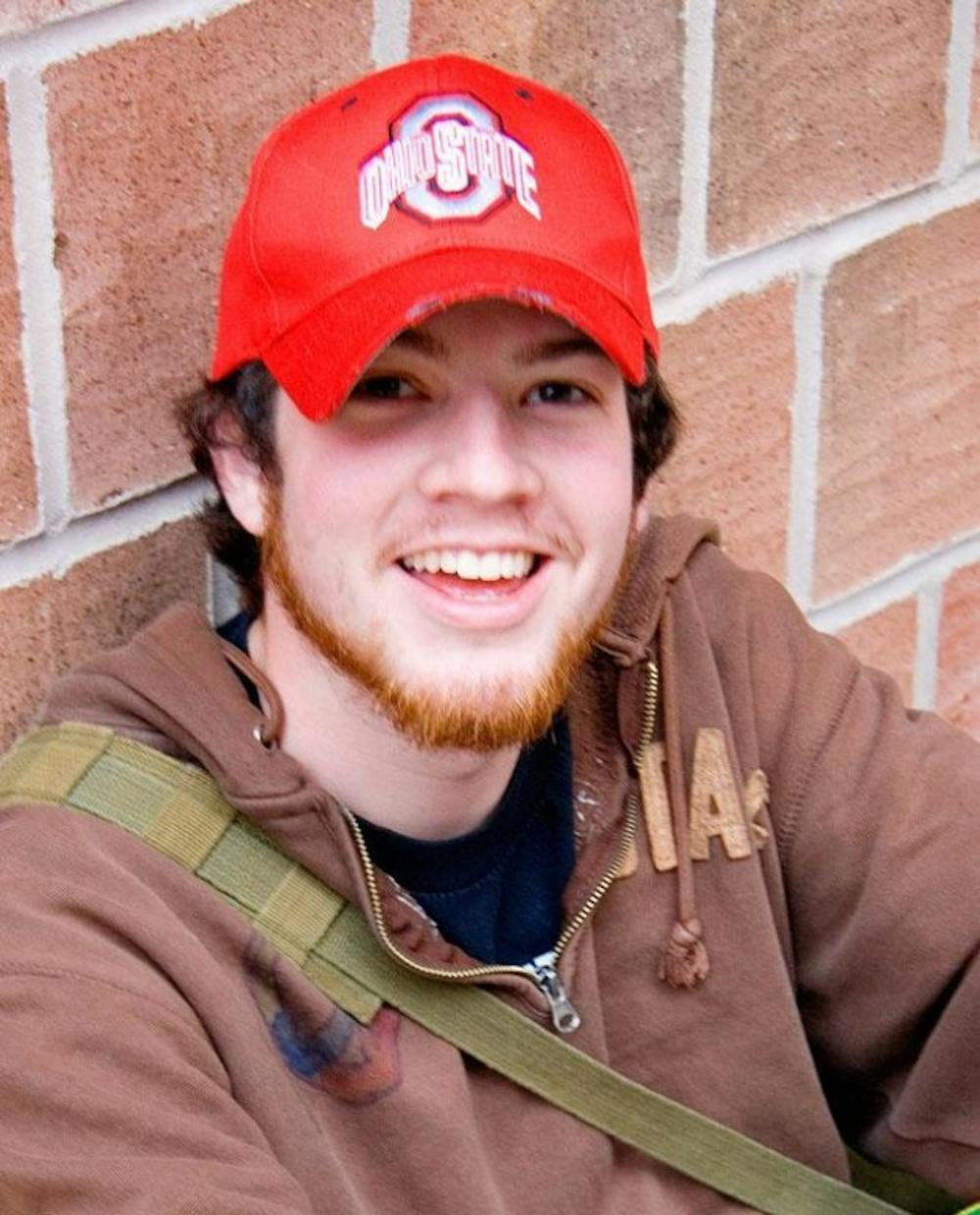
Around midnight on March 4, 2009, Andrea Zlotowitz was doing laundry in Spaulding when she heard an awful, deafening sound - as if something had hit the pavement outside. She walked into the tunnel of the Ellicott Complex and found a body on the ground.
To her horror, it was the body of Jonah Dreskin, a fellow UB student and her childhood pal. She called University Police. She also called his family.
"It was weird because it looked like Jonah, but it didn't look like Jonah," Zlotowitz said. "I was freaking out. I remembered his parents' house number, [called], and said: 'Something is wrong with Jonah; he's hurt, I don't really know what's going on.'"
Jonah died at Millard Fillmore Suburban Hospital a few hours later. Police reports say he had fallen from the seventh floor of the Spaulding Quadrangle tower.
To this day, no one really knows why.
Police have closed Jonah's case and classified his death as undeterminable.
Jonah would have walked with the class of 2012 at UB's commencement services this May.
Dealing with death
Several other UB students have died in recent years, and their legacies, too, are remembered.
Michael Israel died in June 2011 after a long battle with prescription drug abuse. He suffered from Crohn's disease and depression related to his struggles with the illness. He shot himself. Israel would have started his junior year this fall.
In January 2010, Nicholas Orrange was killed in a one-car accident off campus. He was a senior at the time and also the Special Interest Services and Hobbies coordinator for the Student Association.
Just over a month ago, junior Kevin Breen was killed in a car accident driving back to UB after spring break. Breen was a member of the ROTC program through Canisius, and his peers in the program initially had trouble coping with the sudden loss.
Although students don't like to think about it - or maybe they're simply not aware - four to 10 students pass away in any given year at UB, said BarbaraRicotta, the associate vice president for Student Affairs, who is among the first UB officials called when students die. She serves as the liaison between the university, families, and the surrounding community.
Often, as with Jonah's death, the calls come in the middle of the night.
"I hate it," Ricotta said. "It's the hardest part of my job. There's kind of a joke among my colleagues that the best part about my job is that nobody else wants it because nobody else wants to do that. People ask me sometimes how I keep from crying; I say I don't."
The night of Jonah's death, Ricotta met with Katie, Jonah's sister who was also a UB student. She sent a UPD officer to check in on his roommates, and she met with Jonah's parents at the airport in the morning.
Ricotta serves as the go-between for parents and the university. She advises parents how to collect their child's things and how to take care of canceling classes, bills, and health insurance. She often helps parents obtain their child's degree if he or she was close to graduation. She is there to answer questions families may have, and she is available to answer calls at all times.
"We can talk at three in the morning or three in the afternoon," Ricotta said. "I'll call you back."
She and her staff not only deal with on-campus deaths, but every death that affects the UB community.
"It could be a car accident off campus, could be a death at home," Ricotta said. "There's nothing special about our population, except it's big, and unfortunately our students pass away."
Ricotta said the number of students who die can range anywhere from four to 10 - this year, six students died; in 2011, four students; in 2010 and 2009, nine students; and in 2008, eight students.
Ricotta estimated that almost 95 percent of student deaths occur off campus, and she cited car accidents as the No. 1 cause of student death. Suicide is the second-leading cause, according to Ricotta.
UPD is, in most cases, the first outlet to notify families that their child has died. Ricotta said it is often best that the families hear the news in person from a police officer rather than on the phone from her - a voice that families may not trust or believe.
But Ricotta remembers a time she had to notify a family whose son had died of a heart condition on campus. It took three phone calls - full of screams and hang-ups - to convince the family that she was not a prank caller and she was truly sorry for their loss.
"I actually waited an hour before calling them back, after the police had come to the house," Ricotta said. "I remember hanging up the phone, and I just sat in my bedroom and cried."
UPD is also involved in all on-campus student deaths; Jonah's death was one of the biggest cases Chief Gerald Schoenle has seen in the six years he's been at UB. UPD and its investigators spoke to over 80 people in the months after the death, trying to understand how a young, lively, and happy kid could end up falling out the window.
Jonah had fallen out of the window just hours after he and his friends received a citation for smoking marijuana outside of the Millard Fillmore Academic Center. UPD could find no evidence that the incidents were directly related.
The Erie County Medical Examiner ultimately ruled the cause of Jonah's death as undeterminable.
"We wanted to rule everything out and make sure we were 100 percent right, and we were," Schoenle said. "Initially, nobody saw it happen - that was the dilemma within [Jonah's] case. [But] it had a lot of attention. It's tragic when anything like that happens."
Moving on and coping: Jonah's loved ones
Jonah was 19 years old when he died, almost through with his second semester of his freshman year. Family members, who live almost 400 miles away from Buffalo, never thought they would have to say goodbye so soon.
"You spend 18 years protecting a life, and then you let it go," said Billy Dreskin, Jonah's father. "You have to. And you know that this is one of the possibilities. And afterward, you become aware that this possibility happens a whole lot more than you'd ever thought. Who would ever imagine such a thing? Certainly not the parent of a 19-year-old."
On the first evening the Dreskins spent in Buffalo after Jonah's death, they gathered with Jonah's friends to play some of his favorite music and decorate a brick wall at the Ellicott Complex with chalk drawings in his memory. At that moment, Billy knew he and his family could survive through the tragedy and move on.
Zlotowitz, who found Jonah's body in the tunnel, still remembers Jonah as the stubborn and silly 8-year-old she met at a Jewish summer camp. But his death was still a shock, and it wasn't easy for her to deal with it.
"I've always been really weird with death, even growing up," Zlotowitz said. " I wouldn't do this to be mean, but my shocking response was laughing for a minute and then not knowing how to deal with it. So every now and then, I think about Jonah and tear up a little. I'm trying to put aside how I found him [the day he died]."
Matt Kulik, one of Jonah's three roommates that year, took a leave of absence from the university after the incident. He remembers everything about his roommate, who he affectionately calls his "little Jewish comrade," and he was so impacted by Jonah's death that he couldn't deal with his schoolwork. Even three years later, Kulik still feels he cannot face Jonah's family - the memories are still too fresh - and he still hears students talk and wonder about Jonah's death.
"A lot of people would like to know [what happened]," Kulik said. "His death, it cut me deep, but it's always been kind of a mystery to me."
Jonah's father started a blog right after his son's passing, and he regularly updates the page with stories and memories - he hopes to preserve little pieces of his son's short life.
The Dreskin family has also set up the Jonah Maccabee Foundation to honor their son and offer support to students pursing the arts, social justice, and the Jewish faith. The foundation will celebrate what would have been Jonah's graduation on May 13 by establishing a scholarship fund in Jonah's name.
A hug from a father
Avi Israel rushed into his bedroom in his North Buffalo home on June 4, 2011 - just 11 months ago - to find his son, Michael, lying in the fetal position with a shotgun between his legs; his son had suffered from drug addiction related to his struggle with Crohn's disease and took his own life.
Avi held his son in his arms as Michael took his last breath, a memory that is forever etched into his mind.
"It's not very easy. I have a lot of regrets - that I yelled at him that morning, that I ran to the back of the house rather than kicking the door in right away and trying to get the shotgun from him, and I have a lot of trouble sleeping at night because that vision of him with the blood all over comes around every night," Avi said. "There's no greater pain for any parent than the pain of losing your kid."
He thinks of his son every Sunday, the day that Michael and Avi spent hanging out together each week. He remembers his son as the fun-loving comedian with a sharp eye for detail; he could make anyone laugh, and in his spare time, he built award-winning model aircrafts.
But the thing Avi misses most is holding his son.
"He used to ask for hugs all the time. 'Let me have a hug, Pops,' he used to say. I was just thinking how May 4 would be 11 months since I last held him and how I miss holding him," Avi said.
Avi and his wife, Julie, started an organization in their son's name - Save the Michaels of the World - to lobby for legislation to curb the prescription drug epidemic. The group's 1,900 members across the U.S. have fought for the introduction of five federal bills, known as the Michael David Israel laws, with the help of Massachusetts Senator Ted Kennedy.
The Israels also support New York State Attorney General Eric Schneiderman's I-STOP (Internet System for Tracking Over-Prescribing) state bill.
"The aim of all these laws is not to stop the drug or take it off the market; it's to have somebody - whoever writes the prescription and the dispenser - take responsibility for these drugs," Avi said. "Every 19 minutes, we lose a person to prescription drug addiction."
Avi hopes to help kids like Michael suffer less and overcome drug abuse before a tragedy occurs. Avi and his group will be in Albany on Tuesday to continue lobbying.
A sister's love
Samantha Orrange - the sister of Nick Orrange, who died in 2010 - still feels the pain of grief and losing her brother - her role model. She was in her final undergraduate semester at Canisius College, and she forced herself further into her studies - pushing herself into graduate school right after graduation - to take focus off her loss.
Even two years later, she still feels the pain. She sees his face when she looks at her own in the mirror, and she imagines what advice he would offer her for every problem she faces.
"I was afraid, and I wished I had let people help me more from the start, told them that yes, I did need help," Samantha said. "I haven't fully [moved on] yet. I found scuba [diving], something that made me feel alive for the first time since Nick died. I can't even describe how therapeutic that's been for me."
UB hosts the Nick Orrange 5K run each year in Nick's memory; each year, the community gathers to fundraise for a memorial scholarship in his name. Samantha and her grandfather are also in charge of a scholarship given to students at St. Joseph's Collegiate Institute, a local high school, to help them grow and develop in their studies at the school.
"He would've loved [the scholarships]," Samantha said. "He planned to donate to the schools if he ever became rich."
Brotherhood beyond blood
Kevin Breen was a junior history major who was also involved in the ROTC program; he died in a car accident on the way back to UB at the end of spring break this March.
Four of his fellow ROTC members were driving home from a drill competition in Baltimore when they received an accidental pocket-dial phone call from the passenger in Breen's vehicle. Hours later, the group received a text message confirming Breen's death.
Jacob Greenwald, a fellow ROTC member, remembers the moment as feeling "unreal."
"I looked and read the text and, I don't know, it just didn't seem real," Greenwald said. "I felt like it was a big joke at first; I knew it wasn't, but that's what I was hoping it was - just a terrible, terrible prank."
It's now been a month since Breen passed away, and Greenwald said the pain lessens as each day passes. He surrounds himself with members of ROTC and Pershing Rifles - a collegiate military fraternal organization that Breen was also a part of - and takes comfort in the thought that he isn't suffering alone, that others around him are dealing with the same pain.
"[Breen] always used to wear his fleece cap everywhere - always," Greenwald said. "And whenever I'm in uniform and I have to wear mine, I just look at it and think: 'Yep, that's Kevin.'"
A little extra help
Grief is a very painful and individual thing that impacts a person physically, emotionally, psychologically, and behaviorally, said Liz Snider, the clinical director of UB Counseling Services.
Counseling Services often provides group-counseling sessions to students, faculty, and staff following the loss of a loved one. Many of the sessions target different types of loss - from death of a parent to death of a peer or even the loss of a relationship.
The group sessions and individual sessions are open to currently registered students and those currently employed at the university. Counseling Services also provides free consultation services to anyone connected to the UB community; parents and other family members can reach out to the office and be connected with grief resources within the Buffalo area.
"For most people, the tendency is not wanting to move toward it or into it, but counseling certainly can help," Snider said. "It can be a place they can go to and focus on what they need to talk about with that issue for a period of time."
Student Affairs also hosts a remembrance service at the end of the spring semester to memorialize the students who passed away throughout the year. Family members, friends, and all members of the university community are invited to attend.
One family member per student is given five minutes to speak about his or her loved one, or someone from Student Affairs will present on the family's behalf. Each student's name is engraved into the side of the Student Union, and a luncheon follows. This year's service will be held next Friday.
Grief is a process, not an event, according to Snider. The process differs from person to person, and whether the process is long or short, it does get better with time, she said.
"I do understand now, in a way I couldn't possibly have done in the months after Jonah's death, that people have an uncanny ability to heal," Billy Dreskin said. "Not completely, of course, but enough to carry on with life, to even enjoy it again. We won't 'move on,' I don't think. I simply won't ever leave my son behind. But I'll 'carry on' - I'll carry him with me always."
Email: news@ubspectrum.com



