
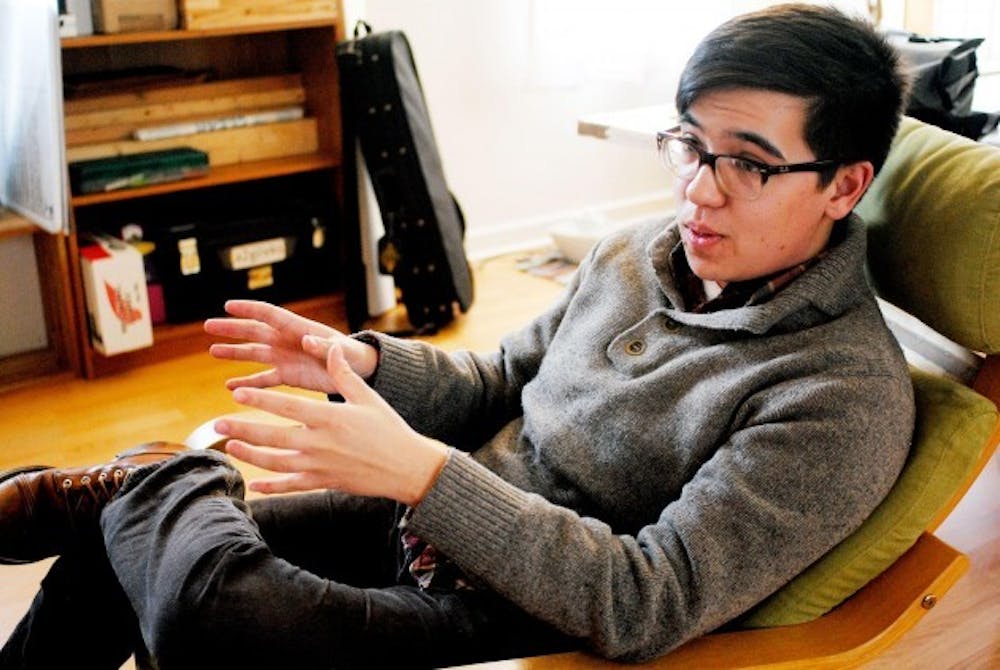
When Cayden Mak applied for his New York State driver's license, he questioned if what happened in the DMV office was legal.
In a society that identifies everyone as male or female, Mak chose not to check a gender box on the DMV's form. He watched a comical argument play out between the two DMV employees. The woman processing the application dropped phrases like "young man," seeking some sort of response from Mak, while her coworker pointed out subtly that he thought Mak was a female.
Mak said the woman must have won the argument; his license is marked "male." But to Mak, neither box truly applies.
"If you're on the outside looking in, you should just see a little Asian dude," Mak said. "But if you get to know me, you come to understand how much more complicated things are."
Mak, a third-year media study graduate student at UB, reinvented himself going into his freshman year of college. Mak is a female-to-male transgender. He has plans to get reconstructive chest surgery this May. He is a campus figure, a teacher, an activist, and a video game connoisseur. Being trans affects his views on the world, politics, and life.
The Transition: Second Puberty
Mak looked at his enrollment as an undergraduate at the University of Michigan as an opportunity to transform himself. It was empowering for Mak; he said he "molted," and he invented the person he wanted to be. He even chose a new name.
Mak started taking testosterone the summer after his junior year. He still vividly remembers the changes he experienced once he started.
"It's like real puberty, but weirder," Mak jokes. "With real puberty you ease into it, but [with hormone therapy] it's like pedal to the metal."
In the first two months, Mak's weight fluctuated. Overall, testosterone speeds up metabolism. His face shape changed and his fat moved around. His ability to build muscle mass increased, and he started growing body hair - something he found alarming, considering he barely had any before testosterone.
Mak described himself as being "irrationally angry" during the first nine months of taking hormones - he was the guy rolling down his window at stoplights, yelling at other people on the road. But as someone who stands at 5-feet-4-inches, Mak laughed as he said, "It [was] just a terrible idea for me to be antagonizing people."
His sense of smell even changed, not for better or worse - just different, Mak said.
Taking doses of testosterone comes with some risk. Female to male trans people who start testosterone are more likely to over-produce red blood cells, according to the National Health Services' A Guide to Hormone Therapy for Trans People.
Taking testosterone hasn't been extensively studied, according to Mak. But to him, the tradeoff is worth it.
"The first time I took a dose of testosterone, it made a lot of sense, like, 'Oh wow, this is supposed to be in my body actually,'" Mak said. "Something in my brain rearranged itself."
Mak has dealt with depression since elementary school, and while testosterone hasn't solved the problem, it's made it a lot easier for him to manage. He feels there is a chemical connection behind the experience.
When he compares how he was six years ago to how he is now, Mak says he doesn't feel like an alien anymore. He calls the whole transition his "second puberty" - an experience more cathartic than the puberty he experienced as a teen.
The most profound changes he experienced weren't physiological or psychological, but in how he perceives the world, and how the world perceives him - it's something he struggles to find the words to justly explain.
"There are some things about this process I don't know that I can explain because they are so fucking strange," Mak said. "They're not within the spectrum of human experience we have established language to describe. I can't even concisely describe my gender identity let alone the experience of almost becoming a different person."
The upcoming surgery
For the last eight years, Mak has been binding his chest to conceal his breasts. In May, he is undergoing reconstructive chest surgery.
Binding - the flattening of breasts with materials like bandages - has become a part of his everyday life, so it's almost easy for him to forget the constant strain it puts on him. Physicians have told him that he is destroying his rib cage by binding, leaving him with long-term health concerns. Mak also worries that his appearance puts his personal safety in jeopardy.
For example, Mak isn't comfortable in locker rooms; while he'd love to work out at a gym, he is uneasy about how people will react to him in that setting.
"The choice between outing myself and having to take care of my body is not a choice I want to have to make," Mak said. "I don't think that's a fair choice for anyone to have to make."
He said the surgery will "remove a major piece of [bodily] evidence" - something Mak knows sounds strange. But ultimately he feels the surgery will make it easier for him to "function comfortably like a regular person."
Mak is getting the surgery in Cleveland. It's a decision he came to because of the strong ties he holds with the trans community at Michigan. In that network of friends, Mak saw in person the results of the same surgeon who will operate on him. That speaks volumes louder than pictures on the Internet, Mak said.
He will be recovering after the surgery with his mom in Michigan. It will be months before he can get back to his normal mobility, and even as an avid cyclist who will obviously have to take a break, he knows he is making the right decision.
It'd be insane not to be somewhat nervous in regard to any major surgery, according to Mak, but in his "conscious rational mind" he isn't concerned, and he's prepared for what will be a summer of recovery.
Addressing Gender
Mak chose the name "Cayden" because it wasn't overtly masculine.
"Maybe some people think I am [masculine]," Mak said. "Maybe some people think I'm supposed to be because why would you want to be masculine if you don't want to be ultra-masculine, but I'm really not."
Mak has two cats that scurry around his tastefully decorated Allentown apartment. He loves his cats and interior design - two attributes he knows don't fall under the conventional definition of "masculine."
Gender studies and queer theory scholars place gender on a spectrum. Mak doesn't think anyone has a stable gender, but acknowledges his may "fluctuate more than others."
When Mak first entered the media study graduate program, there was a social awkwardness with some professors, according to Jordan Dalton, who is also a third-year media study graduate student and a friend of Mak's.
Some professors didn't understand that Mak was transgendered; they fumbled his name and struggled with pronouns, Dalton said. But after three years, they got the hang of it - there was just a bit of a learning curve that Dalton credited to a generational gap.
Mak knows the greater population is going to perceive him as a male, which is what he explains. Mak is okay with being seen as a man, but he also won't berate people for using female pronouns when addressing him. There was a time when he requested people address him using gender-neutral pronouns. But he got to the point where he was tired of correcting people and trying to explain exactly what gender-neutral pronouns are. He said there are more important things for him to focus his energy on.
"As someone who is a public figure, I need to be chill [when people ask questions]," Mak said. "Sometimes I don't have the patience for it, but for the most part, I'm interested in making bridges."
The Activist, the Gamer, the Politician
Mak is passionate about education - it's a reason he organizes and protests. He champions accessible higher education that provides students with the opportunity to study and think about what they want.
He worries that options for students are vanishing and opportunities are being swallowed up.
"The university should be a place of magical potential, not of looming debt and future unemployment," Mak said.
But Mak doesn't sit idly facing a system he thinks is broken. He acts.
Mak has been one of the forces behind multiple campus events organized through New York Students Rising (NYSR) and Defend Our Education Coalition (DOE).
In March, Mak traveled to Albany with NYSR, a group that aims to defend higher education and empower students who it feels are under-represented to state government and university administrations. There, he visited the state capitol to stand up for education.
"He's only lived in Buffalo for three years now, and he's just so in Buffalo," said Theresa Warburton, a fourth year Ph.D. candidate in gender studies and a friend of Mak's.
Neither DOE nor NYSR were on campus before Mak came to UB, and while he didn't start these things single-handedly, he was instrumental to their success, according to Warburton.
In October, he helped orchestrate a "walkout" of UB students; he and over 100 students ditched class and stormed the campus promenade in protest of tuition hikes and loss of services while administrator salaries continue to rise. He also helped organize a breakfast to feed UB students who were unable to buy groceries in the wake of the delayed financial aid disbursements in the fall semester. In March, he helped organize a mock telethon to bring attention to rising student debt, complete with a satirical check that he delivered to the UB administration.
"The thing that makes him different than a lot of people I work with politically is that he's fun," Warburton said.
Warburton feels that "fun" is something that gets lost in a lot of activism, and it can seem draining. She thinks it's important that Mak involves fun and excitement in his protests.
Mak acknowledges his approach as playful - he has a passion for video games (and "games" in general) and makes that work in accordance with all he does.
"He has literally turned his practice into his passion," Dalton said. "There is no real boundary line or barrier between his personal life - what he does in his free time - his professional practice - what he does for his work - and his academic practice, his research. His thesis is around campus organizing. All of those things blend seamlessly together."
Being trans also plays a vital role. Mak isn't in favor of a capitalist society with set boundaries. Laws are designed to regulate gender without accounting for what doesn't fit in conventional categories, Mak said. He feels that because of this, he lives in a space outside the law. To him, trans people live in a state of exception because the law is designed to regulate men and women.
Mak's research in media study connects his political views to his love of video games. It's all deeply connected, according to Mak. Through his life and his research, he wants to create media that can get people to "collectively imagine a post-capitalist future."
"It's not easy to explain these things to people, because they sound really crazy a lot the time," Mak admits. "They're so wildly outside what we think about and can imagine. One of the compelling things about integrating my identity of trans into this work is it's like, 'Look, you can actually be something and you can self-actualize outside of the capitalist system while still using the tools of capitalism.'"
Mak said the world has "biopolitical" controls - both in "gender policing" and a university environment that he feels trains students for a docile workforce. Mak believes universities used to be theoretical "games" because they provided an exchange separate from real life that allowed students to do things they couldn't normally do outside of school.
"It's not just about the education you receive," Mak said. "It's about the people you come in contact with and the other opportunities that present themselves."
Mak stressed that higher education should exist as a place with options for students to explore - like a bunch of doors that students are permitted to open. But Mak has some fear those doors are closing.
"[Education is] so important to the mental political and emotional wellbeing of the country," Mak said. "We are so fucked if we can't get people a broad and deep base of knowledge of the world."
The Force of Nature
Mak's friends lovingly call him a "force of nature" - he's always doing something. When he isn't helping organize students, he's engaging with them in the classroom. He is currently is teaching Game Studies Colloquium in the media study department.
Mak also travels to Stony Brook University multiple times per month for the Graduate Student Employees Union. He is working to reorganize the university's recently unionized research assistants.
Mak's friends are amazed at how he balances everything. He has an incredible work ethic, according to Dalton.
Mak said his apartment helps him manage the madness because it's the perfect workspace, which is surprising considering live music constantly pulsed through his floorboards and walls; Mak's Allentown apartment is near the heart of Buffalo's music scene.
But through all the craziness, Mak has been able to sustain a relationship with his partner, Liz Rywelski, a graduate teaching assistant in the visual studies department.
The two have been together for about 18 months; they met when Mak gave Rywelski a tour of the media study department They bonded over "[a] similar lust for life, nerdy YouTube videos, and long working hours," according to Rywelski.
Mak says he has been lucky to meet people who generally don't care about the gender of their partners. Rywelski feels people have fluid identities, and that potential is limited when individuals are fixed in binary roles.
What really sealed the relationship for her was the evening Mak hopped on his bike and rushed to her apartment. She had texted him a picture of a huge moth she referred to as "the monster." Mak trapped the moth in a cooking pot, slid a piece of paper beneath it, and set it free outside. That evening's events instantly put Mak at hero status in Rywelski's eyes.
Whether it's saving those he cares for from pending moth doom, taking extra time outside the classroom to help his students, or organizing protests to defend education - Mak is clearly someone who is constantly extending himself for others.
"[He] genuinely cares about other people," Warburton said. "At the core at everything he does is his desire to see a world where people have what they need."
Email: news@ubspectrum.com



