
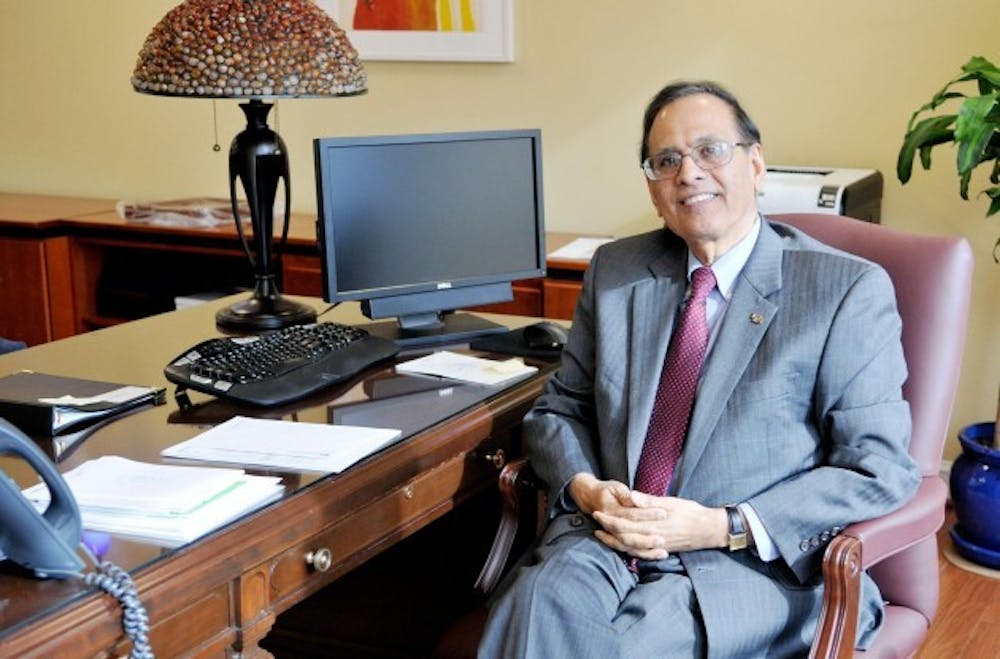
Spectrum Editor in Chief Matthew Parrino sat down for his first-ever interview with UB President Satish K. Tripathi last week, finally getting the chance to ask him about the issues The Spectrum has reported on all year.
From the problems with the HUB and financial aid, to the UB Foundation and TCIE's illegal donation to former Erie County Executive Chris Collins' political campaign, and (almost) everything in between, no question was out of bounds.
This interview has been edited for length and clarity.
The Spectrum:You helped win a $100 million state grant for the Buffalo area as leader of the Regional Economic Development Council. What will the money be used for?
Satish K. Tripathi: So, this is really sort of great news for Western New York…There's a couple of projects on developing workforce; one, for example, is really to be on the East Side of the city to train people in the automobile industry of mechanics and so on, which has a lot of jobs, but there's no real training. And the only training that was available was in East Aurora somewhere, and they couldn't have transportation to go there and do it…
There's also a project where we teach the high school students arts and other things – extracurricular activities that actually increase the graduation rate…There are three or four different projects [involving the] Buffalo Niagara Medical Campus where UB is a major force.
TS: Can you tell me a little bit about the progress of the medical school's move downtown?
SKT: Sure, so the medical school move is a five-year project, which we began last summer…We are working with the SUNY Construction Fund, and we have isolated an area of where we want to build the building, so, right now, negotiation to buy the land is going on in one aspect. We also are hiring architects to think about and envision the ideas – what kind of things could be built…It's going to be a $375 million building.
[Part of the money comes from] the $35 million that was the NY SUNY 2020 Challenge Grant, which the governor announced last year…We have that money already, we have started a campaign to raise $50 million [in] philanthropic money, and we already got $5 million of that $50 million already, so we are moving in that direction.
The governor [N.Y. Governor Andrew Cuomo], in his budget, has a bond here for this construction, about a $210 million bond that should be a part of that construction as well. So a lot of different pieces, moving pieces, but we are making progress in all those and are on target to finish in five years.
TS: Why do you think it's important for the medical school to be moved downtown?
SKT: Well, if you think about the medical education, and if you think about the translational research that the medical field actually produces – something known as bench-to-bed and bed-to-bench – the relationship between the hospitals and the medical school is very, very, very tight.
The students actually don't wait until the third year to go to the hospital, [but] now they're going in [their] second year…So if you think from the educational viewpoint, the experience will [be] next to the hospitals. We don't own the hospitals, so that would be really fantastic.
If you think about the research and the translational research that will come out, that would be fantastic, too, because the researchers, the clinicians, the rest of the group there, the graduate students – they can work together to do the kind of things we need to do so that we actually provide better care, but we can also develop to new technologies and new intellectual property that could actually spin off into more companies and be more jobs in Buffalo.
But, the other aspect really is, think about downtown Buffalo and think about the Buffalo Niagara Medical Campus. The medical school moves there, fills the gap, and this becomes a very vibrant city.
TS: Do you anticipate a negative impact on South Campus?
SKT: I'm very mindful of that, actually. If you think about South Campus, and if you go back and look at the South Campus, and how it was organized, and how it was, [part of] it was [designed by renowned architect] E.B. Green – a very beautiful campus.
Now, what we have there is a bunch of temporaries and some old buildings, so first of all, the…temporaries would go away, and we are going to restore the campus to the E.B. Green design. We are actually investing money there…
When I was provost, and we were looking at this 10-year – or 20-year – fiscal master plan, I said that my goal really is, that at any step of the way, none of the three campuses should be worse off than they were before; in fact, they should improve. That's what we plan to do.
TS: Let's talk about the HUB…Students have demonstrated a lot of displeasure with the system as a whole. What are your thoughts on that?
SKT: I'm a computer scientist, so let me give my view on systems a little bit. Any time you make a big system change like the HUB, which is a multi-million-dollar change, a big change, all kinds of people are impacted. And remember in the background that only 10 years ago, many schools had to spend hundreds and millions of dollars and failed in implementing such a system.
It's a very complex process, and we planned for multiple years, but – no matter how much you plan – when you roll out the system, the users behave differently, and we have been listening to the users and fixing some things that are not the same. From what I understand from the new students, they don't mind it; there are some issues there that we are fixing and we are listening to that.
But it's really change, and when I came as a graduate student…we had these punch cards, and when the punch card was changed, people were not really happy…When you think about the system change, this provides the kind of data you need. It provides the services if you are able to use it properly. These small setbacks are always expected in very large transformations of systems, when you go from one to the other, but if you really do a notational survey, you'll find these issues are much smaller than what's happened at other campuses.
We've been really, really careful, planning over the last four years, actually. Slowly working with all the groups, but we still have to work; it's not a perfect system. And we want to make sure people have better experiences, but at the same time, I want to say, it's a much better experience than other system changes that have occurred elsewhere.
TS: With the HUB issues, with the financial aid changes, and then there was the tuition announcement over break, it seems – from a student perspective – that a lot of things are changing, which sometimes is really good. But, when there's a lot of change, there's also a lot of getting used to the changes, and a lot of students have voiced concerns that maybe the administration – UB has a whole – didn't really prepare them as well as they could have for that.
SKT: I think we have to communicate better and be able to communicate a lot more, and we learn from the HUB changes, and from the decisions on the tuition, and so on – that we need to do a better job there; I agree.
TS: Can you talk a little bit about UB-UUP's referendum to demand that UB withdraw from the Buffalo Niagara Partnership?
SKT: You know, that's a referendum, and UB is [an integral part of the] Western New York region here. We have to be playing the role of working with the business community to have the economic development plan that needs to be there.
If you saw [last week's] editorial, even The Buffalo News talks about how important it is for UB to be in the Buffalo Niagara Partnership and work together. And UB has been part of it since 1951, and so, to me, it seems like it's something that we have to do. We are, and we will continue to do so.
The other part was [that] The Spectrum talked about how I joined the board illegally. Actually, it's not illegal, and we've got clarification from SUNY…So the thing is, really, our job in the community is to create an environment for business development, and we don't necessarily develop businesses ourselves. We create intellectual property and we train our students who might start businesses or who are the work force that can really sustain businesses, but we need to work together so that it's a good quality of life and that the entire region increases.
So the union has its referendum, and that's fine…The faculty and the students are critical, and that's why we need to provide, in terms of education, in terms of research, in terms of infrastructure. But at the same time, we are not on an island. We are part of this community, and the businesses are important here as well.
TS: I want to read you one specific comment on one of our articles, and I would like if you'd respond to it.
"It's disgusting that the public university is run primarily for the benefit of real-estate developers like Ciminelli, National Fuel, and the other businesses that run Western New York. Look at the boards of BNP, BCNY, UB Foundation, Law School Advisory Council, and the local IDAs, and you'll see the same names and the same companies.
UB 2020 is nothing but state-endorsed looting of the university to line the pockets of real-estate developers. UB pays BNP to lobby the state government to cut salaries for professors, waste taxpayer money on building projects downtown, and jack up tuition and fees.
UB Foundation, whose board is made up of the developers who get paid to build the buildings, pays off Tripathi for his support of the project (UB Foundation is the largest contributor to Tripathi's $650,000/year salary).
Meanwhile, students mortgage their entire futures just trying to borrow enough to get a bachelor's degree, sentencing themselves to a lifetime of debt-slavery."
SKT: What do you want me to say?
TS: Could you respond to that? In terms of, that's a student who goes here. It's a law student. He got his bachelor's already. Can you just talk about that feeling, that sentiment?
SKT: I don't see that feeling coming out, except from this law student here. The point is, if you look at the UB Foundation, its job – basically, it's a not-for-profit foundation and its goal, really, is to help UB to raise funds. For example, they raise funds in terms of the students' scholarships. Think about how many scholarships are really given through the UB Foundation.
It actually raises money so we can attract the top faculty members and retain the faculty members and our chairs and so on. And also, it helped in building the dorms we couldn't build before…And foundations really exist to support UB. Its real goal is to make sure UB exists.
Now, you talk about the same people and all who live in the community – they're not all the same people. There are a lot of different kinds of people who support us. Many people give us money to do things. We had a $40 million anonymous gift – that's going to benefit the faculty and the students and nothing else. That's what we're going to do. I can't comment on everything that person [said].
TS: We also reported on the TCIE incident, and, throughout that – I went back and read everything – you never commented on that.
SKT: It was a mistake, and there was some mistake in how the paper was processed. [It] should have never been given to the campaign, and the money was returned, and we're going to fix the process. We actually already tightened the process to make sure that these mistakes don't happen.
TS: It's often been talked about – how important UB is to Western New York. I think the vast majority of people agree with that. But, when it comes down to it, who is UB, as an institution, more responsible to? Western New York, or the students?
SKT: It's responsible to, first of all, not just the students, but everyone at UB. You have the faculty who are teaching, you have the staff, the students; we're responsible to all of that. But…part of the responsibility is to provide better access to our students, what's in here. If you are an institution and the rest of the community is not doing well, you will not be able to attract students, even. It's really [that] you can't separate the two.
TS: The UB Giving website makes it look like all gifts to the university go toward scholarship for students in need. But a lot of the gift money goes toward supplementing state salaries. Should the website indicate exactly where the money goes?
SKT: There are multiple kinds of money that goes to it, right? If you give money through UB Giving, and say it goes in scholarship; all that money goes into scholarship. The donation of the money depends on the donor – where the donor wants the money to go to.
The UB Foundation has to be very careful in terms of what the money is used for and what it was given. That's part of the process you go through, otherwise, you'd never get money if you don't have that kind of relationship with the donor.
So if the money was donated for scholarship, it would never go for any salary. If the money was given for professorship, you would never get any money going anywhere else. So, no, definitely not. Money is used for what it is given for.
TS: Do you think the compensation of public university presidents is out of control at all?
SKT: I can't comment on that, personally. You have to look at the national picture where the compensations are. That's something that, since I'm one of those, it's sort of hard for me to give you a discussion on that.
And you should look at the national data, rather than just somebody saying it, look at the national data, what the compensations are, what kind of institutions are there, and what is happening in the next few years, and so on. Do an analysis based on data and see what it is.
TS: In many jobs, it's commonplace for employees to give themselves self-evaluations. Because you work for UB and students and faculty, can you give yourself a self-evaluation – how you've done?
SKT: That's the toughest job. I think we had a very good semester last semester, if I look at it. We were really able to get the NYSUNY 2020 sort of done. We were able to get the challenge grant from the governor. We were able to sort of look at the students' quality and a lot of improvement in that. We were working on finishing a floor plan. We're getting to a stage where we can really implement it now and do that. Multiple buildings coming in. Very quick, but very, very rewarding first semester.
I was privileged to be asked to be a co-chair of the Western New York Regional Economical Development Council, which has been a great experience for me. Working with the people has benefited both UB and the Western New York region. And then the next challenge is the billion-dollar challenge for the Buffalo region. So if you look, from inside and outside, at what we have been able to achieve, it has been really good…
The provost search is on [full] swing now, and we should be able to get somebody before the end of this summer to join here and come be a part of the team. A lot has gone on, but there is still a lot to do.
Email: news@ubspectrum.com



