
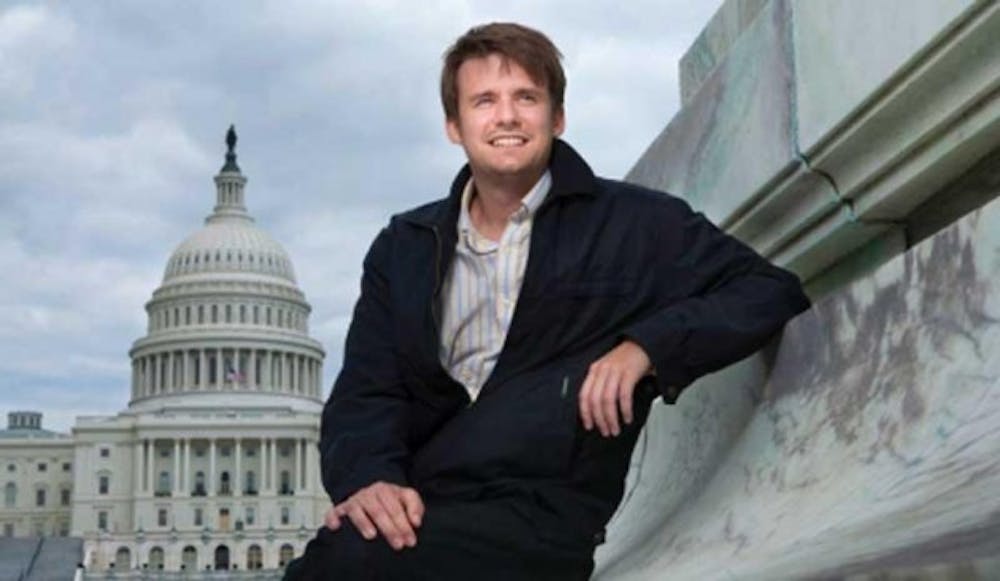
As an adolescent, George Zornick never imagined he'd be reporting on massive civil disobedience movements outside the White House.
Now, he works as a political journalist for left-leaning magazine, The Nation.
Zornick – a UB alum from the class of '05 – has been writing for The Nation since April of this year. He covered a protest in August about an oil pipeline from the tar sands of Canada – a big change from the stories he used cover as a staff member of The Spectrum.
Zornick entered UB as an English major, but it wasn't until his sophomore year that he got involved with journalism, and he joined The Spectrum's news staff.
He moved his way up in the paper's ranks quickly, becoming assistant news editor his second semester on the staff.
By his junior year, Zornick was managing editor for the paper, and by senior year editor-in-chief. His reign as editor-in-chief of The Spectrum took place during the 2004 presidential election: a time that proved to be very volatile for the opinion page.
Before Zornick came to UB, he attended City Honors School in Buffalo.
"English was my favorite class but I was kind of typical student; I wasn't much of a writer in high school," Zornick said. "I did usual high school stuff. I ran track and whatever, but I didn't think about anything I particularly wanted to do."
Erin Shultz, who was a news editor when Zornick first joined the paper, was impressed with his talents right away.
"From about the first day he walked in, his writing was just excellent," Shultz said. "He had a thoughtfulness most freshmen and sophomores [who were on the staff] to fill an English requirement didn't have; he had a natural passion for the business."
Zornick covered a range of stories, like pipes bursting in dorm rooms to intense relations between The Spectrum and the Student Association.
"It was [the] much more interesting stuff like with administration or the battle we had with the SA and how they were spending some of the student fees and blowing it on big lavish trip," Zornick said. "The more I did, the more I was attracted to actual reporting."
Zornick's choice to have a strong, left-leaning opinion page was something he was able to learn a lot from. He expected the College Republicans to hate it, but wanted to spark discussion.
"The College Republicans started their own newspaper," Zornick said. "They said I was ‘raping the campus with my liberal views.' There were a lot of adversarial relationships, but that was good; I think that's what good journalism should be."
The criticisms and opposing opinions helped prepare him for the political field he is now a part of, according to Zornick.
"It got me ready to engage and debate with people and concede some points, and just have a dialogue," Zornick said.
Zornick admitted that in high school, his political opinions didn't stretch far beyond thinking, "George Bush was kind of a loser." All of that changed after he took an honors seminar with Enid Bloch, an adjunct professor in the Honors College, on the psychology of terrorism. The topics in that class caught his interest and attention – something he's never lost.
"When I was in that class as the Iraq war was starting up and being sold that's when I really started to become very active," Zornick said. "I looked at what they were saying about the war and why it had to be done and I was shocked by how dishonest some of the stuff was."
Zornick was able to better develop his opinions with his experience with Barbara Bono, associate professor of English, in one of her literary criticism classes. There, Zornick learned how to read different sorts of texts and understand different arguments to sharpen his mind.
"It was a terrific class, lot of bright students in it, and George was one of the stars," Bono said. "It's difficult to do that job [as editor-in-chief] and do it well. For some people it tears them apart, but others have really grown in that position and developed real careers out of it and were able handle all the juggling, and George was able to do that."
Zornick, who never went to a journalism school, credits his time on The Spectrum with forming his as a reporter. Zornick feels reporting wasn't always something he was good at, and that he had his share of rough stories when he started. But to him, it was all about learning through those experiences.
Zornick's success with The Spectrum translated well throughout his college career, and he was able to get an internship at Channel 7 News. Following graduation, Zornick landed an internship with The Nation.
Zornick's career grew following the end of his internship at The Nation. He worked on the research team of Michael Moore's film Sicko, and he helped defend the film against attacks on facts he was a part of researching.
After his work with Moore, Zornick was in D.C. working as a reporter for ThinkProgress.org. Things aligned for Zornick when The Nation was looking for someone to report on D.C., and remembered him as an intern.
Currently Zonick is fascinated by reporting on the stage that is Washington, D.C.
"D.C. is very interesting right now because so much is at stake," Zornick said. "The economy is teetering on the edge of another recession, and there's about to be huge federal elections that will really offer some dramatic choices on how to fix these problems."
Email: news@ubspectrum.com



