
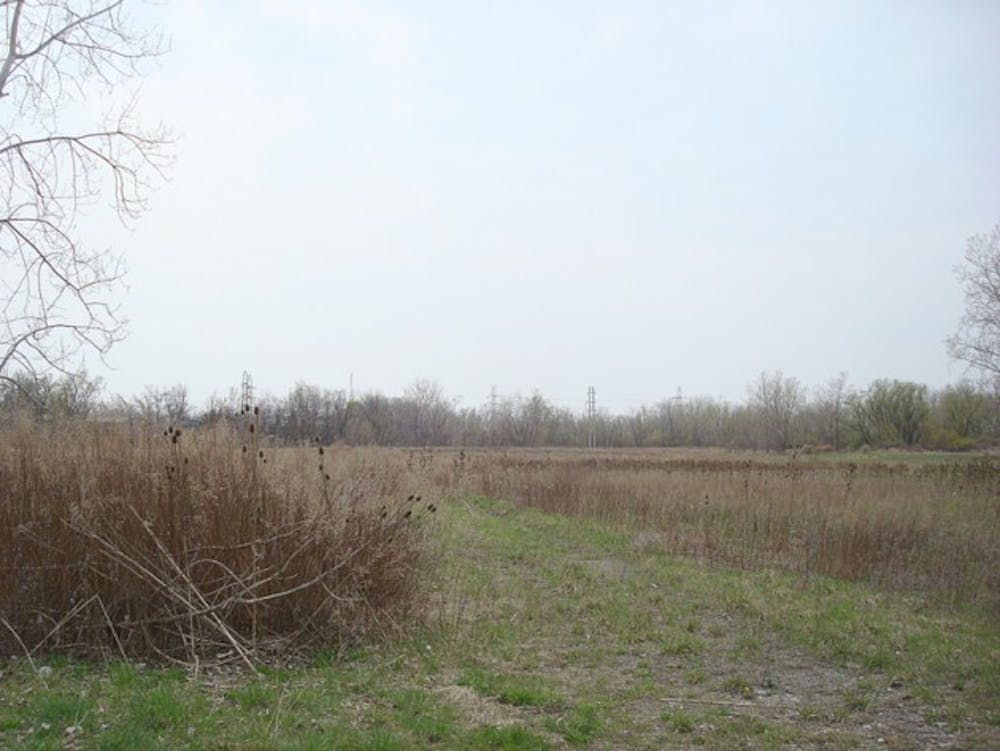
Most people wouldn't expect the Buffalo area to have its own secluded oasis. But the town of West Seneca recently received a donation in the form of a relatively pristine 14-acre wetland.
As part of the University at Buffalo's Ecosystem Restoration through Interdisciplinary Exchange program, UB researchers and graduate students will specifically be utilizing the wetland area. This area provides researchers with the opportunity to study a natural habitat surrounded by a manmade environment, sometimes referred as "incarcerated nature." Ultimately, the program aims to maintain or restore the quality of the West Seneca ecosystem, as well as others.
"The area is an oxbow wetland," said David Blersch, PhD, a UB research scientist and coordinator of the ERIE program. "Other areas in Buffalo River watershed are mostly developed, filled in or drained."
An oxbow wetland occurs when the course of an old meandering river is changed and results in a curve in the river that creates an isolated wetland independent of the river. The isolated area will often form a habitat thriving with wildlife, which is the case with the one in West Seneca. This specific oxbow area was formed off of the Buffalo River.
"The Buffalo River was a fairly polluted watershed and is recovering. This oxbow wetland serves as a natural filter," said Blersch.
Pollutants from runoff water include soil debris, nitrogen, phosphorous, metals and oils from parking lots. Instead of finding their way into the Buffalo River and eventually Lake Erie, the pollutants are taken out of the water system by the oxbow wetland. Along with providing a valuable service to humans, the wetland also serves as a home to a number of species that may otherwise be at risk.
"Amphibian populations are dropping worldwide. This area is not connected to the river so eggs and young are safer from fish," Blersch said
Blersch and his group were surprised with the plant life of the oxbow. In this region, exotic and invasive species are fairly common. These types of plant can take over and infest an area, decreasing the biodiversity and overall health of the habitat.
"The plant community is relatively untouched. We would have expected more of an effect from these invasive and exotic species," Blersch said.
The ERIE program is unique in its hands-on approach that combines research from the departments of civil and environmental engineering, American Studies, biology, chemistry, geography, geology and ecology, evolution and behavior. Through their collaborative work a thorough plan can be put in place, accounting for nearly every aspect that may affect the wetland.
"Restoration techniques are site-specific. All aspects of the watershed need to be understood," Blersch said. "For a stream, water quality and nutrient levels are checked, as is the structural stability of the stream. Upstream development may alter flow conditions and increase erosion, which can impact stream stability and health, which can be repaired and restored."
This multidisciplinary approach plans to take everything into account when studying the area. Geographers may map the area while biologists monitor species. The philosophy of the watershed is even considered when deciding what the ethical choice would be in the restoration process.
In the fall, the ERIE program will have 14 graduate students from the eight different fields. Funding for the program and fellowships are provided by the National Science Foundation.
Email: news@ubspectrum.com



