
'You have the power to save a life.'
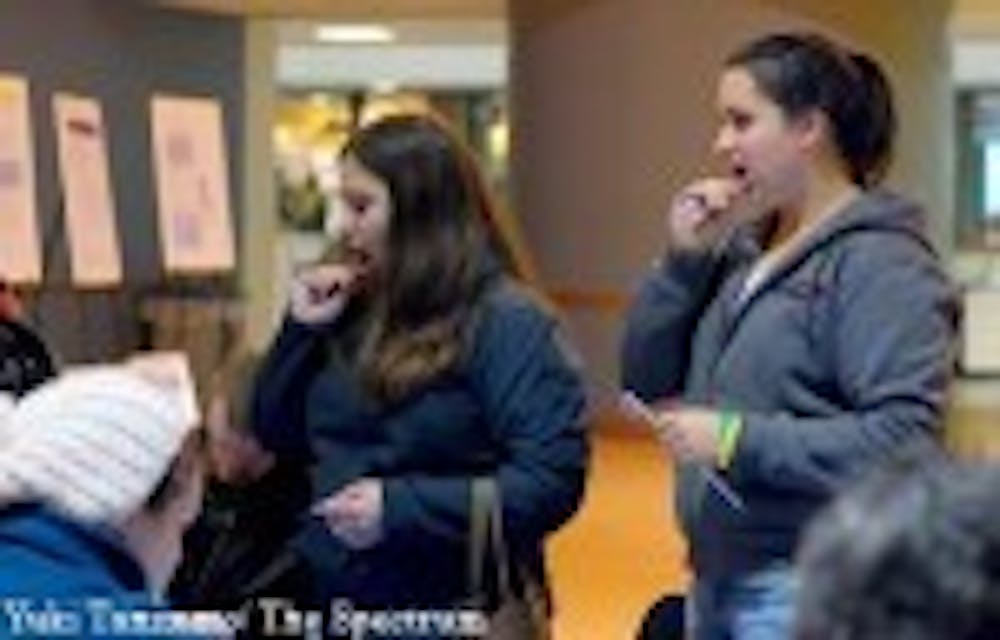
This was the message displayed last Thursday in the Student Union Flag Room as UB students gathered together to register as bone marrow donors in the Be The Match Marrow Registry.
Bone marrow, the flexible tissue found in the hollow interior of bones, produces new blood cells in adults. This provides a cure for suffering patients.
Be The Match works in combination with The National Marrow Donor Program as one of the largest medical registries in the world. There are over 7 million members in the United States, and an additional 5 million worldwide.
But each day, patients suffering from leukemia and other life-threatening diseases must wait to receive marrow transplants. These transplants have the ability to alleviate or cure almost 70 different debilitating diseases.
According to Amelia Vangellow, a freshman undecided major and coordinator of the bone marrow drive, it is absolutely vital that more people join the registry because many people's lives depend on it.
A wide variety of medical conditions, including leukemia and lymphoma, create the need for bone marrow donations.
However, sometimes patients do not have matches within their family, so they must look to outside sources, which is why the Be The Match Marrow Registry was created. But even with the registry, some people cannot find a match.
'Even with the more than 5 million people in the registry, some patients don't find a match … the statistic is [that] only three in 10 get the donation they need to live,' Vangellow said.
Students who volunteered to become marrow donors at the event were asked to sign a consent form. By signing, they agreed to allow their name to remain active in the registry until they were 60 years old, or until they requested their information to be withdrawn from the database.
A painless cheek swab was then performed to determine marrow type and was entered into the database to find a potential match.
An individual must meet a few requirements before they become a donor – they must be between the ages of 18 and 60 and meet certain medical guidelines. Potential donors fill out a registration form and use a cotton swab to swipe the inside of their cheek for 10 seconds to collect cheek cells. The total registration process takes about 10 minutes.
'The cheek swabs are taken to a lab … [The lab tests] for human leukocyte antigens, [which] are proteins – or markers – found on most cells in your body,' Vangellow said. 'Your immune system uses these markers to recognize which cells belong in your body and which do not. A close HLA match between the patient and donor is the most important factor in selecting the best bone marrow donor for a patient.'
There are two ways for students to donate if a match is found.
Blood cell donations are the most common, making up about 70 percent of all donations. This donation is a non-surgical outpatient procedure that is relatively painless.
Marrow donation is a surgical outpatient procedure, often requiring the patient to arrive at the hospital on the day of the procedure and stay for the night after.
Volunteers are anesthetized in the operating room, and typically one to four small incisions are made over the back of their pelvic bone, where the marrow is drawn.
After the procedure, patients might experience some side effects like lower back pain, fatigue and stiffness when walking, according to the National Marrow Donor Program's Web site.
'I'm petrified of the procedure,' said Mary Pentycofe, a sophomore social sciences major. 'But when the time comes, I would still go through with it because it's important.'
The National Marrow Donor Program organizes the donor search and matching process, ensuring that every donor is taken care of before and after the transplant.
The donation process takes about 40 hours in a three to four month span, with no cost to the donors.
Vangellow helped organize the event after discovering the possibility that her mother, a lymphoma patient, might need a marrow transplant.
'I believe this is a good cause and I would like to contribute and donate as much as I can,' Vangellow said.
Many of the students who volunteered decided to do so with the knowledge that they too could save a life.
'My cousin has half of a brain and leukemia,' Pentycofe said. 'I'm donating because it's so close to home and although I might not be a match for my cousin, I can still help someone somewhere.'
Although Pentycofe and her cousin are blood relatives, this doesn't guarantee a match.
There are various components to finding a match, in addition to blood type. According to the National Marrow Donor Program, doctors analyze tissue type as well – specifically the human leukocyte antigen.
There is a shortage of minority donors, which is one of the biggest problems facing the program. As tissue types are inherited, patients are more likely to be a match for someone of their own race or ethnicity.
'It's unfortunate … As a Latino, I believe minorities should donate so that there will be a chance for [everyone],' said Kevin Recalde, a senior finance major.
Volunteers of every background are needed to increase the chance of survival for those who are suffering.
'By donating, you can be the only match in the world to help save a person's life,' said Mike Garbin, an account executive for Be The Match.
Students can help save a life by logging onto www.bethematch.org, or by calling 1-800-MARROW-2 for more information.
E-mail: features@buffalo.edu



