
For the average student, waking up in the morning and preparing for school are almost effortless activities. Even navigating through the campuses and getting to class can be achieved without a second thought.
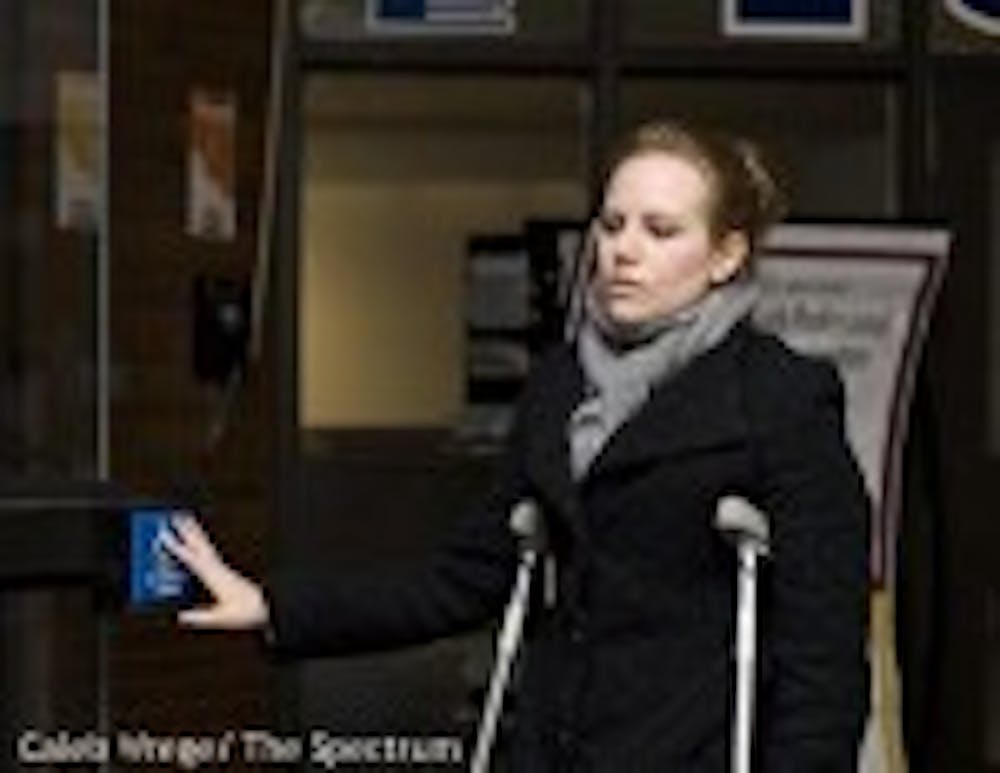
However, there are countless students at UB that due to various disabilities do not experience college life the way most students do. Such students may need assistance from wheelchairs, aids, or from the school's disability services in order to successfully and safely complete their school days.
"A disability is a mental or physical impairment that causes substantial limitations and requires assistance in day-to-day activities," said Randy Borst, director of Disability Services.
Ian Campbell, a junior Spanish and romance languages major, has lived all his life with a disability.
Campbell was born with cerebral palsy, which caused him to have spastic quadriplegia, a condition that affects the movement of his left side.
He is mobile with the help of a motorized wheelchair and his aide, Dan Mitchell whom he met through his church, to help him maneuver safely through UB's North Campus.
"I don't find it difficult to be in school because I love school," Campbell said.
Campbell's day begins at 6 a.m. when he wakes up and gets ready for school. By 7:30 a.m. he leaves his home in Orchard Park, via a wheel chair access transportation provided to him by UB's Disability Services. Once on campus, Campbell visits the Disability Services office to say hello and get his carbon notebook, then goes to his classes.
Campbell tries to participate in as many activities as he can in school. However, since he's a commuter student, there aren't many clubs that he can easily join.
"I socialize through my classes," Campbell said. "Basically if there is any opportunity like granting interviews for the newspaper or helping (physical therapy students) answer questions for projects."
According to Campbell, Disability Services has been extremely helpful in ensuring he has a positive college experience.
"What the Disabled Services people do is a great service and help especially with access points into the buildings," Campbell said. "When I first came there, the disability ramps to the lecture halls didn't have motors. I contacted Disability Services so they could fix the motors."
The main function of Disability Services is to ensure that disabled students get the assistance they need in order to complete their course work successfully.
"We provide access to the curriculums, courses and classes, what going to be on the test," Borst said.
Providing services for over 2500 tests a year, Disability Services supply readers, scribes, computers, distraction reduced settings and extended time services to students in need, as well as books on CD-ROM, interpreters for deaf students and note takers for students with print disabilities.
Disability Services acts as liaison between disabled students and other offices that provide services to students, such as University Residences Halls and Apartments.
"Usually a request goes to Res Halls then comes to us. Requests vary from needing a private room to having wheelchair access," Borst said. "Sometimes (students) have certain dietary restrictions on their meal plan so we work with Campus Dining and Shops on that."
According to Borst, there are currently 478 students at UB who receive assistance from Disability Services. The number of students at UB with disabilities is unknown due to the fact that many do not report to Disability Services. If a student needs assistance, they are required to contact Disability Services.
"They can identify (their disability) at the point they feel the need. We only require timely notice and we will do our best to provide the service," Borst said.
Demetrius Moutsiakis, MD, MPH is a clinical assistant instructor and medical resident in the department of social and preventive medicine of the school of medicine and biomedical science, and has been disabled since 1991.
Moutsiakis suffered a posttraumatic brain injury as a result of colliding with another bicycle on a bicycle path, which caused spastic hemiparesis. After his accident, Moutsiakis was in a coma for two months and in rehabilitation for over three years.
He currently lives alone in Amherst and does not require any assistance. His only true accommodation is the handicapped-parking sticker for his car.
Moutsiakis keeps active on campus by being apart of various organizations. He has been vice president of the Social and Preventive Medicine (SPM) Graduate Student Association (GSA). He is currently a member of the Governing Council of American Preventive Medicine Residents (APMR) as liaison to the American Public Health Association (APHA).
"UB has been the first place since my accident where I have been able to play a more active role," he said.
According to Moutsiakis, he was not aware that services existed for individuals with disabilities at UB or how to access them.
"Last fall, I figured out what to do and how to do it," he said. "The fact that there is no office for individuals with disabilities on South Campus was extremely disappointing."
Campbell too finds some aspects of UB's disability services difficult to deal with, such as wheelchair access door switches that are broken or hard to access.
"I never really understood the layout of Capen Hall, where they put the switches for the door," he said. "The door that's hardest to maneuver is the door with wheel chair access. It's the most inconvenient path."
Still Campbell feels that his experiences at UB as a disabled student have been positive ones.
"I think that my disability has provided a rich opportunity to share with people my prospective on life," he said. "If you ask if I want to be walking, sure I do, but this is what was dealt to me and I deal with it the best I can."



