
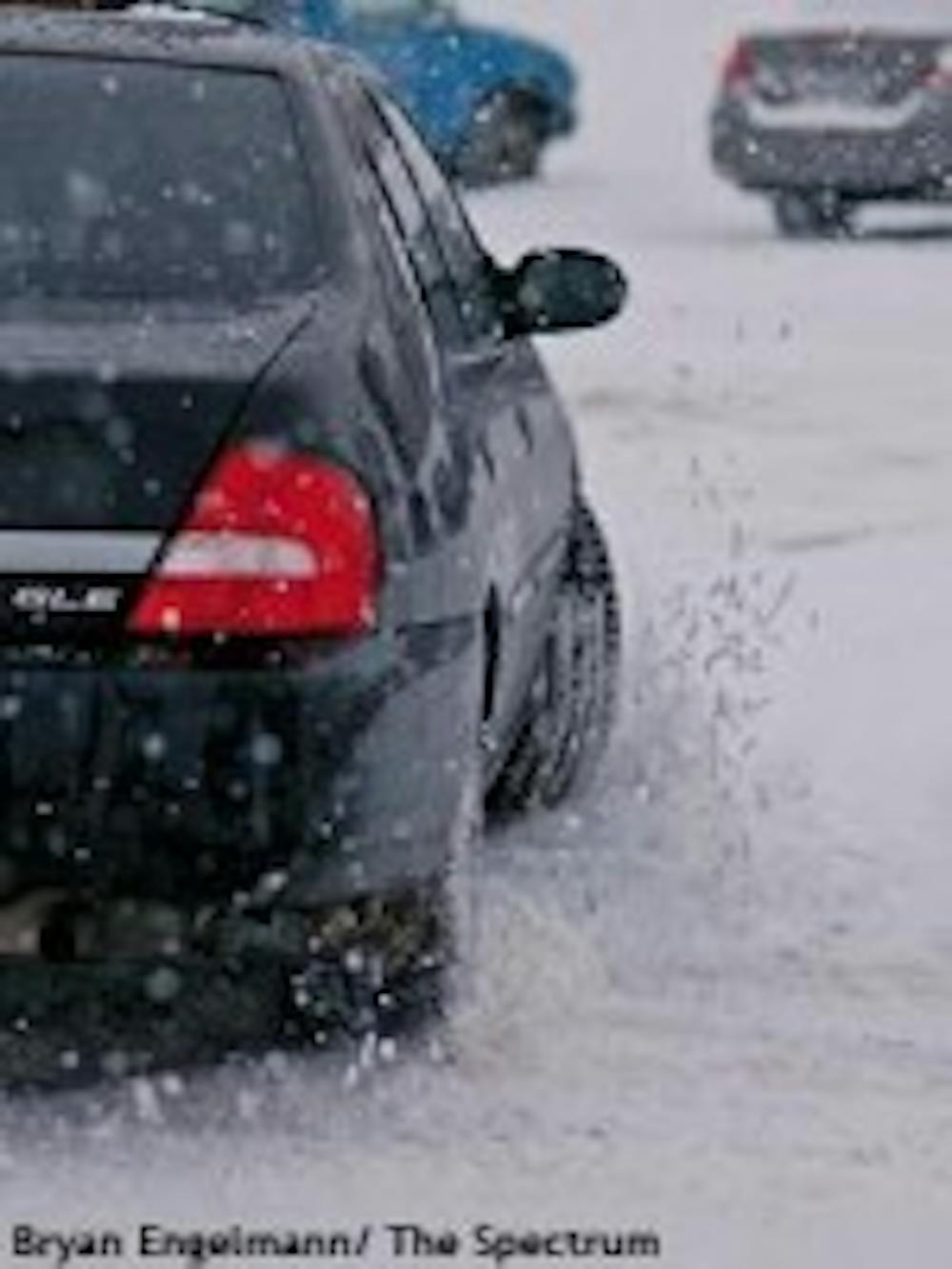
Putting on that heavy winter gear, warming up the car and scraping off the snow is never something to look forward to. Unfortunately, attending class and going to work can't be avoided just because the flakes are falling. With winter in full swing, careful driving is crucial to keeping the roads safe for everyone.
This past Wednesday, as part of the Student Affairs' Life and Learning Workshop Series, students sat down with Mike Formanowicz and Shaun Seufert of AAA Driver Programs to learn how to drive safely when winter is at its worst.
According to Formanowicz, it is vital for students and faculty to prepare vehicles for winter weather, know the precautions to take when driving on icy pavement, and account for a longer drive when it's snowing.
Many students like Leo Ly, a junior business major, are weary of driving in the infamous Buffalo snow, especially those who aren't from the area.
"I think driving safety is very important, especially with the winters in Buffalo. I am from New York City and we don't have the same amount of snow," Ly said. "I think it's important for students to be more aware of their environment."
The first component of safe driving during the winter months is to prepare your vehicle, making sure that it has been thoroughly inspected, according to Formanowicz. A winter driver must also have appropriate tires.
"Tires are the most important piece of equipment for your car. Your tires are the ones actually hitting the road," Formanowicz said.
There are two types of tires that will work effectively in Buffalo weather, according to Formanowicz. All-season tires are good for some conditions, but have limitations. Winter tires have a softer compound and have wider and deeper tread grooves. Making sure tires are properly inflated is an action all winter drivers should take; a 10 degree drop in air temperature means a 1 psi drop in tire air pressure.
Other ways to make sure a vehicle is prepared for winter include checking the battery, installing a good set of winter wiper blades, having a quality ice scraper/snow brush, check fluids and equip vehicle with a winter driving kit. The winter driving kit should include items such as AAA membership card, a cellular phone, small snow shovel, flashlight, blanket, first aid kit, protective clothing and a small bag of abrasive materials, Formanowicz said.
According to Seufert, having the ability to drive in the winter includes knowing how to maneuver the car on ice and snow.
"The most important thing is to slow down; you don't want to skid out there. If you start to feel a skid, always look and steer where you want to go, it will rebalance your car," Seufert said.
For many students, skidding is especially an issue on campus roads that tend to be overlooked more than main roads. Many students, for example, slip and slide on Interstate-990, the highway connecting campus with I-290; some slide all the way off the road, into the ditches below.
"While driving this winter I have not gotten into any accidents. However, I have found myself skidding from time to time and it can be scary," said Kim Sands, a senior exercise science major. "I have heard about accidents that have happened frequently due to the weather conditions and it makes me extra cautious...I think it's important to always be careful and as experienced as I may be, some things may get out of my control."
According to Seufert, applying the gas to accelerate slowly is the best method for retaining traction and avoiding skids. Also, it takes longer to slow down on icy roads. It is important to give time when accelerating, stopping and turning on snow-covered roads. A driver should know their brakes and should avoid stopping if possible.
Students were able to leave the program with a few new tips and a little more confidence with their driving abilities during the winter season.
"I think it was an effective program. I knew a lot of information already, but I learned some things. I didn't know how to control my car and some of the points that were made helped," said Yuya Oshima, a graduate student studying English as a second language education.
According to Formanowicz, drivers should always budget extra travel time in the winter as vehicles need to be cleaned of snow, and traffic moves a little slower; avoid sudden starts, stops or turns and focus on driving by minimizing distractions. Regular rules like always wearing a seatbelt are just as important in winter.
To make sure that cars always start, gas tanks should be at least half full in order to avoid gas line freeze-up. High beam lights and cruise control shouldn't be used in inclement weather.
"The tips that were given in the program were very helpful to keep in mind, and I was able to learn a lot of valuable information that made me feel more confident to drive during winter," Sands said.


