
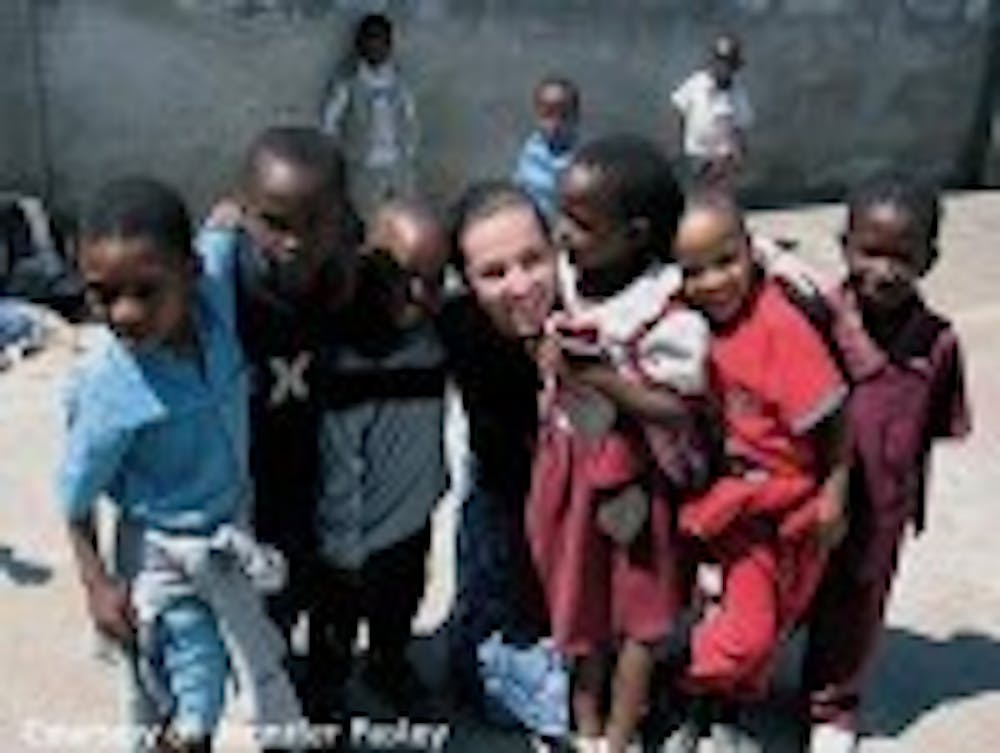
When people decide to visit Africa, they may choose to go for the nice weather, animal safaris and exotic food. Jennifer Pasley, however, went for completely different reasons and had an experience that has completely changed her outlook on life.
Pasley, a senior nursing major, visited Tanzania for three weeks this past summer as a volunteer with Cross Cultural Solutions - an organization that allows people to do internships and volunteer work in underdeveloped countries all over the world.
As a nursing student, Pasley didn't have much of an opportunity to do any kind of study abroad program during the year. She also didn't want to be a part of a typical study abroad program, so she researched volunteer opportunities on her own.
"I found Cross Cultural Solutions on the Internet," she said. "The goals of it were perfect for me."
From May 12 to June 2, 2007, Pasley lived in a home base in a rural area not far from Arushia, Tanzania with 25 other volunteer members from all over the world. Pasley said she felt completely safe and had lots of support.
"The staff said they never had a group get along so well," she said. "Everyone went for their own reasons, but we all had one common goal. That was a huge benefit of the program: meeting people who have the same goals of helping as I did."
According to Pasley, the main initiatives of the program were to provide laborers, health care, childcare, teaching and technology to the community in which they were staying. Two to four volunteers per group were assigned to different areas according to their interests and careers.
Pasley was assigned to work with a local organization called WEMA, which was set up by a Tanzanian doctor whose goal was to provide heath care and counseling for women and children living with HIV/AIDS.
According to Pasley, the group met challenges from the moment they began. Since the organization's funding had run out, the doctor thought they were there to give money.
"We had to explain that we were there to provide help and manpower, not funding," she said. "That was difficult because we were seen as rich white people when we had to save and take out loans just to get there."
The next challenge was that the doctor didn't know what kind of work to have the group do, so they decided to do home visits and observe the community to see where their help was needed. The group quickly realized that their main focus should be the children of the village.
"There were children from ages one to 15, just on the streets trying to amuse themselves," she said. "We realized they were street children and their parents weren't there because they were either sick or working."
From there they decided to set up a daycare center, which ran two days a week. There was an overwhelming response to the newly established daycare. According to Pasley, the group only had the capacity to take care of 15-20 children, and almost 30 children were brought on the first day alone.
"Every day we had daycare, more mothers would bring their children," she said. "I didn't want to let myself cry, but when we had to turn some kids away, I did."
The group provided books and toys for the children to play with. Though there was a language barrier, they were able to teach the children some English.
"By the end of the three weeks, they could count from one to 10 and knew barn animals," Pasley said.
One thing that Pasley especially remembers is how the older children took care of the younger children, when they were still extremely young themselves.
"When we'd let them out for the day, they'd just disperse. The five year olds would just take the three year olds and go," she said. "There was just a sense of camaraderie that they had because their parents weren't there."
Another project that Pasley's group was involved in was working with Tanzanian peer educators who met to discuss strategies for combating the HIV problems in their community. Together, they visited primary and secondary schools to educate the students about HIV/AIDS. According to Pasley, at one lecture over 200 students crammed into a small room to hear them speak.
"I bet the primary school kids came just to see the Americans, but the secondary school kids, they stayed after their finals jut to hear us lecture about HIV/AIDS. They just truly care and want to know how they can fix it," she said. "The teacher was even asking questions - we were teaching him."
Pasley said she felt fortunate to have been able to go Tanzania to help and make an impact.
"I went over there knowing I wouldn't be able to help as much as I wanted to, but if I could make just one suffering child smile or help just one person it would be worth it," she said. "I just think so much seems unattainable, unfixable, uncontrollable, but I feel like what we do have control over is to make a difference."
Pasley has definite plans to return to Tanzania. Her time in Africa not only gave her the first-hand look at African life that she wanted but solidified her desire to become a nurse.
"(This experience) has shaped my life and what I want to do. I realized how important education is for everything," she said. "The best way I can help as a nurse is to work for three years before I go back. I don't know if I can stay away for that long, but I need to get more experience."
Pasley strongly recommends this program, especially for first time volunteers.
"I felt that I learned and gained an incredible amount of experience," she said. "I want to encourage anyone thinking about it at all to do it."
For more information of Cross Cultural Solutions, go to http://crossculturalsolutions.org.



