
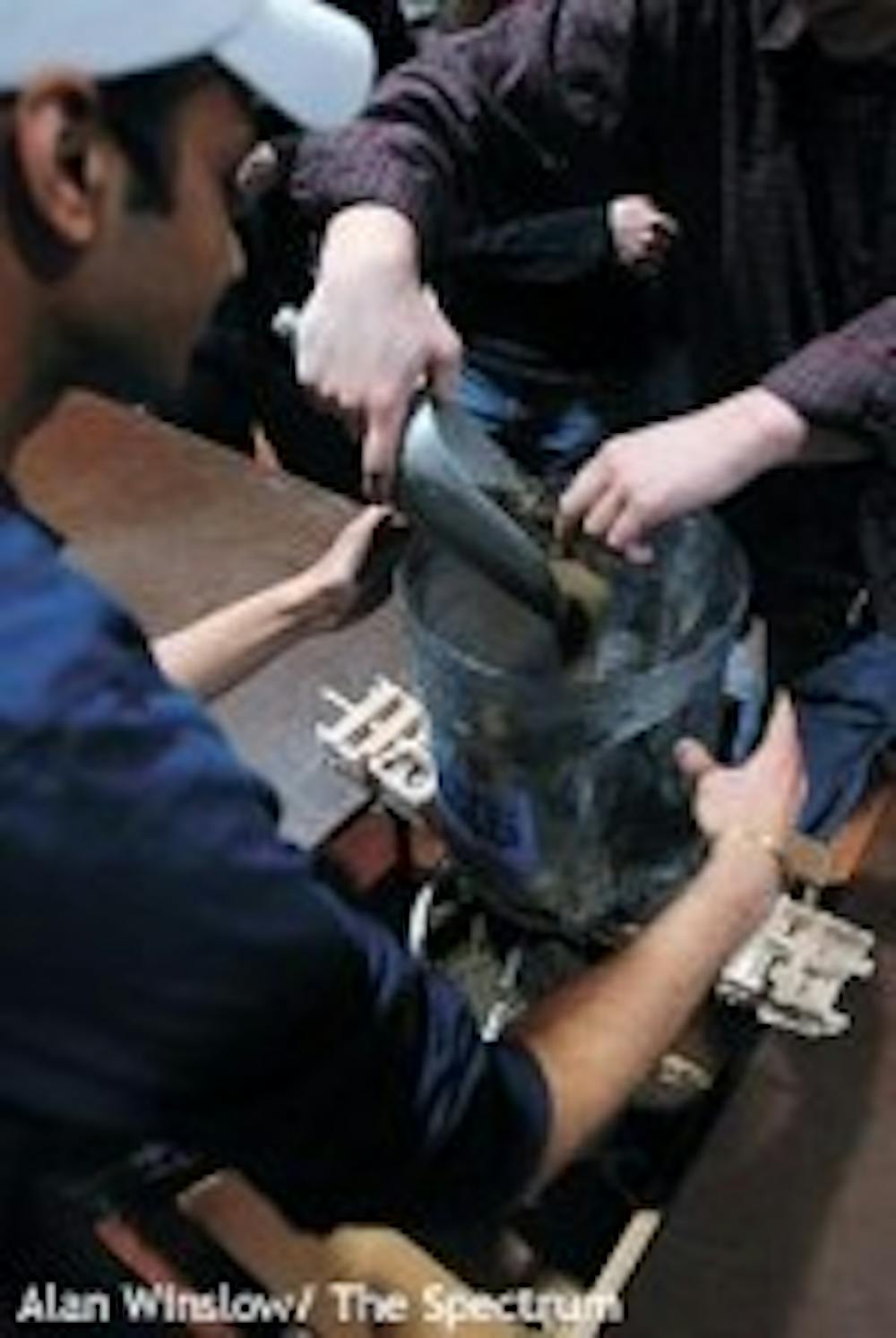
The crackle of snapping wood and the thud of more than 30 kilograms of sand brought cheers and applause to the Student Union on Tuesday as Engineering Week's Bridge Building Competition took over the flag room.
"We're not all just about books and stuff, we do have a lot of fun. That's why we do the bridge competition," said Chris Drucker, Student Association Engineering Clubs Coordinator and overseer of the event.
UB's 13 engineering clubs encompass both department-specific and interdisciplinary groups. Eight of the thirteen clubs took part in the competition, bringing many design styles to the table.
"It looks good because they can display what they do within a club. They could show everyone in the university, this is what we do in engineering," Drucker said.
Guidelines created by UB's American Society of Civil Engineers allotted competitors 300 Popsicle sticks, a hot glue gun and one hour. Within that time, teams had to create a structure four inches in width capable of spanning an 18-inch gap. The bridges were weighed and then tested with increasing amounts of sand suspended in buckets strapped to, or sitting on the structure. Final judging was based on a maximum bridge-to-weight ratio.
"I've given that task to ASCE, because they're civil engineers," Drucker said. "Building bridges is more of a civil discipline. So I told them: you guys come up with the specs for the bridge."
As the fourth event in E-week, the bridge building competition is a big opportunity for club participation and a real challenge. UB Robotics rose to the test, with one member building for the entire club, while as many as seven participants worked together at once for the Society of Automotive Engineers team.
"It's too much effort to do it by yourself. Even with two members it's difficult," Drucker said.
According to event officials, former records have been set with bridges supporting weight upwards of 200 pounds.
"Three-hundred popsicle sticks holding 200 pounds is impressive," Drucker said.
In the past, different materials for both bridges and weights have been used.
"We weren't really sure what materials there'd be, but they're definitely much more organized this year," said Michael Dinezza, junior electrical engineering major and member of the Institute of Electronics and Electrical Engineers team.
Though the clubs as a whole were all returning competitors, many individual team members were first time builders and had no pre-determined plans.
"We're just winging it," said Zac Lochner, senior electrical engineering major and member of the IEEE team.
Teams showed great ingenuity by using multiple concepts, though I-beam and cross structure designs seemed most popular for providing the best support.
"Everyone's got their own idea," said Mike Maciejewski, senior mechanical engineering major and member of the Society of Automotive Engineers team.
Given a two-hour window in which to build, teams were able to work around busy class schedules and the engineers showed their skills in determining what would make for a good design.
"People saw what was stronger last year and they know what's weak," Drucker said.
Testing ran until each bridge snapped under the weight, keeping engineers and passersby in crowded suspense.
"The club has the right to stop the weighing if they want to keep their bridge, but it's neat to see them shatter," Drucker said.
The flag room got the afternoon atmosphere of an elementary school crafts class that everyone seemed to enjoy.
"It's funny to see a bunch of college kids playing with Popsicle sticks," said Alexandra Sullivan, sophomore Electrical Engineering Major and Engineering Clubs Coordinator Assistant.
Despite its air of jocularity, E-week is seeing some fierce competition.
"A couple of teams are actually really competitive, such as SAE, because they're trying to win it all," Drucker said.
Out of the ten events in E-week, seven are point-worthy. Along with SA credit, clubs collect a certain amount of points assigned to participation in each event. Those who win first, second and third place collect added bonuses. Points will be tallied at the end of E-Week to decide a winner.
"Not only are you seen as the best engineering club, but it's also bragging rights to the other clubs because there's a lot of competition, internally, going on, so everyone always wants to win E-week." Drucker said.
Though it was a fairly close finish, the prediction proved accurate. The American Society of Civil Engineers team took first place with bridge weight of 203.9g and a load of 35.8kg - a ratio of a ratio of 0.1755. The American Institute of Astro-Aeronautics team came in second, followed by the Institute of Electronics and Electrical Engineers team.



