
On the wall of Clyde Herreid's office in the Distinguished Professor's department hangs a ten foot cut out of a bright red snake made in Japan, alongside an African mask, colorful batiks from Indonesia and a small black hat with a white rabbit sticking out of it.
Dr. Herreid, a distinguished teaching professor in biological sciences who has been at UB for almost 39 years, is also a magician. In the past he and his family would do shows for events where he would appear to read minds and bend spoons, among other things.
But the magic Herreid brings to the classroom is what he is most noted for at UB.
Herreid, an academic director for the Honors Program, currently teaches evolutionary biology each fall and an Honors Seminar each spring.
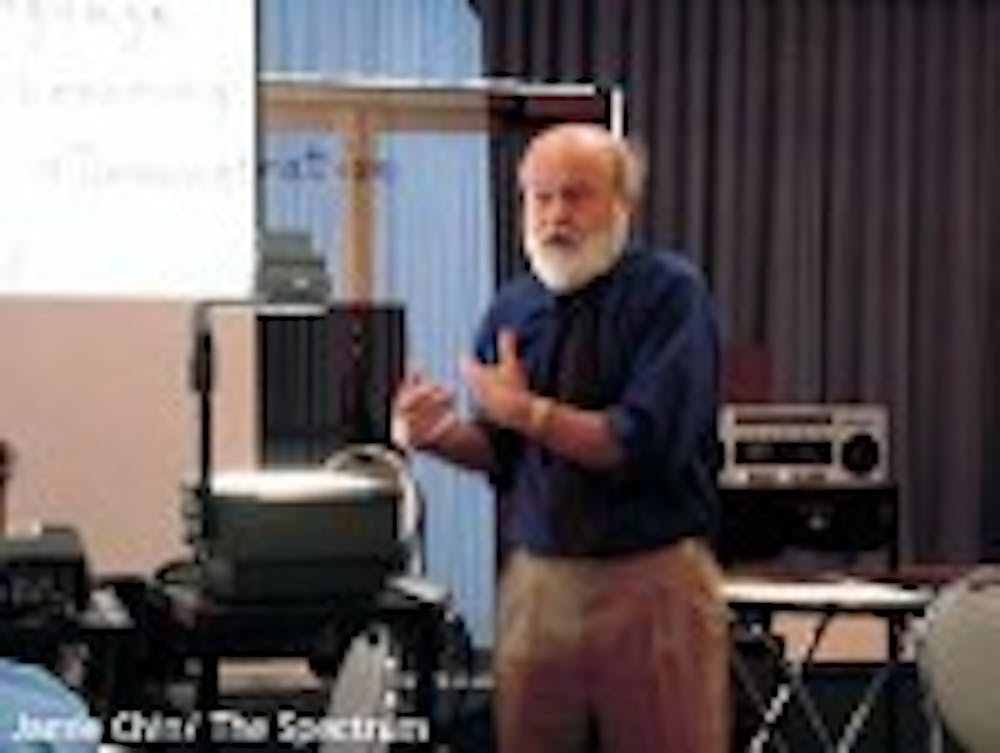
While some lecture halls are sparsely populated with the few students who care to show up, Herreid's Knox 20 classroom is packed to the limit with students wanting to know what the professor's next antic will be.
"I try to make the class not just interesting, but interactive," Herreid said. "It keeps them awake and it keeps them coming."
Herreid has his students use electronic clickers to answer questions he puts on the overhead. In one class, without explanation, he had everyone stand up and hold their breath for as long as they could. When a student had to give up and take in a breath of air, they clicked in how long they held it for, and sat down.
"When everyone sat down I said, 'you need oxygen to survive,'" Herreid said.
He then went on to explain to the class the evolution of oxygen on Earth, and how the differences in time that students can hold their breath shows evidence of multiple genes for this capability.
"He's by far the most lively professor I have," said Garrett Elsner, a freshman biology major. "He does something different everyday."
The resemblance Herreid bears to the most famous evolutionary biologist, Charles Darwin, is uncanny, and each semester he grows his white beard out and dresses up as his alter ego for class. Like Darwin, he too has traveled the world on scientific adventures. India, Africa, Australia, China, Russia, the Antarctic and of course the Galapagos Islands, just to name a few.
After earning his PhD at Penn State University in Zoology, and working on marine biology in Miami for a short time, Herreid received a job offer in Alaska. With his wife and infant in tow, he embarked on a road trip. Leaving behind the humid subtropics, Herreid and his family traveled the 5000 miles to temperatures of 70 degrees below zero in a Volkswagen bus with no heater in the dead of winter.
Another academic endeavor took him to a pleasantly warmer part of the world - Panama. There, Herreid conducted research on the exercise capabilities of unusual animals. He had cockroaches, for example, running on mini treadmills to test their endurance and energy. The bizarre experiments were even published in Sports Illustrated.
As the professor tells these stories of insects, penguins and caves filled with millions of bats, it is easy to see how he keeps the interest of his students. He illustrates the stories with elaborate descriptions and sound effects. Most of all, his enthusiasm shows the passion he has for teaching and telling.
"We love him," said Chani Becker, a freshman biomedical sciences major, speaking on behalf of some classmates. "He has an insane amount of energy."
Herreid believes that the most effective way for a student to learn a concept in science is through a story. His recent book Start with a Story lays out the method of teaching with case studies, or specific examples of issues taught in class.
He created and directs the National Center for Case Study Teaching in Science, and with funding from the National Science Foundation, runs workshops throughout the country advocating his teaching methods.
The professor takes the experiences of his many journeys and uses them in the classroom to help students expand their horizons and understand how life has evolved on Earth.
"It's fun helping you better understand the world that you're going into," he said. "I'm part of helping students see how different the world really is."



