
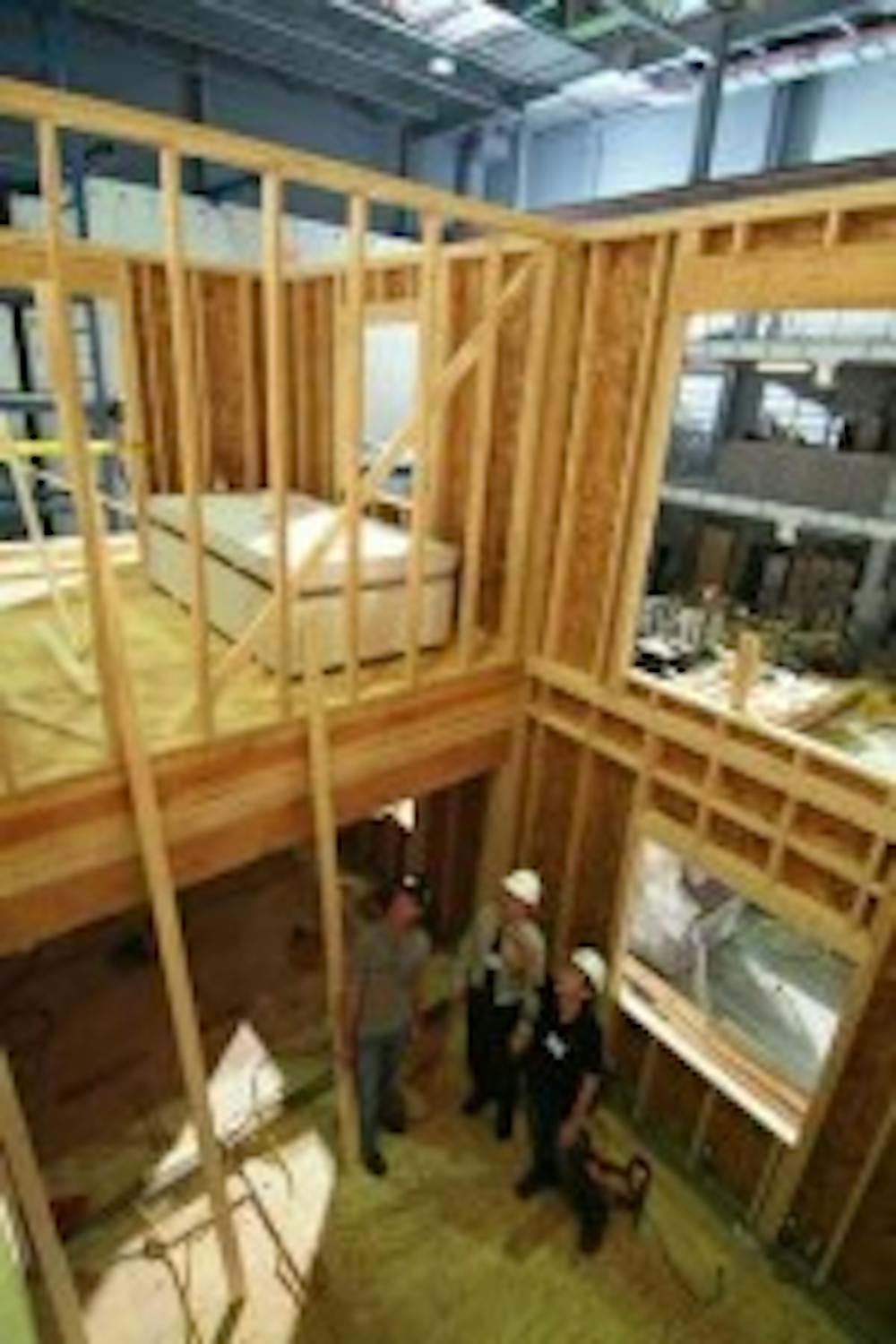
On Tuesday, an earthquake measuring 6.7 on the Richter scale shook Ketter Hall.
Inside, a four-story wooden house rocked violently back and forth for 15 seconds while the crowd held their breath. When the shaking subsided and One UB Drive remained standing, those in the audience cheered.
Professor Andre Filiatrault, professor and deputy director of UB's Multidisciplinary Center for Earthquake Engineering Research, explained the importance of the simulated earthquake test, which featured a full-scale house constructed on the center's twin shake table.
"This is by far the biggest test I have been involved in my life," Filiatrault said. "Ninety percent of residential structures are made of wood, yet we know relatively little about how they perform in earthquakes."
Construction of the house began in April 2006, and over the summer the house was completed and fully furnished. Included were a living room, children's room, kitchen, college dorm, master bedroom, living room, and garage. A Chrysler "K-car" sat in the garage, complete with a very local touch: a Buffalo Sabres license plate.
The intensity of the earthquake was comparable to the Northridge earthquake that shook Los Angeles in 1994, and the test's audience was warned about possible dangers, as the results of such a test were highly variable. Straps designed to prevent the collapse of the structure were added to prevent the worst.
"It's Murphy's Law - there is always something that could happen," Filiatrault said. "Something could go wrong - you never know."
Over 60 students were involved with the project, which was the first of its kind. Nick Granger, a senior mechanical engineering major, worked in the earthquake center to prepare the house.
"I wanted to see mass chaos and destruction," Granger joked. "But it was impressive."
After the test, damage was most evident inside the house. The second floor appeared more damaged than the ground level, while a previously, and "oddly clean" dorm room was left trashed, with computer and television on the floor.
Robert Wurstner, a junior civil engineering major, worked on the project and helped to furnish the house.
"It's not going to be able to withstand (the simulation)." Wurstner predicted before the test.
However, on the first floor, plates on the dining room table remained intact, barely moved from their placemats. In the living room, a tray of fake fruit remained on an end table, and a mug on the coffee table was not overturned. Structural damage appeared throughout the house, evident through cracks in the doorways.
"(From an) economic perspective, it would cost money to repair this house." Filiatrault said.
Two-hundred and fifty sensors were located throughout the house, each linked to a computer that processed exactly how much each sensor shifted during the earthquake. Initial measurements showed an overall shift of one to four inches. Engineers say it will take six months to fully analyze the data, which will be used to help architects and engineers design safer homes.
"Never before has a structure been pushed so far," Filiatrault said. "Never before has this data set been gathered."
This benchmark test is the first of a four-year project for the Earthquake Center. UB, in collaboration with Colorado State, Cornell University, Rensselaer Polytechnic Institute and Texas A&M among others, has the distinction of being the preeminent research facility for earthquakes in the United States. The facility, located in Ketter Hall, is worth over $22 million.
"This is for the hundred thousand people who lost their lives in earthquakes in the twentieth century," Filiatrault said. "We have a lot to learn, and perhaps this knowledge can trickle down."



