
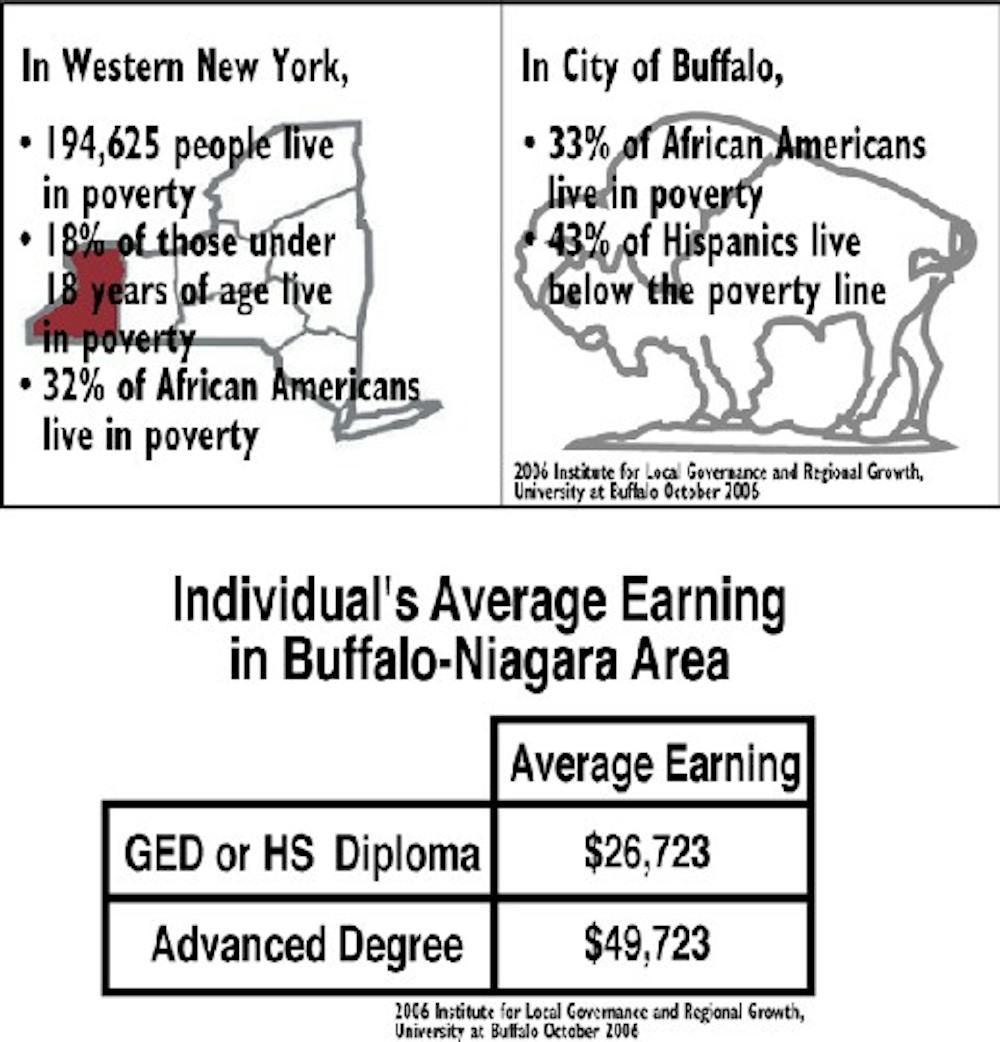
With a fourth of the Buffalo population statistically destitute, a speech this past Monday on economic issues by John Edwards hit home.
Former senator and 2004 vice presidential candidate Edwards spoke at the Center for the Arts on the burgeoning issue of poverty in Western New York and the greater United States. He is the director of the Center on Poverty, Work and Opportunity at the University of North Carolina at Chapel Hill.
Edwards examined the issue thoroughly, discussing topics ranging from where to draw the poverty line to dissolving poverty through a proposed thirty-year plan.
"The solutions may be complicated," Edwards said. "But the issue is not. Thirty-seven million people in the United States live in poverty."
Currently the poverty line, or minimum threshold to meet basic needs, is drawn at a yearly income of $9,971 for a single person or $19,971 for a family of four.
"Our way of measuring poverty makes absolutely no sense in today's world," Edwards said.
One out of every eight Western New Yorkers lives in poverty; in the city of Buffalo, the rate doubles to one in four. The poverty rate nationwide is 12.6 percent; Buffalo's is 26.9 percent.
In contrast, the suburb of Amherst has a poverty rate of 8.2 percent.
If attacked correctly, Edwards believes that the issue of poverty could be eliminated in only three decades. He offered three economic proposals: increasing the national minimum wage, expanding earned income tax credit to lower class families and easing the ability to unionize in the workplace.
Edwards called the national minimum wage, which stands at $5.15 an hour, a "national disgrace." There are ballot initiatives in six states to raise the minimum wage above the national level, and he is confident they will pass next week.
The former senator also offered some non-economic proposals dealing with health care, public housing and education, echoing similar ideas of Bill Clinton in 1992.
He also challenged what he said was a faulty public housing system.
"We have a public housing system in America that is completely broken," Edwards said. "How long is it going to take us to figure out that it does not work?"
With respect to education, Edwards cited a lack of opportunity for young people and the consequences an uneducated population would bring.
"The problem of young people who are not college educated is they have no skills to get into the work force," Edwards said.
He cited China as having a model educational system, saying it "will soon be the largest English speaking nation in the world. Half of their kids are majoring in math, science and technology. They are doing what they need to do."
Edwards called out the current administration on a lack of leadership.
"What is missing is not the will of our people," Edwards said. "What's missing is national leadership. We need national leaders driven by ideas that are value based."
Several students appreciated learning about economic issues from a distinguished public speaker.
"I want to take every opportunity I can to learn something," said Nicole Mutignani, a freshman political science major. "You never get these opportunities in high school. I think (Edwards') intentions are good and he really has his heart in it."
Freshman political science major Lance Newman was also interested in seeing Edwards and hearing about the problem, as it relates to Western New York.
"I wanted to ask him a few questions about alternatives to poverty, like microlending," Newman said. "I've been in (the city of) Buffalo a few times, and it's pretty disgusting."
Prior to Edwards' speech several local leaders held a panel on the fight against poverty, sharing insights on Western New York's situation and the tough issues of stigmatism, racism and regional differences.
"We're better than this," Edwards said. "It is important to demonstrate to the rest of the world what our real character is."



