
A growing trend around the country, increasing numbers of engineering graduates are heading into the workforce without first getting licensed in their field. Although not a mandatory step, the new UB dean of the School of Engineering and Applied Sciences is pushing for more of his students to get their credentials after they leave the university.
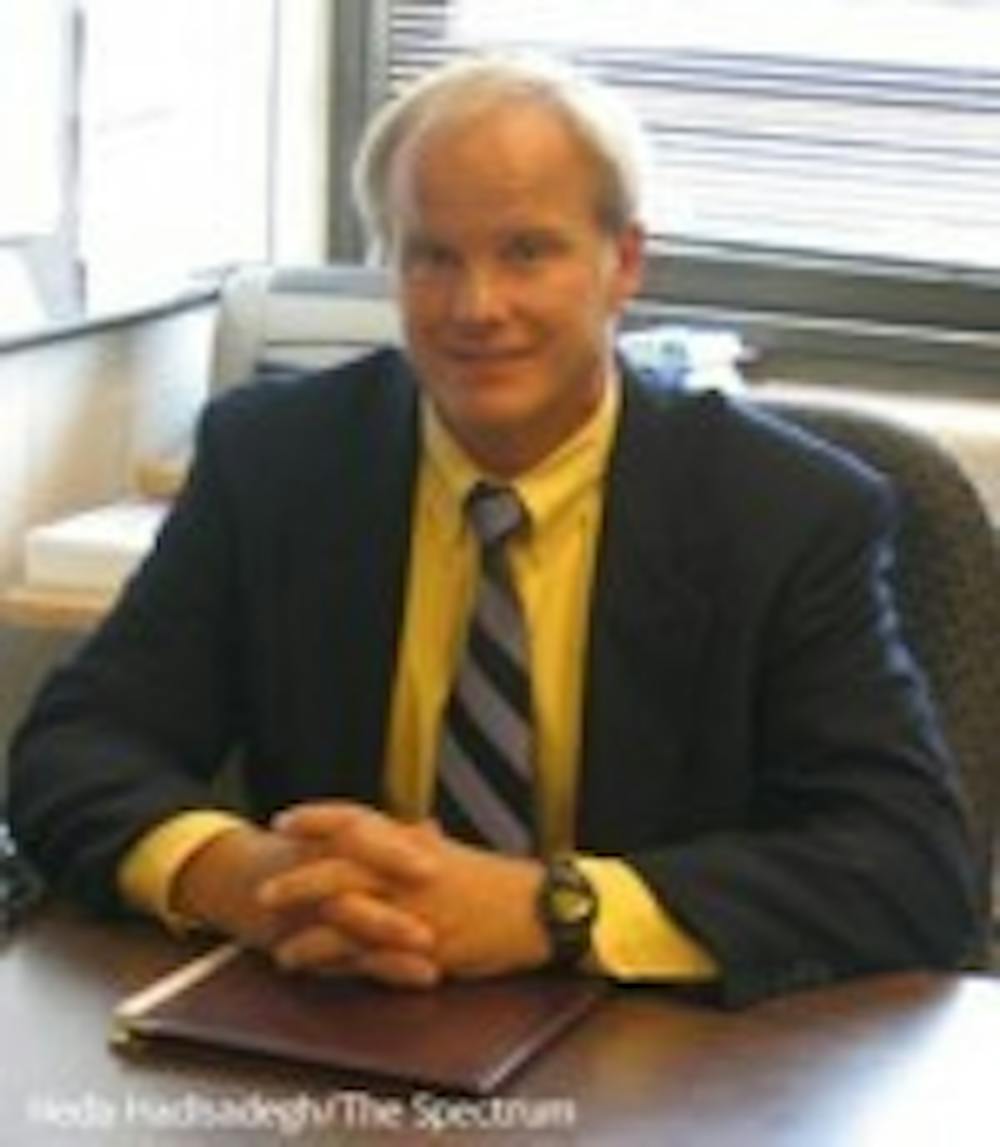
Dr. Harvey Stenger comes to UB from Leigh University in Pennsylvania, where he was dean of the College of Engineering and a mechanical engineering professor for 22 years. He formally addressed the Faculty Senate Executive Committee for the first time Wednesday.
During the conference, Stenger discussed the initiatives being taken in the Engineering program. One approach to reevaluating the department, as he outlined for the committee, is to create a series of questions that would "develop useful answers" rather than simply point out what is being done correctly or incorrectly.
"I'm just trying to pose questions, food for thought," Stenger said.
One such question he'll be posing for the engineering department is, "Do we market ourselves (engineers) well, and enough?"
Peter Nickerson, chair of the Faculty Senate and director of Graduate Studies, questioned Stenger regarding the lack of engineer licensing in the United States.
"Can we solve our nation's problems at UB?" Nickerson said.
Although it may seem as if there are many undergraduate engineering students at UB, the probability of all of those students getting licensed after graduation is not very high.
"More than two-thirds will graduate, but won't get a license," Stenger said. "However, they will still call themselves engineers."
According to Nickerson, the problem is that in today's society, one can get by as an engineer without a license.
For example, when questioned about the current engineering program's faculty, Stenger said that even most of them are not licensed.
The dean did say, however, that the current faculty will take the extra effort to encourage its students to take the licensing test, saying that while the certification is not necessary today, it could become pertinent in the future.
Despite licensing issues and other potential roadblocks, Stenger is very optimistic about his new position.
"I think I sense a lot of positive feedback in the school," he said.
Also discussed in the meeting was UB's status in the SUNY Strengthened Campus Based Assessment (SCBA), a SUNY-wide appraisal of general education academic programs.
According to Director for Assessment Carol Tutzauer, the SCBA is focused on results.
"UB will be spending the next three years piloting a unique assessment process based upon the General Record Examination (GRE)," she said.
Tutzauer also said that after the state-wide faculty senate decided to implement an assessment of learning outcomes in general education, a negotiation with UB's FSEC allowed all SUNY schools to offer a variety of techniques.
These included a general education guideline for all campuses, the use of a SUNY system that capped the numbers for each part of the GRE, or the ability to create a plan of their own, which is what UB will be doing.
Since no other school opted to do so, UB is diving into this process with no previous plan to use as a guideline.
"Unlike other campuses, UB will meet its twenty percent sampling target spread across all three years of the assessment cycle, rather than only assessing once each three years. This will provide yearly data, and allow more fine-tuned analysis of the impact of changes in our program."
As part of her Key Components of UB's Modified SCBA plan handout, Tutzauer briefly explained how the program will work.
"Selected students will attend a workshop relating to post-graduate study... (and will learn) general information about opportunities, the application/selection process and relevant entrance examinations," she said. "Students will then take a practice GRE examination, which will be the basis for assessing writing, mathematics and critical thinking."
The mock exam covers the required SCBA assessment areas.
"Participating students will then receive individual feedback on their performance and will be given an opportunity to register for a lottery to take the graduate examination test of their choice at SUNY/UB expense," Tutzauer said.
She discussed the fact that some details of this plan still need to be worked out, such as SUNY's final contribution economically to the program and the basis for the lottery. It was determined, however, that the workshops would be offered, in majority, to those students with advanced sophomore standing.
Additional reporting by Tom Halleck.



